The Cat-Human Bond


Cats and humans started their relationship 10,000 years ago. It was a symbiotic relationship – the cats ate the mice that fed on the grain and, consequently, the farmers were able to keep more of their grain. The relationship has changed over the years – we no longer need the cat’s mousing abilities but value their independence, and cleanliness; they also fulfill a social need for many, a chance to care for another creature. The cat receives food, shelter, and social interaction.

How Cats See Us


When we adopt a cat, we take over the role of the mother cat, particularly for kittens. We provide food, comfort and security. Cats, who have been house-raised and  are well socialized with humans, seek out and enjoy human company.

Cats that are not particularly well socialized with humans view us as a valued resource – a source of food and care. These cats may think of us big, clumsy cats and rub against our legs, and sniff our hands. These cats are not inclined to solicit attention unless they want something. What Makes a Friendly Cat? A Good Pet Cat?

The Tale of Gus…



Gus was trapped when he was  about 2 years old. He had become a neighborhood nuisance, prowling around and fighting with other cats. After being neutered and undergoing 6 months of drug therapy (for agression and anxiety) and training, he became tolerant of humans and now lives in a multi-cat home. His behavior contrasts with his housemates, 3 house raised-cats. He does not engage in “snuggling” or sitting with humans; he rubs up against our legs and monitors our activity with regard to feeding times and walks. A human is a  big, clumsy cat that provides food and shelter, not  a surrogate mother for Gus, a tamed, previously free-roaming cat.

The Cat-Human Bond: How We see Cats


Cat are not little people in fur suits.  It is easy to treat them this way and attribute human motivations to the things they do.  We cannot totally understand  why cats do things – we see their behavior through the lens of our human experiences. To successfully understand and interact with cats, we must empathize not anthropomorphize.

The Cat-Human Bond – Empathy vs Anthropomorphism


Empathy is the ability to understand and share the feelings of another.
Empathy can help us understand why cats do what they do.

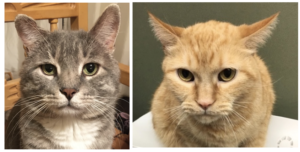
Anthropomorphism is attributing human characteristics to animals or objects.  The famous meme of Grumpy Cat attributed a sour disposition to a cat afflicted with feline dwarfism. She looked as if she were scowling, and therefore “grumpy”, to humans. Per her owners, she was a friendly cat who liked to be held and snuggled. 

Empathy


  • I had a bad tooth and it was painful – maybe my cat’s bad tooth hurts too.
  • If I were small and a giant scooped me up without warning,  I would be frightened. Maybe I should greet my cat before picking her up.

Anthropomorphism


  •  My cat pees on my clothes just to be mean.
  • I did not feed my cat on time  so he punished me by scratching the carpet.

When we anthropomorphize our cats, we are expecting a human response from them.  Cats are designed to hunt and eat mice, mate and raise kittens – they are not capable of understanding human ideas of right and wrong. If your cat pees on clothing you left on the floor, she may have a bladder irritation, she may like the soft texture of the cloth on her paws, or another cat is blocking her access to the litter box.  She is not trying to be “mean” or spiteful. What does my cat feel?

Your cat may  be tuned in to feeding time but he can’t read the clock. Scratching is a normal behavior for him – it feels good and he is marking his territory. He is not able to connect scratching the carpet with your displeasure.

Don’t expect human responses from your cat. Instead, try to put yourself in her paws and view the world from the Feline Purrspective!

Socialization in Cats – How Much is Enough?


Socialization in cats continues until they are 3-4 years old. However, they learn best when they are younger, ideally at 2-7 weeks of age.

How much socialization does a cat need?

Early Adoption…


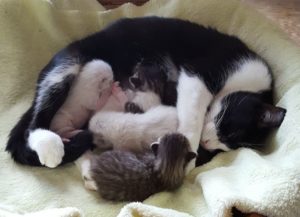
A kitten’s instruction in the language of Cat begins with his mother, aunts, and litter mates in the cat colony. Once weaned, he continues his studies with other juveniles and adults in the colony. When we adopt a kitten at 8 weeks or so, we interrupt socialization in cats.

If the kitten joins a home with friendly, well-socialized cats, she will be able to learn the nuances of cat social behavior. She should thrive and prosper.

Adoption into a household of where the cats are not socialized or where our kitten is an only cat may result in a confused and fearful kitten.

Orphan Kittens…


These are kittens where the mother cat is absent due to death or abandoning her kittens. Kindly human volunteers will undertake the raising of these kittens by hand, bottle feeding them, cleaning them, weaning them, providing play and social opportunity.

Without interaction with other cats, an orphan kitten will grow up like a “feral child” and may never be able to respond to social cues from other cats. Aggression towards humans is common among hand-reared kittens.


The Tarzan syndrome
Tarzan, a fictional character from the Edgar Rice Burroughs novels, is a human child raised by apes after the deaths of his parents when he is an infant. He miraculously learns to speak and briefly joins society as a young adult.

Accounts of “feral children “are not science fiction like Tarzan. These children are often fighting and competing for food with the animals they join. The outcome of these cases depends on when (at what age) the children are abandoned to survive on their own and when they are brought back to society. Many of these feral children may not ever be able to speak and socialize normally with other people

  • Keep hand reared kittens with their litter mates for socialization. The kittens can learn from each – if one kitten bites another, he will get bitten back. He will learn boundaries this way.
  • If you are planning on an early adoption (kitten is less than 6 months old), consider adopting two kittens, preferably members of the same litter or kittens of a similar age.
  • It can be risky to introduce small kittens (less than 16 weeks) to adult cats. Adult cats who have no experience of kittens will not know how to deal with them.

If you opt to introduce kittens to older cats, SUPERVISE AT ALL TIMES. Make sure your older cat is vaccinated for upper respiratory diseases and feline leukemia (if he goes outdoors). Gradual introduction is still recommended. A pair of kittens may still be your best bet in this situation and give you time to introduce all the cats at their own pace.

Not enough socialization…


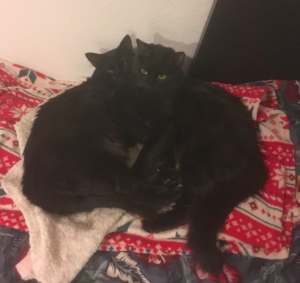
Bonded cats often sleep together.

After the euthanasia of their male cat, owners of a female cat decided to adopt a new cat. They were smitten by two 10 month old male cats they found at a rescue for dogs. The two cats were litter mates and had been at the rescue since birth. 

During several months of keeping the young cats separate from the older female cat, gradual introductions, pheromone therapy and time-sharing, the larger of the two young cats repeatedly attacked the female cat.

What happened?


  • The young cats were not able to read the social cues  (body language, olfactory cues) of the older cat. Their time at the dog rescue did not include socialization with cats other than their litter mates.
  • The larger male kitten was fascinated with the older cat but also fearful of her.  He attacked what scared him.

A Happy Ending


The “aggressive” cat has since been re-homed as single cat to another household. He is affectionate to his human family and doing well. The remaining male cat has started to bond with the older female.

Cats will play with toys on their own and often enjoy an interactive session of play with their owners. You may also see cats playing with other cats.

“Play fighting” is a way for kittens to hone their fighting and hunting skills. This social play peaks around 3 to 4 months of age, although adult cats will still “play fight”. Both feral and pet cats may “play fight” with other cats they are bonded with or familiar with. It is fun to watch two familiar cats wrestling, chasing, and pouncing on each other.

Cats Playing with Other Cats

  • claws are sheathed
  • chirrups and trills or no vocalizing
  • no hissing or growling
  • cats will take turns chasing and being chased
  • cats will roll onto their backs
  • body language is relaxed – ears are forward


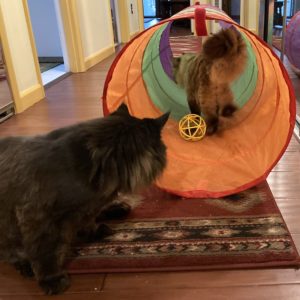
Marley and Zelda play in a cat tunnel

If your cats are inclined to play with each other, cardboard boxes, cat tunnels, furniture can be places for one cat to hide and pounce on one another.

If play gets out of hand…


Kittens and young cats often don’t seem to know when enough’s enough. Sometimes things get out of hand.

What may not be play…

  • one cat exclusively chases another
  • one cat blocks the other from going through a hall or door
  • one cat backs another into a corner

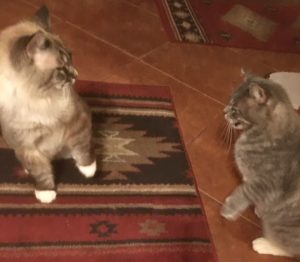
    Gus and Marley tolerate each other with the occasional spat.

What to watch for:

  • Be alert to direct stares between cats at “play”
  • Body language: ears flattened or out to the side, fur on end, lip licking
  • Body posture: aggressor may have an arched back, hair on end, slowly advance on the “victim”
  • “victim”: feet under the body, may slowly move away from the “attacking” cat
  • hissing or growling

Watch this short video of two cats who tolerate each other but are not affiliated.


You may want to manually advance the video to catch the action.  Gus (grey cat) and Marley have a brief spat that could be mistaken for play.

The two cats look to the side, then look directly at each other, then look to the side again. Their ears go out to the side, Gus lashes out.  He and Marley exchange punches, then Gus retreats and hisses.  We need to monitor this duo and ensure that conflict does not increase.


What you can do…


  • DO intercept a hostile stare or distract the aggressive cat with a wand toy or laser pointer.
  • DO have a sturdy piece of cardboard and a towel in a convenient place to help separate fighting cats
  • DO herd the cats away from each other with a sheet of cardboard into separate rooms.
  • DO isolate cats if necessary and allow them to “cool down”; reintroduce them slowly when they are calmer
  • Have a sturdy pair of leather work gloves to use with a towel as a last resort -better to herd the cats away from each other with a sheet of cardboard than try to pick them up
  • SEEK MEDICAL ATTENTION IF BIT!  Cat bites easily become infected
  • Consult your veterinary professional if fighting is frequent and injury to humans or other pets occurs

The domestic cat is hard wired to hunt. He is good at detecting fast motion – cats’ eyes construct around 60 visual images per second, which is 2x as fast as our human brains. He is ideally suited to detect the quick, rapid motions of the mice and other small creatures that he hunts. Hunting is part of who he is.

When the kittens are about 3-4 weeks old, the mother cat starts to bring back dead, injured or fatigued prey to allow the kittens to practice their hunting skills. Mother Cat will intervene if the kittens lose control of the live prey, otherwise she watches as they develop their hunting skills.

It’s important that we offer our cats an opportunity to engage in predatory (hunting) behavior. How do cats hunt in the wild?


  • Your cat scans the landscape.
  • She sees something moving, and goes over to that spot.
  • She hears and smells MOUSE! 
  • She stalks her prey
  • The mouse scurries away – she chases and pounces!
  • Success! She catches and eats her prize.

We are not going to release live mice into our homes deliberately, so what can we do to allow hunting in the home?

Object (Toys) Play


Playtime or hunting in the home can be interactive or it can be playing alone.

Interactive games – with us


Zelda plays with a toy mouse on a fishing pole toy.
  • Go Fish – fishing pole or wand toys
  • Chasing string
  • Catch the red dot – laser pointers
  • Treat toss – toss treats and let your cat go get them.

Start with short, fast motions to get your cat’s attention, then move to longer runs.

Put all fishing poles, strings and other interactive toys out of kitty’s reach when the play session is done

Playing on their own


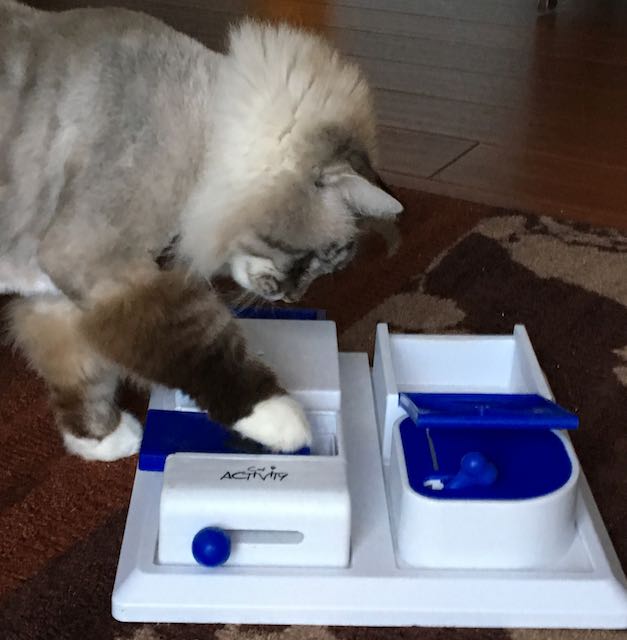
Marley works the Poker Box, a food puzzle.
  • Catnip mice
  • Food puzzles
  • Boxes
  • Play Tunnels
A play tunnel for children fits large cats !


How Does Your Cat Feel when Hunting?


Human hunters report feelings of exhilaration while on the “chase”, satisfaction when capturing their quarry and frustration when they miss.
Your cat shares these emotions. Avoid toys that present frustration – they may not be popular for long.

A Frustrating Toy


The mouse squeaks as the cage rolls along but the mouse does not come out!

 I bought a toy with a mouse in a ball-shaped cage. The mouse would squeak as the ball rolled. Marley spent an hour trying to paw the mouse out of the cage without success and then left the toy alone – he had better things to do!

If the mouse in the cage had been a removable food puzzle, Marley would have had the satisfaction of “catching” the mouse and getting a treat.


Avoiding Frustration


The laser guides Gus to a treat at the end of the play session.

Try to end play sessions on a positive note.  Play should be challenging but not impossible to catch the prize! If the task is too hard, cats, like people, will give up.  For example, when using laser pointers, end the session with some “targeting” – direct your cat with the light to treats you have hidden  around the play area.


Interactive Playtime – Communicating with your cat


  • Daily interactive play time is best
  • Short, intense play sessions of 5- 10 minutes often are enough
  • It is best if these are at the same time every day, say after dinner.  This way, your cat knows what is going to happen – the routine is a way for you to communicate with him.

Keeping the hunt alive with “self play” toys


  • Rotate toys every 1-2 weeks
  • “Marinate” toys not in use in a box with catnip
  • Store the week’s toys in a box with an opening so your cat can choose the toys she wants

Cats can also engage in hunting behavior through play with other cats.  Our next blog post will look into “social play among cats”.

Do cats have feelings?


Let’s say that a feeling is “an emotional state or reaction”.  We humans experience many feelings, among them fear, anxiety, joy.  Like us, cats are mammals and have many of the same brain structures we do.  Brain imaging studies of humans and other mammals have linked different areas of the brain to positive and negative emotional states. Cats certainly have feelings.

What kinds of feelings do cats experience?


Cats likely experience fear, anxiety, pain, and frustration, as well as pleasurable sensations that give rise to positive feelings. They do not experience more complex emotions, such as guilt and spite. Happiness for cat is different than for a human – the cat certainly will not be writing poetry and singing songs about how good he feels but he may purr or knead a blanket with his paws.

How do cats experience these feelings?


The neurological pathways are thought to be the same for all mammals. Outwardly, how the animal feels is expressed by his behavior. Different individuals may behave differently while experiencing the same emotion. Two cats may both be feeling frustrated while waiting to be fed. One cat might pace and meow; the other cat may swat at the first cat.

How do I know what my cat is feeling?


Observe your cat’s posture (body language) and behavior.

  • Is she relaxed (calm, confident) -OR- tense, and hunched into a ball (anxious)?

Look at your cat's posture

  • Does he approach you with tail in the air, crooked at the end (confident, happy) -OR-  is his tail twitching rapidly back and forth, tucked tightly (agitated, anxious)?


  • Are his ears up and listening (calm) -or- are they flattened out (anxious, unhappy)?


  • Is she vocalizing – hissing (distressed)? purring (calm and happy)? meowing loudly(frustrated)?


What can I do to make my cat feel good?


Make sure that your cat’s environment is rich, emotionally and physically.

  • Each cat needs place of his own, where he feels safe
  • Have several feeding and watering stations and scratching posts
  • Have more than one litter box in quiet, easily accessed places
  • Have toys available that encourage play and hunting behavior
  • Play and interact with your cat daily
  • Cats have a very sensitive sense of smell – avoid using strong smelling household cleaners, air fresheners, perfumes.