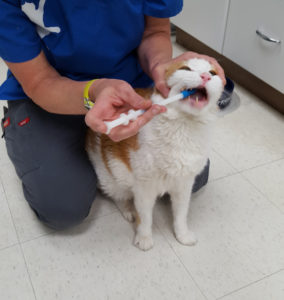
Pilling a Cat with Pet Piller
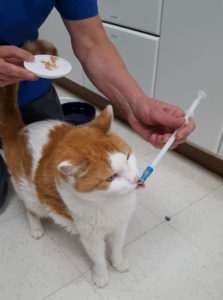
This cat knows how to take medication from a pet piller.

Many cats are terrified coming to the veterinary clinic. Some freeze in fear while others fight for their lives.  Calming medications given before the vet visit can reduce your cat’s anxiety!

Your vet has prescribed calming medication for your cat. So, what’s next?

How to Give Your Cat a Bitter Pill


Calming medications such as gabapentin and trazadone are bitter.  How do you give your cat a bitter pill?

Giving Medication in Food
Pros: convenient for the caregiver
Cons: If you give your cat a bitter pill in her food, she may refuse to eat that food in the future. Use something other than your cat’s regular diet, say, tuna fish.
Cons: Your cat needs to eat all the food to get her full dose of medication. Use as small an amount as possible of strongly flavored food to deliver the medication.

Tip: “Hunger is the best sauce” according to Sancho Panza’s wife, Teresa, in the novel Don Quixote. If your kitty is hungry, she will be more likely to eat the food containing the medication. Fast your cat overnight or pick up her food 2-3 hours before offering the medication in food.

Pilling by hand
If your cat accepts being “pilled”, coat the capsule or tablet in some butter or a pill treat, and slip it down kitty’s throat. Video Link.

Pros: You will know that your cat has gotten the medication
Cons: No one likes having something shoved down his throat. Your cat may gag and spit out the tablet.
Cons: It may be hard to repeat the dose if your cat decides to hide.

Tip: Reward your cat with some tuna juice or a tuna paste treat after she swallows the pill.  This will also help the tablet or capsule go down.

Other Ways to Give Your Cat a Bitter Pill


Make your cat a partner in his health care. Let’s reward him with something of value for taking the medication. Take a few minutes and think about what your cat really likes.  Is there a particular treat he likes – liverwurst, cheese, tuna or chicken paste? Catnip? Grooming session?

Do some “pill training” with the following methods before you try giving the medication. You can use hard treats or kibble as “fake pills”.  Start 3-4 days before you have to give the medication. This way you can practice your technique without wasting the prescription medication or running the risk of your cat biting into the bitter pill.

Introducing a pill into a stream of treats

This technique works best if the tablets are small and the cat is hungry. With larger tablets, you run the risk that the cat will bite into the bitter pill.

  • Offer your cat several treats.
  • Then offer a “fake” pill (a treat in a “pill treat”, cheese, liverwurst – something you can mold around the pill).
  • Immediately present more treats as your cat finishes eating the “fake” pill.
  • Video Link

Using a Pet Piller

Contercondition Pet Piller
Niki enjoys some chicken baby food on a pet piller.

You can use a “pet piller” to give the capsule or tablet. A pet piller is a tube with a plunger and a soft tip. The pill fits into the tip.

To use a “piller”, it is best to practice first with treats. If your cat likes tuna or chicken paste, start by offering your cat the paste on the piller and letting him lick it off. This way he associates swallowing with piller.

Work up to offering a “fake” pill in the piller after your cat has licked off the paste. You want to ease the “fake pill” into the side of mouth onto the “wave” (back) of the tongue. Avoid cramming the piller down the cat’s throat and making him gag. Follow with more paste on the piller to help your cat swallow the pill.

It may take a few trials for your cat to learn to use this gadget. Once he does, he will voluntarily swallow the pill in anticipation of getting more treats. This method works well for a variety of sizes of tablets and capsules. Video Link.

Using a Squeeze-Up Treat

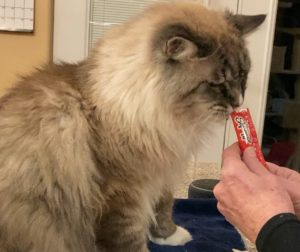
If your cat likes the tubes of paste (Churu, Delectable) that you can squeeze up into her mouth, you can try to give small capsules or tablets using squeeze-up treats. You will want to cut the tube so that the opening is wide enough to accommodate the tablet or capsule that you are giving.

  • Give your cat some of the paste
  • Slip the capsule/tablet into the tube
  • Squeeze the paste with the medication up into your cat’s mouth.
  • Squeeze fast enough so that the tablet or capsule slips up into your cat’s mouth while she is licking and swallowing. On the other hand, don’t squeeze too fast or your cat will gag and refuse the treat.
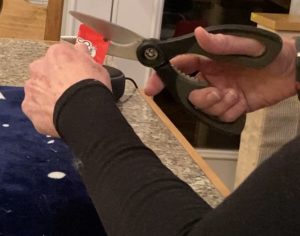
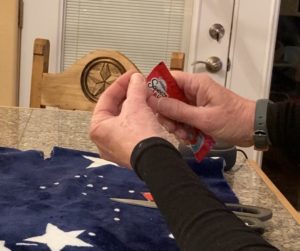
Zelda, a Maine Coon cat, needs several gabapentin tablets to be calm for a lion cut. The other day, she bit into the first tablet in a pill pocket and then, understandably, refused the next treat-wrapped tablet. Fortunately, Zelda is trained to accept medication via a pet piller. She readily took the next tablet with the piller and was rewarded with a Churu treat.

Calming medications help reduce your cat’s anxiety and fear, resulting in a more productive veterinary visit. But it is challenging to give your cat a bitter pill. Training your cat to take medication not only ensures that your cat gets the medication he needs but also strengthens your relationship with him.
Want to keep up with the world of cats?  Subscribe to The Feline Purrspective!


Subscribe

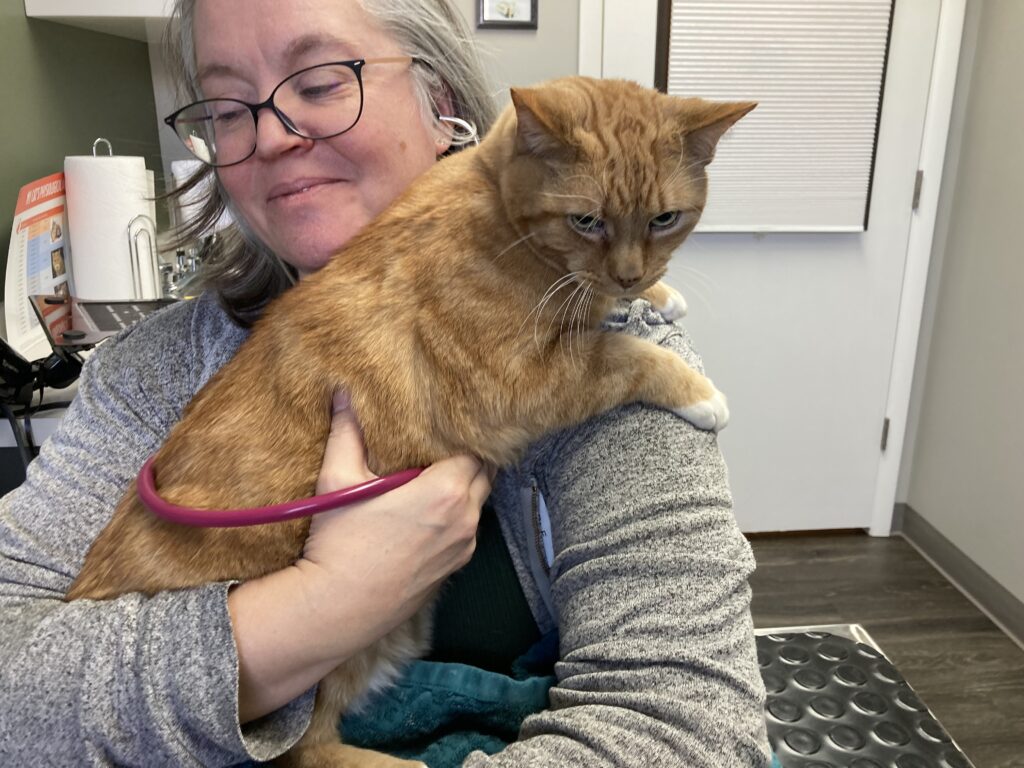
A feline practitioner listens to this cat’s chest in his preferred position.

What can your cat expect at her veterinary exam? The typical exam starts at the head and works through the body to the tail. This way health vitals are systematically collected. But it is important that the feline practitioner pay attention to the individual cat. For example, if your kitty seems to have pain in her mouth, in the cat friendly exam the vet may work through the rest of the exam first, and address the possibly painful mouth last. Saving the worst for last keeps your cat from anticipating pain throughout the entire exam.

Cats prefer high-intensity interactions that don’t last long. So, your cat may be offered a break between parts of the exam. Your cat may enjoy treats, toys, or gazing out a window during these breaks.

The Cat friendly Exam


Auscultation of the chest
Here your vet “listens” to your cat’s heart and lungs, measuring a heart rate and respiration rate in addition to noting abnormal heart rhythms (eg. heart murmur) and abnormal breathing sounds (eg. congestion). The vet typically will approach the cat from the back or side and use a stethoscope.

Head and Neck examination
Parts of this exam may happen even before your cat is on the exam table. Head tilts and facial swellings can be observed from a distance while your cat is walking around the room. In the more hands-on part of this exam, your vet may use an ophthalmoscope or otoscope to check the eyes and ears. He or she will also raise your cat’s lips to get a look at her teeth and open her mouth to check the oral cavity and get a quick look under her tongue.

Abdominal Palpation
In this part of the exam, the vet massages your cat’s belly to feel her intestines, kidneys, and bladder. It is also a check for possible growths in the abdomen and thickened walls in the intestines and bladder.

Back and limb assessment
This part of the exam includes assessment of the muscles along the spine and legs. The paws will also be evaluated and the claws extended.

Under the Tail Check
A quick look under the tail for fecal debris, swelling, and discharge… completes the exam.

Reference: “2022 AAFP/ISFM Cat Friendly Veterinary Interaction Guidelines: Approach and Handling Techniques”, Rodan et al.,  Journal of Feline Medicine and Surgery, Volume 24, Issue 11, November 2022, Pages 1093-1132

the cat friendly exam: practice at home


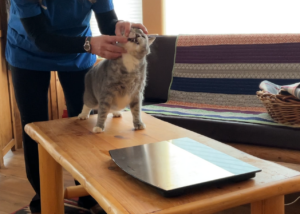
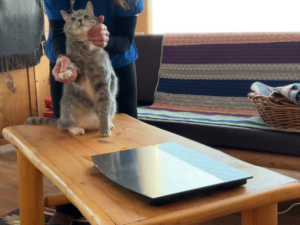
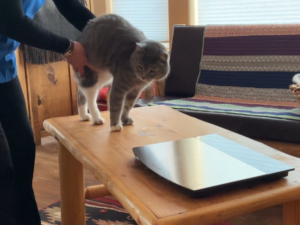
Some of the handling your cat may encounter at his vet visit includes being lifted up onto an exam table, getting weighed on a scale, sitting on an exam table to have his chest auscultated, having his head and mouth examined, and having his back and legs massaged and handled.

You can practice some of the cat friendly exam handling with your cat at home.  Training some basic behaviors such as “pick up“, “sit” and “target” can make this a pleasant experience for you and your cat.

First – choose an area at home where you will train
Pick a table, counter, or dresser (avoid the kitchen table or counter) where you can set up your “exam room”.
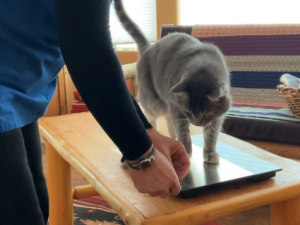
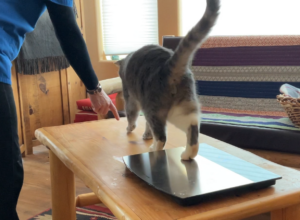
You can purchase a baby scale to weigh your cat if you want to monitor his weight or just get the bathroom scale and place it on your counter. The weight from the bathroom scale will not be accurate but your cat will have the experience of getting on a scale.

Fast Forward…
Let’s say you have trained your cat to be picked up, to sit and to target. Your practice vet visit at home may go something like this:

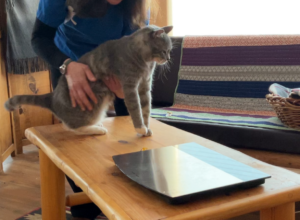
Give your cat the “UP” cue and gently lift him (support his front and back body) and place him on the counter. Make sure to reward him (treats, head rubs…).

Once on the counter, use your target stick or finger, to guide him to walk over to the scale and climb on it. Once he is on the scale, ask him to “Sit”. Reward him when he sits.

Next, ask him to get off the scale using the target stick or your finger and have him sit on the counter.

Approaching him from behind, rub his head and hold it gently. Work up to lifting his lip to view his upper teeth.  Reward and repeat on the other side.

To evaluate his feet, massage each foot, gently extending his claws – reinforce cooperative behavior with a reward.

Give your cat the pick up cue, and gently put him back on the floor. Reward him for a job well done!

It does take some time to train your cat to be picked up, sit, and target and combine these behaviors as outlined above. And – unless your cat is used to performing away from home – he may not go through his home routine at the vet clinic, especially if he is being handled by strange people. But the handling in the cat friendly exam will be familiar due to his practice exams at home and should not trigger him to engage in protective or defensive behaviors.

Cats that are used to being handled do not get as stressed and anxious as those who are only handled occasionally. A cooperative cat needs little or no restraint and can often be examined by one person. Make sure you let your vet know which behaviors your cat is familiar with and what the cue is for each one.

Want to keep up with the world of cats?  Subscribe to The Feline Purrspective!


Subscribe

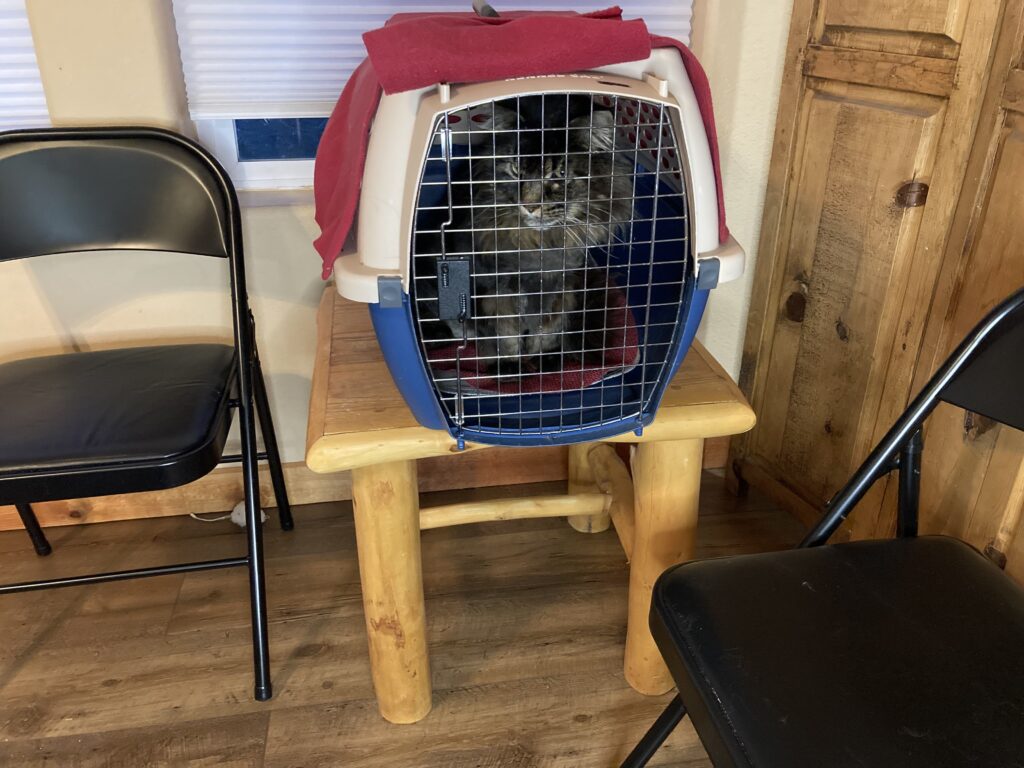
Cat in carrier in waiting room
Your cat will do better in the waiting room if her carrier is covered and on a higher surface.

Your cat is in his carrier and the ride to the vet clinic went well. He went into his carrier for some treats without a whole lot of fuss. You played some of the cat specific music on the ride and your kitty was actually quiet for a change.

You pull into the clinic parking lot and pick a spot to park. What’s next? The dreaded waiting room!

managing your cat’s stress in the waiting room


You enter and check in at the front desk. You put your cat in his carrier on the floor and immediately a small dog and child run up to the carrier. You are thanking your lucky stars that you covered that carrier. After checking in, you look for a place to sit and wait. The place is packed with barking dogs and some terrified looking cats in carriers. You find a seat and squeeze in to wait.

your cat’s stress in the waiting room


The Cat – Both Predator and Prey

The waiting room at a veterinary hospital can be a terrifying experience for your cat. By nature, cats are hunters but they are also hunted by larger animals, from coyotes and mountain lions to domestic dogs. Now your cat is shut in his carrier, with potential predators around.

The Cat – Both Solitary and Social

The waiting room may also have some other cats waiting. They may be frozen in fear or hissing and growling.
Cats are by nature solitary hunters but they will come together in social groups called colonies if there is enough food available. The core of the colony is the mother cat and her daughters, sisters, and their offspring. Consequently, cats are social with their immediate families, although not necessarily with other cats.

The Cat – the Language of Smell and Scent

Cats communicate in large part by smell. The waiting room is most likely full of unfamiliar scents and smells. There are the scents of strange cats and canine “predators”, in addition to the odors of humans, cleaners and disinfectants.

The Cat – Unfamiliar Sounds

Cats have one of the broadest range of hearing of any land animal – they hear the high-pitched sounds of mice (that we can’t hear) but also lower pitched sounds, like that of the human male voice. Returning to the waiting room, your cat may be hearing not only the barking dogs and hissing cats but also the sounds produced by the clinic office equipment. These unfamiliar sounds can be stressful for your cat.

tips for managing your cat’s stress in the waiting room


  1. Cover the carrier so that your cat will not see other animals or people.
  2. Place the carrier on a higher surface off the floor – on a chair, on your lap. Being higher up helps your cat feel safe, less vulnerable to predators.
  3. Play cat specific music – this music can be downloaded to your phone and played at a very low volume. Your cat can hear sounds that are almost inaudible to people. Place the phone in your cat’s carrier and allow her to hear some familiar, soothing music.
  4. Spray the carrier cover with pheromone spray (“Feliway” Classic, Comfort Zone Calming) prior to leaving for the vet clinic. Pheromone sprays can send your cat a message of safety and territory.
  5. Bypass the waiting room: Ask the clinic staff if you can wait in your car until an exam room is open. Explain that you are trying to keep your cat’s stress levels down.

Choosing a cat-friendly practice can alleviate the concerns we have listed above.  A Cat Friendly Practice will have a strategy to keep your cat from seeing, smelling and hearing other animals that can make your cat fearful and anxious.

  • waiting area just for cats
  • cat-only appointment times
  • allowing you to wait for an open exam room in your car

Managing your cat’s stress in the waiting room is another step toward having a good veterinary appointment.  Because you have prepared your cat for travel to the clinic and given her ways to cope with the stress in the waiting room, she will not be so anxious during her exam.  Our next step is to demystify the veterinary examination for our cats.  Thank you for being an active participant in your cat’s health care!

Want to keep up with the world of cats?  Subscribe to The Feline Purrspective!

Subscribe