
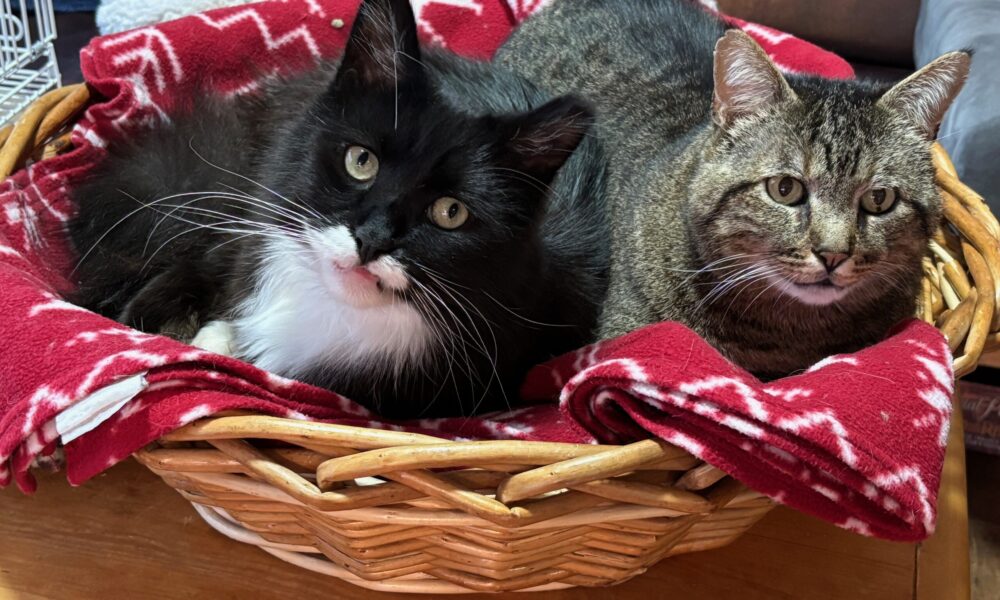
If you visit an animal shelter to adopt a cat, you may find some pairs of cats designated as “bonded”. These cats must be adopted together and, if returned to the shelter, must be returned together. Statistics show that cats labeled as “bonded pairs” may take 3 times as long to be adopted as a single cat (Reference 1).
What are “bonded pairs of cats”?
“Bonded” cats show a very high level of attachment to each other. These are typically cats that have spent most of their lives together – either as littermates or long-time companions. There are concerns that one or the other may develop separation anxiety or become inappetant when separated. There is not much research on this phenomenon.
Social Bonding in Cats
If there is a reliable source of food, free-roaming cats outdoors will often form groups called colonies. Within the colony, there are smaller groups of 2 or more cats that prefer to spend time together. These cats are comfortable sharing resources such as food, water, latrine areas, sleeping and resting places.
Sharon Crowell-Davis observed multiple cat colonies and found that certain cats could be found close together (less than 1 meter) more often than they were found with other members of the colony. She coined the term “preferred associates” to describe these cats. “Preferred associates” are thought to come together because of their social bond, not just to share resources (Reference 2). How do we identify “preferred associates”? How do we identify “bonded pairs of cats”?
Identifying Preferred Associates
Cats show a variety of affiliative or prosocial behaviors. A 2019 study of affiliative and conflict behaviors in cats listed 4 affiliative behaviors (Ref 3):
- Sleeping in the same room as another cat
- Grooming another cat by licking them around the head or ears
- Sleeping touching another cat
- Touching noses with another cat
Other sources also include head-butting and rubbing up against each other as signs that cats are affiliated. There are no hard and fast rules to affiliation: some cats will not snuggle together, but will groom each other and play together. “Preferred Associates” will show some if not all of these affiliative behaviors with each other. You may see some conflict behaviors from time to time. These cats tend to stay close to each other, form social groups, and share resources.
Bonded pairs of cats
Bonded cats are said to show mainly affiliative behaviors and spend most of their time near each other. Identifying bonded pairs of cats can be challenging – how do you know which cats will become distressed if separated?
Shelter staff often label cats as “bonded pairs” if they were surrendered together, especially if the intake form indicates that they have spent a long time in the same house. We humans are predisposed to pair bonds – human societies in general view a lifelong exclusive relationship as the ideal model for love, marriage and family life. We humans have a tendency to look for pair bonds, whether they are there or not.
Dr. Malini Suchak set out to determine whether or not adopting cats in pairs influences adoption times (Reference 1). As part of the study, videos of group-housed cats in a shelter were taken and analyzed for affiliative and conflict behaviors. Videos of cats that were labeled as “bonded” as well as cats that were not considered bonded were in included in the behavior analysis.
What did this study find?
- In general, cats labeled as “bonded” showed more prosocial behavior than cats who were brought in singly
- But there was a large discrepancy between pairs the shelter classified as “bonded” and those who would be classified as “bonded” based on behavioral observations (video analysis) alone
- Adoption times were 42% longer for cats adopted in pairs compared to being adopted singly and up to 185% longer for those labeled as “bonded pairs of cats” (Reference 1).
There is no easy way to identify bonded pairs of cats. We look for proximity and affiliative behaviors as we do with preferred associates. But cats may come together more to share resources than because they have a special bond. Consider cats snuggled together sharing a bed – in the winter, the attraction may be the warmth of the bed rather than snuggling with the other cat.
Dr. Suchak recommends using behavioral observations to label cats who need to be adopted together. The following list of questions may be helpful to shelter staff when trying to identify bonded cats (Reference 1):
- Are the same two cats regularly sleeping and sitting together?
- Have you ruled out them sleeping together due to shared resources?
- Have you seen other signs of affiliative behavior like grooming or touching noses?
- Is the behavior specific to a particular cat (one of the pair) or are the cats just generally friendly?
- Ask owners surrendering multiple cats questions regarding affiliative behaviors on the intake survey.
Decisions to adopt cats out in pairs should be made carefully since keeping cats in the shelter longer not only costs the shelter more but risks exposing the cats to disease, psychological distress, and behavioral problems. On the other hand, if a pair of cats will suffer distress and illness when separated, it may be worthwhile to wait for the right adopter or find a foster home in the meantime.
references
- Engebrecht L, Smith T, Suchak M. Single vs multiple cat adoptions: A trade-off between longer adoption times and social bonding in shelter cats. Animal Welfare. 2022;31(3):329-339. doi:10.7120/09627286.31.3.006
- Crowell-Davis SL, Curtis TM, Knowles RJ. Social organization in the cat: a modern understanding. J Feline Med Surg. 2004 Feb;6(1):19-28. doi: 10.1016/j.jfms.2003.09.013. PMID: 15123163; PMCID: PMC10822437.
- Elzerman AL, DePorter TL, Beck A, Collin JF. Conflict and affiliative behavior frequency between cats in multi-cat households: a survey-based study. J Feline Med Surg. 2020 Aug;22(8):705-717. doi: 10.1177/1098612X19877988. Epub 2019 Oct 18. PMID: 31623526; PMCID: PMC7383420.
Want to keep up with the world of cats? Subscribe to The Feline Purrspective!