
This post was originally published on June 20, 2021. It has been updated to reflect recent trends and changes in animal training.
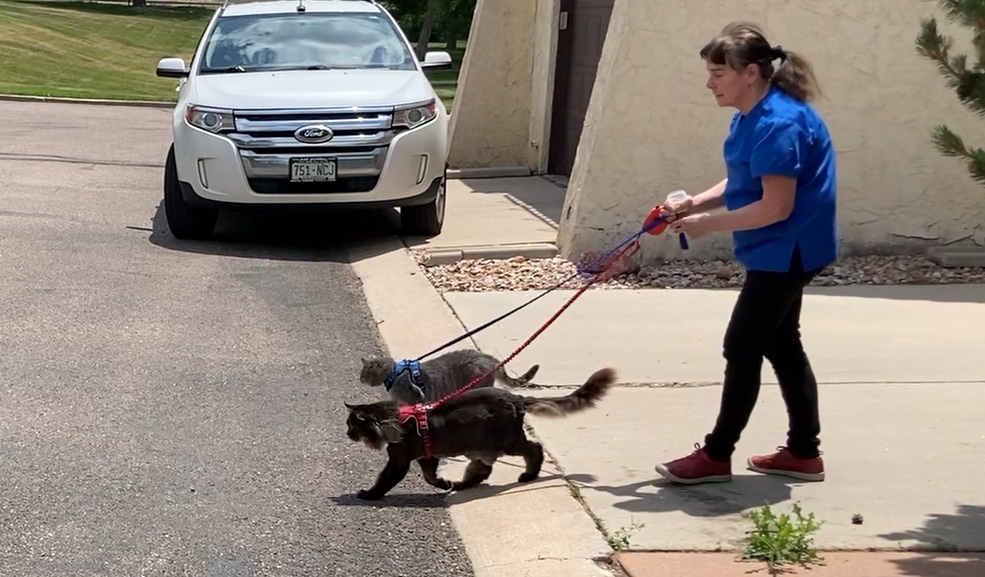
The other day I was walking with Gus around the pond on the condo property. A neighbor came down the path – Gus approached him with his tail up, in greeting. The neighbor did not reciprocate but instead stopped a few feet away from Gus. Gus sat down and stayed still. The neighbor then walked by and muttered “ typical cat” as he passed by.
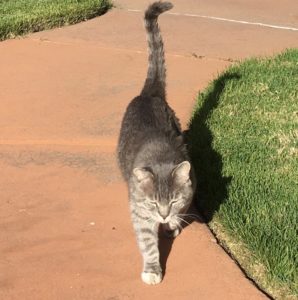
The neighbor clearly did not understand the tail up greeting. I wondered what he expected from Gus – was Gus supposed to come over wagging his tail? Gus approached with his tail up in friendly greeting. When the greeting was not returned (the neighbor did not offer his hand or get down on Gus’s level), Gus sat, and tried to figure out where the interaction was going – was it hostile or neutral? It certainly was not friendly.
In the past few decades, cats have increased in popularity as pets. Consequently, cat behavior and cat care have become popular subjects to study. We have learned that cats are social animals and can be trained. The stereotype of the aloof, antisocial cat is starting to change. We are starting to change how we think about cats.
Change how we think about cats
Cats – Mysterious? Aloof?
 Indeed, we are more familiar with dogs’ body language than that of cats. People see dogs as more social than cats. Someone getting a puppy will plan to take it places, walk it and play with it.
Kittens often stay at home and don’t venture out into the outside world – we don’t have to walk them; after all they have litter boxes. Once the kitten grows into a cat, people often don’t “play” with her that much – after all she is getting older and seems to sleep most of the time.
Dogs are viewed as more social than cats but recent research reveals that dogs and cats are similar in sociability. Cats are found to spend as much time with people as do dogs and the distribution of sociability in cats is similar to that found with dogs. (Reference 1).
There are some cats and dogs who are very social, spending most of their time with people. There are also cats and dogs in between, spending some of their time with people. At the end of the spectrum, there are cats and dogs who spend little or no time with people (Reference 1).
Cats – social and trainable
In the past few decades, cats have increased in popularity as pets. Consequently, cat behavior and cat care have become popular subjects to study. We have learned that cats are social animals and can be trained. The stereotype of the aloof, antisocial cat is starting to change. We are starting to change how we think about cats.
Dog training is shifting from traditional obedience to a cognitive approach by focusing on the dog’s thought processes, emotions, and problem-solving skills, rather than just rote memorization. This type of interaction is also appropriate for cats.
One way to engage a cat in conscious thought is through words and gestures. Studies have shown that cats recognize their owners’ voices and learn the names of their companion cats. A recent study found that cats associated verbal words with pictures faster than human infants (8-14 months old). Like apes, parrots and dogs, cats can learn human vocabulary (Reference 2).
teaching vocabulary – name & explain (Reference 3)
It is useful for your cat to know the words for the parts of his body, particularly those that may be touched. My cats learned the words “head”, “chin”, “cheeks” and “back” in 2-3 sessions. This exercise engages the cat in conscious thought and can be handy if, say, you’re going to comb the fur on his back. You say “ I want to comb your back”, and wait a few seconds before starting the groom. The cat knows what to expect and is less likely to startle or run away.
If your cat is amenable to being touched, touch the body part and name it. Then start to use the word – if the cat appear to understand, great! If they don’t seem to know it, simply name it again. If you are working with a cat who is leery of being touched, consider using a touch stick and a food reward (see “Teaching Cats How to be Touched“).
A quiet revolution is happening – be part of it. Change how we think about cats. Start a conversation with your cat and the enjoy the company of a companion who is not aloof, not mysterious, not just a sofa ornament but an interactive, thinking animal.
references
- Mills, Kim I. (Host). (2024, February). What’s going on inside your cat’s head? With Kristyn Vitale, PhD (No 275), [Audio podcast episode]. In Speaking of Psychology.
https://www.apa.org/news/podcasts/speaking-of-psychology/cat-human-bond - Takagi, S., Koyasu, H., Nagasawa, M. et al. Rapid formation of picture-word association in cats. Sci Rep 14, 23091 (2024). https://doi.org/10.1038/s41598-024-74006-2
- Cover, Kayce. Talk To Me, A communication guide for people living and working with animals. Synalia Imprints publication, ©2010 Kayce Cover, pp. 10-15
Want to keep up with the world of cats? Click the button below and subscribe to The Feline Purrspective!

Angela Ava says:
That typical cat moment is so relatable and it’s a good reminder that a lot of the cat stereotype comes from humans missing the meaning behind what the cat is doing. Tail up + slow approach reads friendly to me, and the sit and observe response when the greeting isn’t returned feels like a cat trying to assess safety, not being aloof. I also like the practical idea of naming body parts before grooming handling . even a few seconds of warning seems to make cats feel more in control. Do you think leash walks (like Gus’s pond loop) help cats become more socially flexible over time, or is it mostly personality dependent
felinepurrspective_u3q4o6 says:
The leash walks primarily offer the cat enrichment and exercise. New sights, scents and sounds provide mental stimulation and help combat boredom.That being said it is not for all cats. It does have a lot to do with their personality Gus, a former street cat, looks forward to his daily walk because he wants to interact with his environment – he has given up on trying to get treats from people we meet. On the other hand, my youngest cat Miso (also an ex-street cat) will greet people and interact with them.