
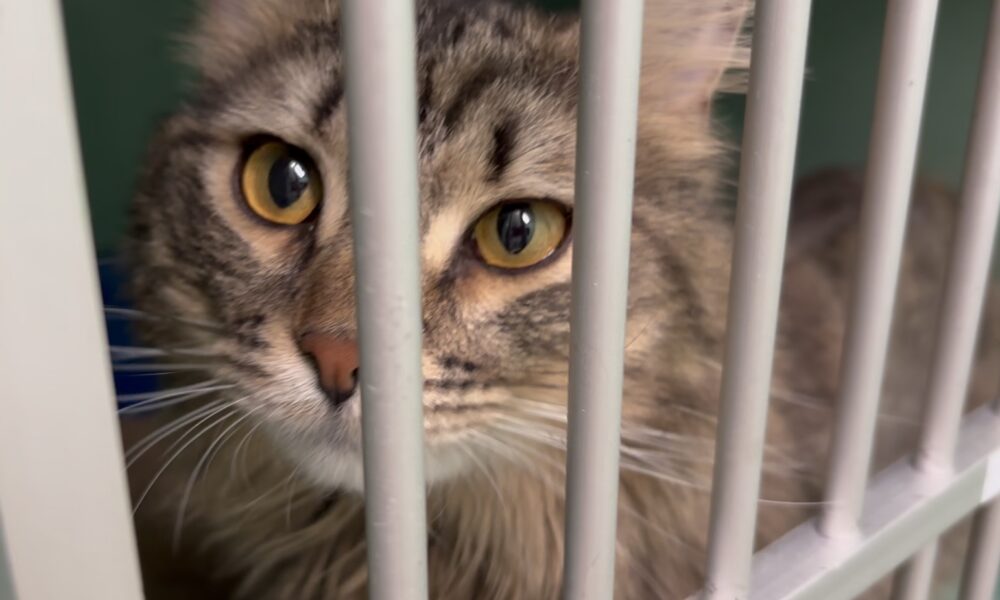
Cats can be found worldwide, even on remote islands. The global population of domestic cats including those that live with us and those that roam free is estimated to be about 1 billion (Reference 1). The cat has been so successful that their numbers need to be controlled and animal shelters always seem to have a ready population that need homes.
nurturing capable House cats in the shelter
Assessment of a cat’s potential to be socialized and live in a human home are the subject of many shelter protocols; one of the most prominent of these is the Feline Spectrum Assessment (FSA) developed by the ASPCA (Reference 2).
The FSA takes place over 3 days after the cat arrives in the animal shelter. During this time, the cat will be assessed 4 times for about 5 minutes. However, if a cat shows friendly behavior immediately, they may “graduate” in less than a day (Reference 2).
What are the hallmarks of a cat “Likely to be Socialized”? Here are some of the behaviors the shelter employee assessing a cat looks for (Reference 2):
- The cat is at the front of the cage
- The cat is willing to play with an interactive toy, such as a toy mouse
- The cat does not hiss but instead makes a friendly, chirping sound
- The cat has their tail up
- The cat is “making biscuits” with their paws
- The cat’s paw makes contact with the assessor, toy or wand inside the cage or through the bars
- The cat rubs against the cage door, bedding or wand
If a cat exhibits just one of these behaviors they are judged to be Extremely/Likely to be socialized. If the cat does not exhibit one of these behaviors, a more thorough assessment continues over the next few days (Reference 2).
The FSA has a second checklist of behaviors – if a cat shows 4 or more of these other behaviors they can be found “Likely to be Socialized” and adoption into a human home may yet be possible. Cats who do not pass the assessment must undergo further evaluation as to whether they can be adopted or other care must be arranged.
what does the cat “likely” to be socialized know?
In the FSA, the assessor is told to stand 1 foot in front of the cage, body slightly at an angle, making indirect eye contact. The assessor speaks softly in a high pitched voice. They avoid making fast or jerky movements and open and close the cage door quietly (Reference 2).
A cat accustomed to humans recognizes that a human behaving this way does not pose a threat to them. On the other hand, these cats also know NOT to approach a person who is behaving loudly, aggressively, or just in an atypical manner. An unsocialized cat does not know the difference between a “safe” and “unsafe” human – most humans represent a possible threat to these cats.
Of course, the friendly shelter cat has more to learn once he’s in a home. Over time, cats who are the most successful at living with human acquire a number of skills and become “Capable House Cats”.
Capable House Cats – what they know
- Know their names
- Come when called
- Permit respectful and predictable handling
- Accept being picked up
- Are calm in the presence of humans and in control of their emotions so they rarely scratch or bite
- Learn to “read” their owner’s reactions to people and events and follow the owner’s cue when responding (Reference 3)
Cats in an animal shelter can learn some of these “super-skills” in a foster home or from a training program at the shelter.
About a billion cats live in the world today. Cats have been so successful that their numbers are controlled by spay and neuter programs. Free-roaming cats often find themselves in shelters looking for homes. Let’s teach these cats to look to humans for information and guidance. Let’s make them “Capable House Cats”!
references
- De Martino et al. The dispersal of domestic cats from North Africa to Europe around 2000 years ago. Science. 2025 Nov 27;390(6776):eadt2642. doi: 10.1126/science.adt2642. Epub 2025 Nov 27. PMID: 41308130; PMCID: PMC7618505
- ASPCA. (2016). The ASPCA’s Feline Spectrum Assessment Training Manual and Guide. ASPCApro. https://www.aspcapro.org/sites/default/files/ASPCA-FSA-manual-2016.pdf
- Merola, I., Lazzaroni, M., Marshall-Pescini, S. et al. Social referencing and cat–human communication. Anim Cogn 18, 639–648 (2015). https://doi.org/10.1007/s10071-014-0832-2
Want to keep up with the world of cats? Subscribe to The Feline Purrspective!