
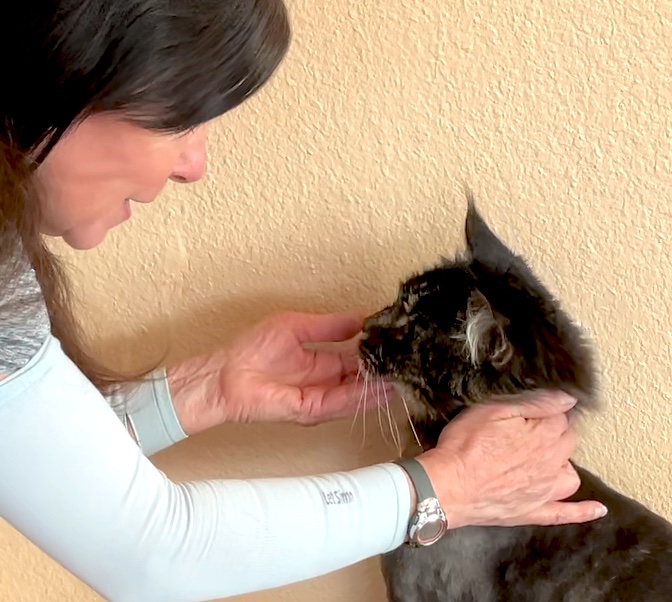
What does your cat see when they look at you? Do cats recognize human faces? Can they tell the difference between their caregiver’s face and that of another human?
Do cats recognize human faces?
How cats and humans see the world
Cats see the world quite a bit differently than we do (Reference 1).
- Cats are not able to see things closer than about 25 cm or 10 inches.
- Cats are much better at detecting fast motion than we can – cats’ eyes construct more than 60 visual images per second, which is 2x as fast as our human brains.
- We have better color vision. Cone cells in our eyes respond to red, blue and green light. Cats have cone cells that are sensitive to blue and yellow light, but not red or green light.
- A cat’s world is “faded” and “blurry” compared to ours. The average human has a visual acuity of 20/20 while cats range from 20/100 -20/200. This means that a cat must be about 20 feet to see sharply what an average human sees from 100-200 feet away.
- Cats can see 6-7 times better in dim light than humans can.
Facial recognition and cats
Cats’ vision is well adapted to their role as hunters. They see well in the dawn and dusk conditions when their prey such as mice are most active. They augment what they see with what they hear, smell and feel with their whiskers to arrive at a complete picture of their environment and the creatures in it. However, facial recognition plays an important role when hunting or being hunted.
- A predator wants to know if its prey is looking away, grazing, or sleeping for a successful ambush.
- A prey animal can rapidly detect a forward-facing face pointing directly at them and prepare to act defensively.
Facial recognition is important in a social context. It helps animals identify members of their social group and read emotional cues (Reference 2).
Can cats recognize human faces?
In 2005 (Reference 3), researchers investigated whether domestic dogs and cats could identify their primary caretakers using only facial recognition. The study used 2D photographic images, eliminating other sensory modalities like scent, voice, or body cues.
After the cats and dogs were weaned, dedicated human handlers worked with the animals for 2 hours daily for 6 months. When the animals were 9 months old, they tested for visual discrimination, using pairs of photographs.
RESULTS
- Dogs chose their handler’s face over a stranger’s face 88% of the time while cats scored around 55% (only slightly better than a 50/50 random chance).
- Both cats and dogs recognized the faces of animals they lived with: dogs 85%, cats 91%.
- Both chose a familiar background scene over an unfamiliar scene: dogs 89%, cats 86%.
CONCLUSION: Dogs are able to discriminate their handler from another human based solely upon face recognition.
A question of Handling?
As noted above, facial recognition is tied to survival and social interactions. If cats could recognize other cat’s faces, why did they fail to identify their human caregivers?
Would a cat recognize the face of an “attentive” caregiver?
When confronted with a toy or food that they can’t access, dogs will alternate their gaze between the human and the hidden toy/food, “requesting help”. Cats are not thought to do this. However, a 2021 research study found that cats would look back and forth from the owner to a treat box they could not open. Cats with “attentive” caregivers looked to their caregivers earlier and more frequently than those with “inattentive” caregivers. (Reference 4).
Somehow, I think the jury is still out on whether cats recognize human faces. I feel they at least recognize that we humans value vision – they seem to know to look directly at your face. Many cat caregivers are familiar with the “silent meow” – the cat looking up, directly at their caregiver, silently requesting food, attention or access to another room.
I have been tapped on the shoulder to turn around and find a cat directly staring at me, wanting a head rub. I have had a cat run in front of me, sit down and stare up at me, wanting to do a training session. I think they know who we are by looking at us.
References
- “Cat Vision: What do Cats See?”. updated 9/3/2026. https://www.purina.com/articles/cat/behavior/understanding-cats/cat-vision. viewed 10-10-2026.
- de Moraes, P.Z., Diniz, P. and Pessoa, D.M.A. (2025), Detecting a Stalker: The Effect of Body Posture, Gaze Direction, and Camouflage Pattern on Predator Detection. American Journal of Primatology, 87: e23699. https://doi.org/10.1002/ajp.23699
- Lomber, S.G. and Cornwell, Paul. “Dogs, but not cats, can readily recognize the face of their handler”. August 31, 2005. Journal of Vision, Vol. 5, No. 8, Article 49. doi:10.1167/5.8.49
- Zhang, L., Needham, K.B., Juma, S. et al. Feline communication strategies when presented with an unsolvable task: the attentional state of the person matters. Anim Cogn 24, 1109-1119 (2021)
Want to keep up with the world of cats? Subscribe to The Feline Purrspective!