In my job as a veterinary technician, owners often tell me “I can’t train my cat – food does not motivate my cat ”. ” My cat won’t eat his medication in a treat – he doesn’t like treats”.
Like people, cats are individuals – some are grazers and others will eat at any time. BUT… all domestic cats share common ancestry -Felis Libyca, the African Wildcat – and they have inherited a certain physiology.
The Behavior of Feeding
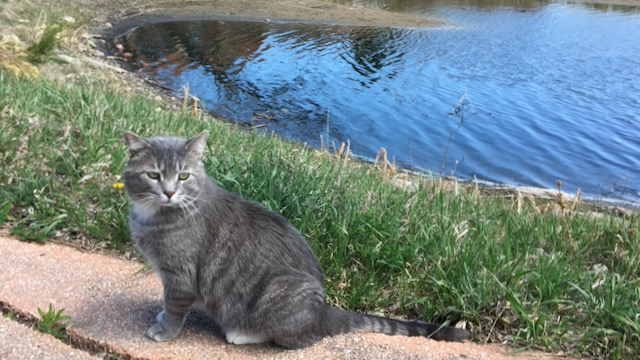
Marley looks for critters in the bushes
Cats have small stomachs and a short GI tract designed to digest meat.
They cannot wait until they get hungry to hunt – they will starve if they do.
Their lifestyle is one of being on the prowl most of their waking hours, looking for food
CATS ARE HARD-WIRED TO HUNT
“NEW PREY” IS A STRONG MOTIVATION
The free-roaming cat eats up to 8-10 meals daily. The number of meals depends on the size of the meal – it will take a bit longer to digest a rabbit than a few bugs!
You say “Food does not motivate my cat”? What if we try to mimic the prowling feeding style of the wild cat?
Feeding 4+ Meals a Day
How much to feed?
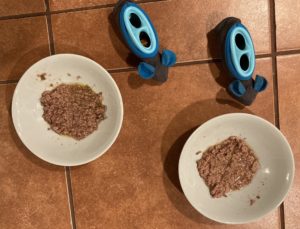
A cat’s daily food ration – 2 meals of canned food with two puzzle feeder meals of dry food.
What your cat will eat in one sitting.
watch your cat – pick up and measure the food eaten when he leaves the bowl -OR-
offer a “2 mouse” meal of about 50 kcal
Feeding 4+ meals if you are not home during the day
Avoid leaving large amounts of food out. While it is convenient just to top up the bowl, you don’t know how much your cat is eating. Boredom can lead to self-soothing behaviors such as over-eating and over-grooming.
Move the puzzles and feeders around when you can. Once your cat is prowling to dine, he will be more interested in training treats and treats for medications. Train and medicate BEFORE meals. Find the treats he values or use his regular food as treats.
To train your cat to do a new skill, you will need to set aside a time and decide what you are training that day. However, training should not always be something you do at a scheduled time with specific goals.
Training is a way of communicating with your cat, so training is a part of your cat’s day.
My kitties wake up to a medication session. My oldest cat, Athena, is medicated twice daily. After having Zelda, the Maine Coon, dive in, snatch and swallow Athena’s medication, I decided to make training work for me.
Medication Etiquette
I prepare the medication (getting the treat box and wrapping the pill in a treat)
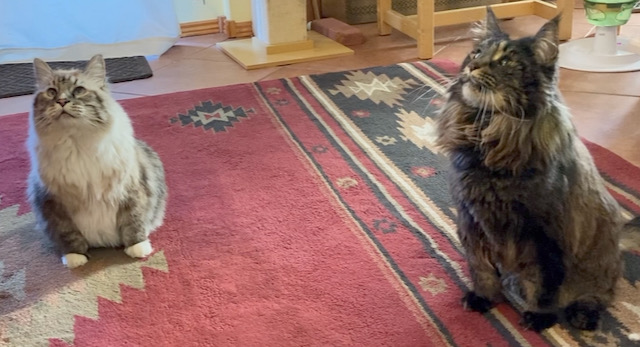
Marley, Gus, and Zelda COME and SIT on the floor by the dining table.
Athena is directed to the dining table.
Marley, Gus and Zelda are then asked to STAY.
Athena is given her tablet which she eats most of the time. If not, I give Marley, Gus and Zelda a REWARD and repeat the STAY command
I take an extra minute to pill Athena.
Marley, Gus and Zelda are REWARDED for the stay.
Athena is REWARDED for taking her pill.
I give all cats the ALL DONE signal.
The medication etiquette uses 4 skills the cats have learned.
COME when called
SIT
STAY
ALL DONE
It is a real time-saver when medication has to be given and I need to get to work.
Other times training is a part of your cat’s day…
Off the table!
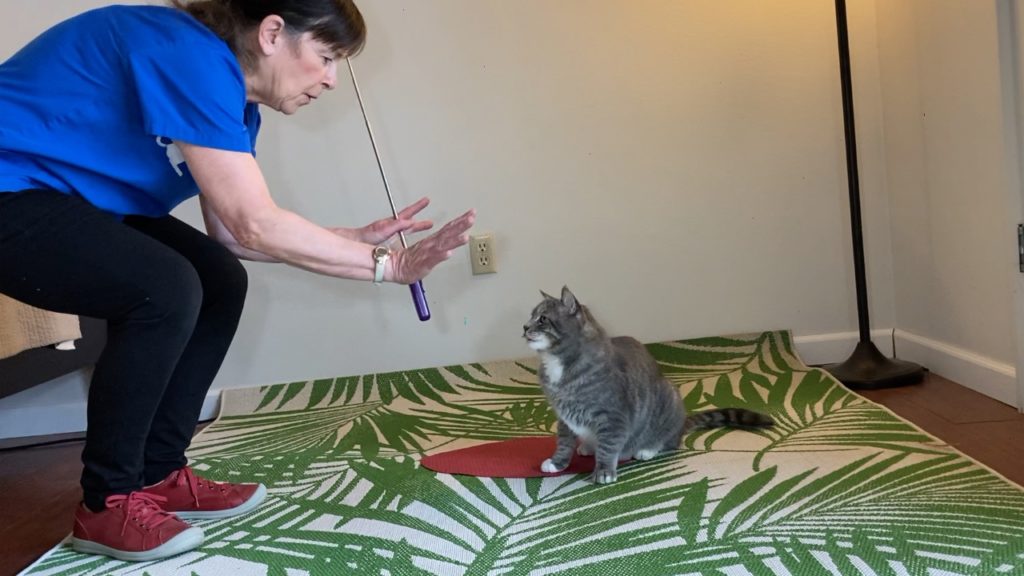
You can ask your cat to move from place to place with your finger or a target stick. Let’s say that your cat jumps up on the table when you don’t want her to. You ask her to jump down; she does and gets rewarded with a treat.
Sit and wait for dinner!
You can ask your cat to SIT and STAY when you are fixing his food. You may need a few treats to keep the STAY going until his dinner is ready.
Behavior when you don’t want it
Sometimes, you turn around in a minute or so, and your cat is back up on the table waiting to jump down and get a treat. When training, we repeat skills several times to see if kitty has gotten the idea. So, it is not all that surprising when kitty repeats his skills when not asked, hoping to cash in on more treats.
It may be better to ask him to jump down, treat, then have him sit and stay for the count of 5. Then, give him a treat and the all done signal to let him know the session is finished.
The all-done signal is very important – it means that you will walk away and there are no more treats for the moment.
The “all done” signal marks the end of a training session.
Of course, you must have reasonable expectations. For example, if kitty really likes seafood, it may just be better for everyone if you ask him to go a room and close the door while you fix the fish or shrimp!
This is a story about bringing a wild cat indoors. This is the story of Gus, a cat who was wild in a previous life.
Gus’s story starts in a neighborhood in Colorado Springs, CO. He is a young, intact male who wanders around hunting, fighting with other cats, and seeking mates. He is what we call a “community” cat – an outdoor, free-roaming cat who does not have a guardian. He hunts mice and rabbits but also will eat food that some of the neighbors leave out for community cats.
Gus’s Timeline
Early March 2019: Gus is trapped with a live trap
March 5, 2019: Gus is neutered. He has a weak positive for Feline Immunodeficiency Virus and needs to have an indoor home.
March 25, 2019: Gus starts taking fluoxetine, for anxiety and aggression due to anxiety.
Clicker and leash training begin in early June, 2019.
Gus is adopted on August 2, 2019. Owner continues clicker training and outdoor walks.
Gus is weaned off fluoxetine by late November, 2019.
Gus’s Caretaker at the vet clinic says…
“At first he was absolutely untouchable. I couldn’t enter his room without using a flattened cardboard carrier as a shield to protect my legs from his vicious attacks. As I moved through the doorway, Gus would try his hardest to escape by lunging, striking, and biting at me. Once I was inside, he would rapidly alternate between seeking affection and getting over stimulated. He would often rub up against my leg, become overwhelmed at the sensation, and then hiss, yowl or bite me in response.”
Medication and Behavior Modification
At first, fluoxetine just makes Gus sleepy and dopey.
In a few weeks, he is allowed to roam freely around the veterinary clinic. He is exposed to people coming in and out of the vet clinic.
Gus takes well to clicker training. He begins to enjoy lunchtime walks several times a week.
Gus Today…
Gus is a member of a 4 cat household. He has been weaned off fluoxetine – his final dose was in late October, 2019. He is a little grumpier now that he is off fluoxetine. However, he is not aggressive toward his owners and visitors to the house. He goes for once to twice daily walks on a harness with or without a leash.
Gus is different from his three house raised feline roommates – he does not sleep on the bed; he does not greet his owners with a face rub; he does not sit with his owners but prefers to nap in a back room.
Bringing a wild cat indoors is not always successful. What went right for Gus?
Gus tolerated the behavior drug well. It reduced his fear and anxiety and made accepting his new surroundings easier. He got used to a variety of people at the vet clinic.
Clicker training gave him a way of knowing what people would do. Leash training helped him grow accustomed to indoor life with some exposure to the outdoors he grew up in.
Finally, Gus was a still a young cat when trapped. This gave him flexibility (social learning in cats continues up to 3-4 years of age). He also has a practical and unflappable nature which helps him with new experiences.
I got my first cat when I was 8 yrs old. Marty was a Siamese kitten that came from a litter owned by one of my father’s co-workers. Marty was an indoor-outdoor cat. We did keep up on his vaccines at his yearly veterinary appointment. There were cat fights and he went to the vet frequently to be patched up. My sister got a female Siamese cat and Marty mated with Mischi and a number of cats resulted from this pairing. Marty was neutered when he was 7 years old.
I took him to college with very little thought as to how the outdoor cat would adapt to being the indoor-only cat; he did all right although my college roommates were not taken with his scruffy, tomcat appearance. I adopted two of Marty’s grand kittens with little thought as to whether all the cats would get along. Luckily, the old cat and the two younger male cats (they were neutered) got along famously. Marty lived to be 15 years old.
Changes in Cat Care – Things Are Different Today
In America, many pet cats are indoor cats now. In Europe, the cat flap is still a thing and cats tend to have more outdoor access.
Medical care for your cat has advanced – dental care and treatment for kidney disease and hyperthyroidism are more common now.
The dietary needs of cats are much better understood now. Not only are there commercial diets formulated to meet basic nutritional needs, there are also diets for treatment of medical conditions.
There are not many studies on the longevity of domestic cats but the general consensus is that the indoor cat lives longer than the outdoor cat, being protected from hazards such as cars and disease.
The Indoor-Only Cat
Pros
The indoor-only cat has less risk of diseases spread through interactions with other cats, such as Feline Leukemia, Feline Immunodeficiency Virus, Feline Infectious Peritonitis.
The indoor-only cat has less exposure to parasites such as hookworms, roundworms, ticks, and heartworms.
The indoor-only cat has little risk of a road traffic accident as long as she does not escape outdoors.
Potentially stressful and injurious interactions with neighboring cats are reduced for the indoor cat – but…indoor cats in multi-cat households can get into fights.
Living indoors reduces the risk of your cat being attacked by larger animals such as dogs and coyotes.
Keeping cats indoors can protect wildlife species that are potentially prey for the domestic cat.
Cons
Indoor cats are have a greater incidence of obesity and associated risk of diabetes. Your cat, designed to be a hunter, can become bored from lack of activity, and soothe himself by eating.
An indoor only cat has less opportunities to engage in predatory behavior than the outdoor cat. Cat guardians must provide these opportunities through interactive and object play.
Urine spraying, scratching and facial rubbing are normal behaviors for a cat. Cat guardians need to provide outlets for these behaviors with scratching posts and areas for facial rubbing and be prepared to address house-soiling behaviors.
Outdoors, a cat has control over its actions; the indoor cat can become frustrated since she is confined.
Indoor cats in multi-cat households may not always get along. Access to the outdoors increases the size of the home territory and allows cats to “space” themselves.
Making the Life of the Indoor-only Cat Fun
Play with your indoor-only cat every day. Laser pointers and wand toys can simulate hunting. Make sure that your cat has a successful hunt by getting a treat at the end or being able to have the toy itself at the end of play.
Keep your kitty on the prowl by feeding multiple small meals a day. Use food puzzles if you like or move feeding stations around.
Be sure to provide elevated places for your cat if she is a climber or boxes and play tunnels if he tends to stay low.
The Compromise
Your cat may enjoy supervised walks in the backyard on a leash. If you venture further, have your cat trained to a backpack or stroller for safety.
A catio can allow your cat fresh air and sunshine in a safe place.
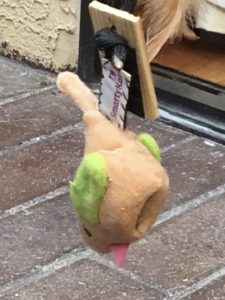
This cat toy can be “captured” by kitty. It is attached with velcro.
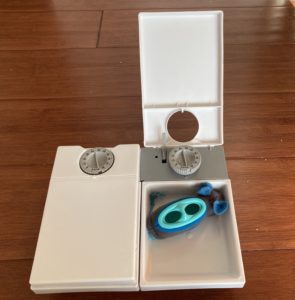
Food puzzles are tucked into this automatic feeder. It can be moved to different places making kitty hunt for it.
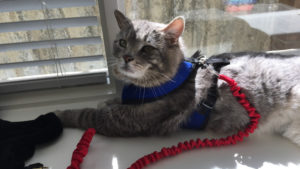
This cat is enjoying a stroll on a leash.
My Cat Household Today
My current household has 4 cats. My two older cats, are 14 and 16 years old and have access to an outdoor yard if someone is home. The younger cats are 4 and 5 years old – their access to the outdoors is by once to twice daily supervised walks. All cats have access to a small catio in the backyard and another on the second story porch.
The easiest way to avoid the drama of giving your cat pills is to train your cat to accept medication. Establishing a daily “treat time” can be fun and rewarding for your cat. The idea here is to get your cat accustomed to accepting “fake pills” – treats that are wrapped in pill pockets, cheese, or liverwurst. When your cat needs medication, she is already used to accepting treat-wrapped things.
Getting Ready
choose the place and the time – try to go to the same place every day around the same time.
cats don’t tell time, so pay attention the household routine – maybe treat time should be after dinner time or before bed time.
Have everything ready when giving the “pill”. Have a chair or stool nearby to park treats and “prepared” pills on. If you are giving a capsule, have some butter to lubricate the capsule.
You may want to train your cat to a particular mat or blanket that is used just for treat time!
Method 1 – Starting from Scratch
Lure your cat onto the mat or blanket using treats or a toy.
Once on the mat, reward with several treats and head rubs.
Work up to having your cat accept a “blank” pill in the stream of treats.
The next step is make a “fake” pill – break a treat into small pieces. Wrap one of these pieces in the pill treat, cheese, or liverwurst.
Put the doctored treat in the stream of the treats.
Method 2 – Using Previously Trained Behaviors
If you have trained your cat to target and sit, it is easier to train your cat to accept medication.
Using your target stick (or chopstick or laser pointer), direct your cat to the “pilling” spot and reward her with a treat.
Ask your cat to sit and again offer a treat.
Offer your cat the “blank” pill followed by a treat
Work up to offering the fake pill.
End session with the all done signal and another treat.
Method 3 – Train Your cat to Accept Medication Using a Pet Piller
I find the piller particularly useful when you are faced with giving a capsule.
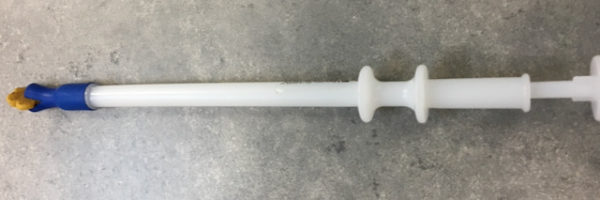
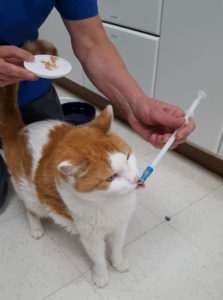
Start by offering a treat on the piller – you can start with having your cat lick some baby food or pureed treat off the piller. This will get him used to having the piller in and around his mouth.
Offer hard treats using the piller; work up to using the plunger to put the treat in your cat’s mouth.
Accustom your cat to getting the treats off the piller with you behind him.
Give a stream of treats with the “fake” pill in it.
End the session with a reward and the all done signal.
Something to consider: If the medication you need to give is bitter, putting it in a capsule lubricated with some butter or petroleum jelly avoids risking your cat biting into a bitter pill.
It is a good idea to have your cat get used to you being behind him when offering the treat on the piller. This gives you more control when offering the pill and kitty will be more focused on the treat than on you giving the pill.
Giving your cat a pill is not difficult if she will readily eat the pill in a treat. However, she may refuse to eat her medication in a treat if the medication is bitter or she does not feel well. Regardless, she needs her medication.
Other Techniques for Giving Your Cat a Pill
What about giving the tablet or contents of a capsule in his favorite food?
Pros
Not very stressful for your cat
Some medications, for example, the antibiotic doxycycline, are associated with inflammation and narrowing of the esophagus when given directly
It is often recommended to open the doxycycline capsule and mix the powder in tuna fish (or other strongly flavored food)
Cons
Many pills are bitter and may result in your cat refusing to eat his food
If you mix the crushed pill in his food, he may not get the full dose if he does not eat the entire portion
If your cat is on a restricted diet for, say, food allergies, avoid putting crushed pills in his food – you don’t want him to develop an aversion to the one kind of food he can eat
If you need to give medication in food, choose a different food than the one your cat usually eats.
Limit the amount of this “doctored” food to about a teaspoon, so that you can be sure your cat gets his full dose of medication
Make sure your cat is hungry when he is offered the medication in food – you may need to pick food up several hours before giving medication.
Giving Your Cat a Pill “by Hand”
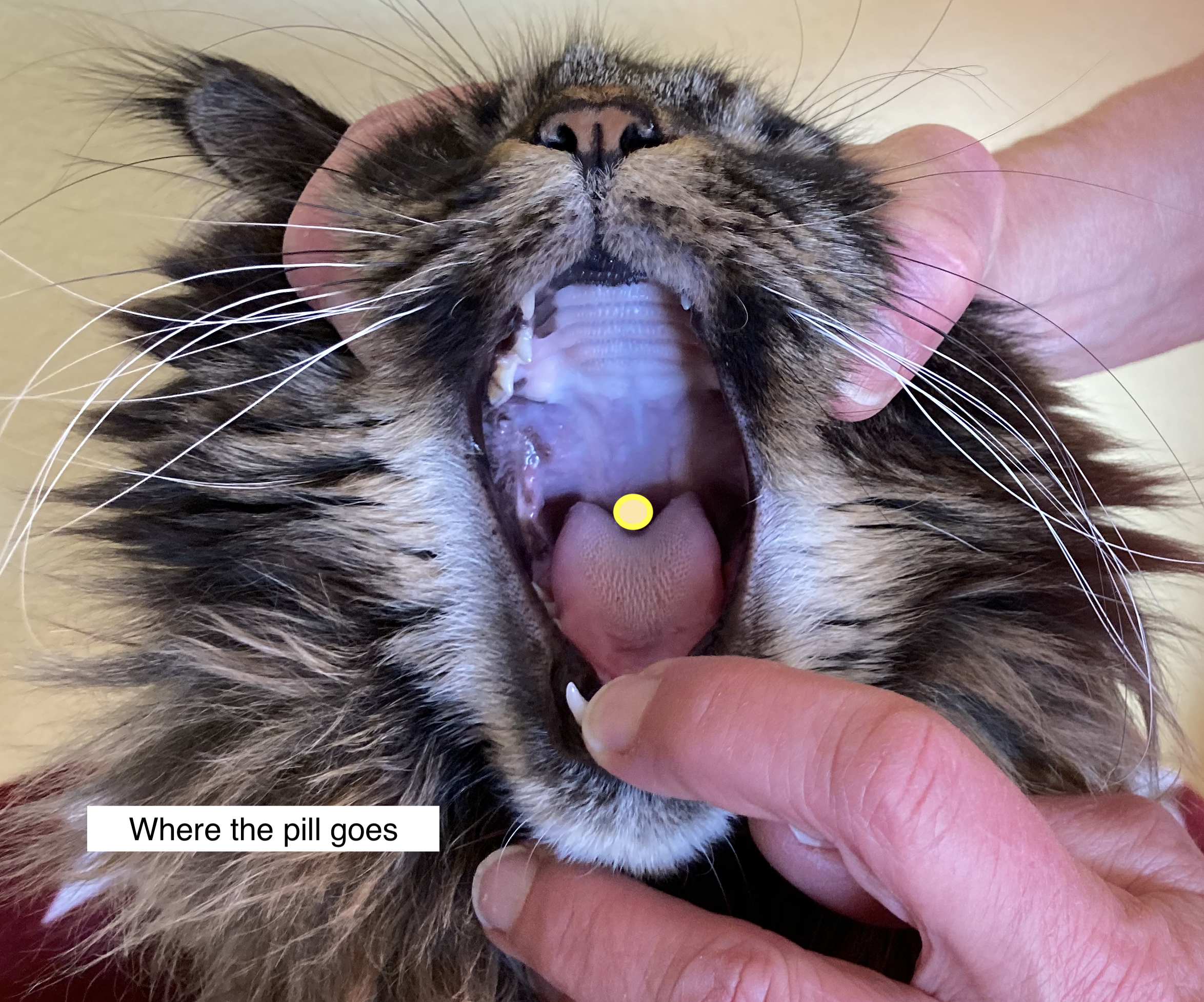
Often, you will get a demonstration of how to pill your cat at your vet. The accepted technique is to hold your cat’s head like a baseball with your non-dominant hand, tilt his head back, gently open the lower jaw with your third finger, then pop the pill in as far back in the throat as possible with your index finger. Often, the vet team will recommend “massaging” your cat’s throat to help him swallow the pill. IT IS A GOOD IDEA TO FOLLOW THE PILL WITH SOME FOOD, WATER OR TUNA JUICE.
This technique takes practice to master and a wily cat can still manage to gag and spit the pill back up! At the veterinary hospital giving a pill may seem to go smoothly – Please remember, the veterinary team pills cats frequently AND your cat is not in the comfort of his home.
Using a towel wrap when pilling
Does your cat like to snuggle? She may appreciate a towel wrap or a ThunderShirt when being medicated to make her feel more secure. A towel wrap is also helpful if your cat paws at your hands when you are giving the pill.
Test your cat’s acceptance to these when NOT giving a pill. Your cat may struggle initially with towels or pressure wraps but should calm and STOP struggling. Count slowly to 5 – if she is still struggling at that time, these are not for her.
Giving Your Cat a Pill using a “Pet Piller”
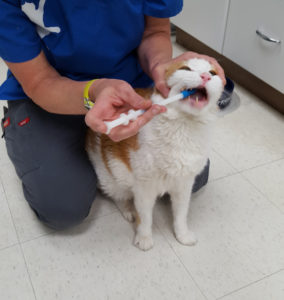
Another technique to aid in giving oral medication to your cat is using a pill gun. A pill gun is a plastic tube with a plunger. The tip should be soft so that it does not cause any trauma to the throat when pilling.
Introduce your cat to the pill gun by letting her examine it and lick some baby food or other treat off the end. If she likes hard treats, see if she will take a treat from the pill gun.
Lubricate the tablet or capsule with petroleum jelly or butter.
Load the lubricated tablet into the pill gun.
Have some snacks ready for rewarding your cat after the pill is given.
Kneel down on the floor and gently snug your cat between your legs – this will keep him from backing up, away from the pill gun
Hold kitty’s head gently and
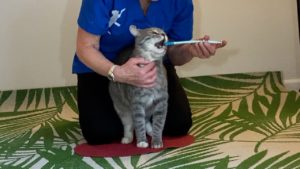
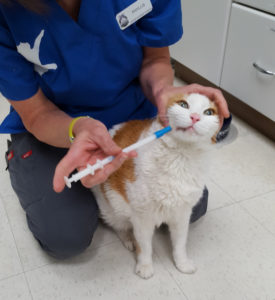
gently guide the piller into the side of Kitty’s mouth.
Depress the plunger to release the pill.
REWARD!
Offer Treats with the Pet Piller
Guide the Piller into the side of Kitty’s mouth
Work the Piller toward the back of the mouth and depress the plunger
Giving My Cat a Pill is Impossible!
If you are running into difficulties…Take a break and come back to giving the pill in 15 minutes or so.
Are there other treats you have not tried – “lickable treats” in tubes? Chicken baby food? Catnip or playtime?
Talk to your veterinary team – are there other forms of the medication? Some medications are effective as transdermal gels that can be applied to the inside of your cat’s ear; other medications can compounded into flavored tablets or liquids or given by subcutaneous injection.
Make giving the pill a positive experience – have something good happen!
At some time in your cat’s life, he will probably need to take some medication. Giving pills or injections to a cat can strike fear into the most stalwart cat guardian! The best way to proceed is to find out what works best for your cat – what will make taking the pill or getting the injection the most fun.
Medicating your cat : The feline purrspective…
From the cat’s point of view, taking a pill is unnecessary and unpleasant. When you least expect it, your person levers your mouth open and shoves something down your throat. You feel like you are going to choke! You gag and spit that thing back up; then run and hide.
As cat guardians, we don’t wish to distress our cats but we do want them to take their medication. After all, we just spent money for an exam and possibly diagnostics to find out why our cat is not feeling well! We just want her to feel better. Medicating your cat can be feline friendly – pick a spot, pick a treat, and give the pill!
A favorite spot with a soft blanket.
Pick a Spot
Does you cat have a favorite spot, a preferred basket she sits in, a blanket she likes?
Make this spot pleasant – offer treats, attention, play time here.
What does your cat like?
Does you cat have particular treats that he values? Can we get something that is special – say some of the lickable treats, chicken baby food, crunchy hard treats? If your cat is not all that food-motivated, pick up food a few hours before giving medication. He will more inclined to eat the pill if he is hungry.
Establish a Routine
Offer your cat treats or head rubs when in her favorite spot.
Get her favorite spot ready and give the medication close to the same time every day.
You may think that surprising your cat and sneaking up on him to give pills would be a good way to pill him – after all, he is not expecting it! But…sneaking up on him can result in his being fearful and hiding from you – after all, you may be coming with the dreaded pill at any time! A routine lets him know the pill comes at particular time and once the pill is taken, it is over with.
Medicating Your Cat – taking a pill in a treat or a stream of treats
Your cat is in her favorite spot. What next?
You can use a commercial treat such as “Pill Pockets” – these are soft, flavored treats with a modeling clay consistency – to disguise the pill. Break a small piece off the pill pocket and mold it around the pill. Alternatively, you could mold a piece of sliced cheese, a bit of liverwurst, or anchovy paste around the pill. Some cats will eat the pill in a treat.
Your cat, being a solitary hunter, may be suspicious of this new food item. You may need to entice him to accept it. If your cat has treats he likes, you can start by offering a treat, followed by another, then a “blank” (the pill pocket without the pill), followed immediately by more preferred treats. Wait a bit then offer the treats, the pill in the pill pocket, then more treats.
Give the medication around the same time every day in the favorite spot. You may find your cat will anticipate the activity and go to her spot and wait.
Be Creative!
Let’s say your cat likes laser pointers. You may be able to guide him to a treat with the pointer, then the pill wrapped in the pill pocket, then another treat. Finish with a fun laser pointer session.
“My cat is not falling for these tricks and she needs her tablet! ” Each cat is an individual and each medication is different. In the next post, we will look at other ways of making your cat feel safe and secure, and giving a tablet or capsule using traditional pilling or a pet piller!
Do you have a cat that is picked on by your other cats? Everyone else seems to get along okay but this one cat seems to be singled out for torture. He or she does not fight back, just tries to slink away and hide. You may have heard the term pariah used for such a cat – a pariah is an outcast, someone who is not part of the general social group.
Often, one or more cats will pick on the “pariah”. These feline bullies may..
stalk and track their victim
stare directly at their victim
attack her or him
prevent the pariah cat from using critical resources – litter boxes, food, sleeping places.
Bullies can exist within any multi-cat household – like human bullies, they tend to pick on the timid, old or sick that respond to threats.
Why should you intervene when cats don’t get along…
The victim may develop a stress-related illness due to the constant threat presented by the bully.
A out and out cat fight may result – fear and anxiety can lead to overt aggression on the part of the bully or the victim.
Unlike the outdoor colony, the victim cannot vote with his or her feet and leave.
In an outdoor colony, “membership” is loosely “managed” by the group of core females. If a cat pushes the limits with bullying behavior, the core females may drive him or her off, if they perceive a threat to their kittens or resources.
Our indoor colonies rarely have a group of mother cats at the core – as the surrogate mother cat, the cat guardian must police the bullies and promote harmony in the group when cats don’t get along.
When cats don’t get along: the bully/pariah emergency
First Aid: Separation
Separate the cats involved. You may need to redirect the bully (with a laser pointer, wand toy) to allow the other cat to escape or separate the cats physically and herd them away from each other
Remember cats are socially flexible – they can live alone or in groups. Put your pariah cat in a room of his or her own with litter box, cat tree, food and water while you figure out what to do. The pariah may need to remain in this room for several weeks. Make sure to give him or her attention and play time!
Assess the Situation:
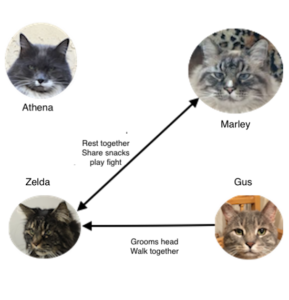
Identify the social groups in the house : identify the bully(ies), the pariah(s) Social Groups of Cats
Evaluate resources – enough litter boxes, feeding stations, water sources? Are these separated so that all cats have access?
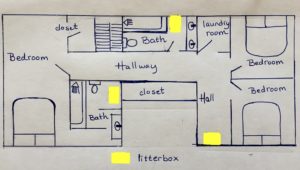
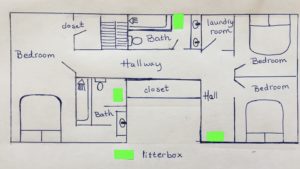
Is there enough room for cats to avoid each other? Try to “think like a cat” and draw the paths a cat must take to get to his food, water and litter boxes. These paths must give enough room for cats to pass each other comfortably. Beware of potential ambush spots – you may need to move some furniture.
A sketch of your home can help with locating resources, eg. litter boxes
Your cat is indoor-outdoor and is being bullied by a neighborhood cat…
keep your cat inside or accompany her when she goes outside
identify the aggressor cat and where he or she comes from
if possible, speak with the owner and find out when the bully cat goes out and see if a time-sharing arrangement can be worked out
Restoring Harmony…
Once you have gotten the cats separated, consider veterinary exams to determine if any of the cats are sick. Sickness can be frightening to healthy cats – their housemate may not smell right or behave quite right.
If all cats are healthy, make a plan to reintroduce cats slowly and gradually with some environmental modifications if needed. Introducing Cats: A Short Guide
Other Options if Aggression continues or become worse…
Consider re-homing the victim.
Under the direction of your veterinarian, give the victim and/or bully anti-anxiety medication and implement a behavior modification plan. If you decide to choose this route, make sure you are willing to work with your cats daily to desensitize them to each other.
When Cats don’t get along: A Tale of Two Siamese Cats
Demian and Rupert were two neutered Siamese cat who had lived amicably for over a year. Rupert would bully Demian, stalking and attacking him; there were no injuries. The tables turned one day and the victim became the aggressor – Demian stalked and attacked Rupert and backed him into a corner behind the toilet in the one bathroom in the 1 bedroom apartment. Demian would not let Rupert move. After separating the two cats, Demian went to stay with a family member for about 10 days. Fortunately, we were able to reintroduce the two cats afterwards.
If there is plenty of food around, free-roaming cats often form groups called colonies. Within the colony, there are smaller social groups of 2 or more cats that prefer to spend time together. Cats belonging to a particular social group, will share food, water, latrine areas, sleeping and resting places.
Cats in different social groups tend to keep their distance from each other. How cats get along is to “timeshare” or “take turns” using essential resources such as resting areas and feeding stations. When one social group is done, another cat or group of cats will move in to use the resource.
Timesharing in the Multi-Cat Home
Like cats in a colony, cats in a multi-cat home timeshare resources. You may notice that different cats will occupy a particular favored resting place at different times. If you watch carefully, you may see a cat watching this place, waiting for the resident cat to vacate the space, before moving in to use the space.
Cats timesharing a resting place – one cat will use this bed if the other is not in it
If there are enough beds, litter boxes, etc. available, this system usually runs smoothly. But if too many cats want the same thing, bickering can occur and more dominant cats may push other cats away from these resources. How cats get along in an outdoor colony may be to vote with their feet and move on – indoor cats do not have this option.
Cat society does not have a rigid hierarchy – there is no alpha male or female. There are simply some cats that have more dominant personalities. Unlike dogs, where a lower-ranking dog will surrender the prize to a higher-ranking dog, cats don’t have a hierarchy that dictates who gets what.
If a fight arises between cats over resources, the relationship between the cats involved may be damaged – they may not be able to tolerate each other after this. Needless to say, if the contested resource is a litter box, cats may be forced to find other places to eliminate and we, as caretakers, will not be happy.
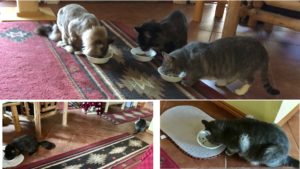
In this video, 3 cats have worked out a way to avoid fighting over the nighttime treats. While not timesharing, the video shows resource sharing set up by cats.
Owner Managed Timesharing
If the cats are unable to timeshare resources on their own, we must set this up for them.
Setting up a Timesharing Plan
There are 3 social groups in this 4 cat household.
Gus is much more relaxed when eating away from the other cats.
Are there enough feeding stations, litter boxes, beds, scratching posts? The rule of thumb is (#cats +1) or (#social groups + 1)
Are resources separated enough so that cats of different groups can access them?
Can access to these resources be blocked by another cat?
Is there enough room for cats from different social groups to pass each other “out of paw-swipe”?
If resources cannot be spaced appropriately and conflict continues, you may need to keep one social group in another part of the house, while the other is using the main area. Have different social groups use critical areas in shifts. Slow, planned re-introduction may be possible between cats who “have fallen out” with each other. Introducing Cats: A Short Guide
Managing multiple cats in a confined, indoor space is a balancing act. We must ensure that all cats have access to essential resources and be able to use them without fear.
Cats tend to be homebodies. Most are not very fond of traveling. However, with some training and attention to their needs, trips to the vet and even cross-country do not need to be a traumatic experience.
Choosing A Carrier for Your Cat
There are lots of options out there. The traditional plastic box works well; it is secure and easy to clean. Make sure the top is easily removable – some carriers have more bolts (9+) than necessary. If you have one of these, you can often remove about 1/3 of the bolts even if your cat is heavy.
There are more and more styles of fabric carriers – if you are looking for one, choose one that has side panels that open up, or a top that zips open. Think: How will you get your cat out of the carrier? How will you get him back in (if he is reluctant)?
Make sure the carrier is big enough. Cats are masters at squeezing themselves into small spaces but the carrier needs to be comfortable in case your cat must stay in it for a bit. Your cat should be able to stand up and turn around in her carrier.
Method #1- Feeding in the Carrier
Using method #1 for carrier training your cat, you will feed your cat in his carrier.
Place your cat’s food bowl near his carrier. Over the next few days to a week, you will move the food closer to the carrier, then put it just inside the carrier, then finally put it in the back of the carrier.
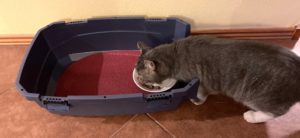
Gus was trapped as a feral cat. He was reluctant to enter the carrier, so we removed the lid for him.
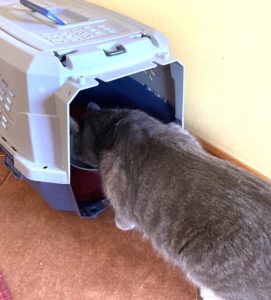
Once Gus was comfortable eating in the bottom of his carrier, we placed the top on the carrier without the gate.
Once he was willing to eat in the carrier with the top on, we introduced the gate.
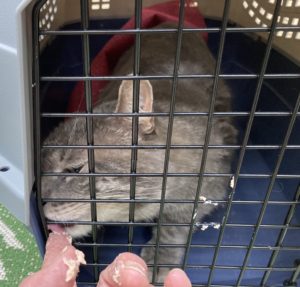
First, we had him eat with the gate open; the next step was to close the gate for a minute. Some food on the gate helped him stay calm for this.
Method #2 – Using Targeting
Carrier training your cat using method #2 is based on a clicker training technique called targeting.
you start by luring your cat to the back of bottom half of her carrier using the target stick.
once she will sit in the bottom half of the carrier calmly, place the top on the carrier. Have her enter following the target stick and then sit.
work up to having her stay for the count of 5
once she is calm with this, close the door and have her stay for the count of 5
Extra Credit:
Once your cat is comfortable in her carrier, lure her in with a snack or target stick, close the door and move her to another room. Upon arriving in the other room, open the door and reward her with a snack!
Make sure to take your time. Cats are individuals and some learn faster than others. You may need to break up the training into smaller steps if your cat is reluctant to enter the carrier. Gus, a former feral cat, is leery of things that may be traps – it took longer for him to accept the carrier than Zelda, who appears in the video above.

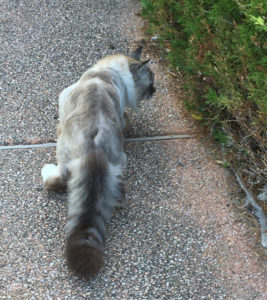



 Guide the Piller into the side of Kitty’s mouth