I have seen a lot of advertisements and posts recently on social media about taking your cat for a walk. This can be a source of enrichment for your cat; it is also be a great time to take photos of your friend and bond with her more.

Just like many humans, cats don’t like surprises. If you want to try taking your cat for a walk, be prepared to spend at least a few weeks preparing him.


What you need


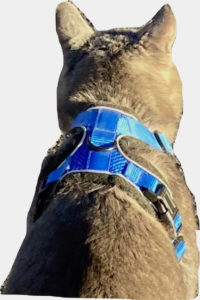
  • A harness made for cats – these should be adjustable with comfortable padding to distribute the pressure on his neck and chest if he pulls against the harness
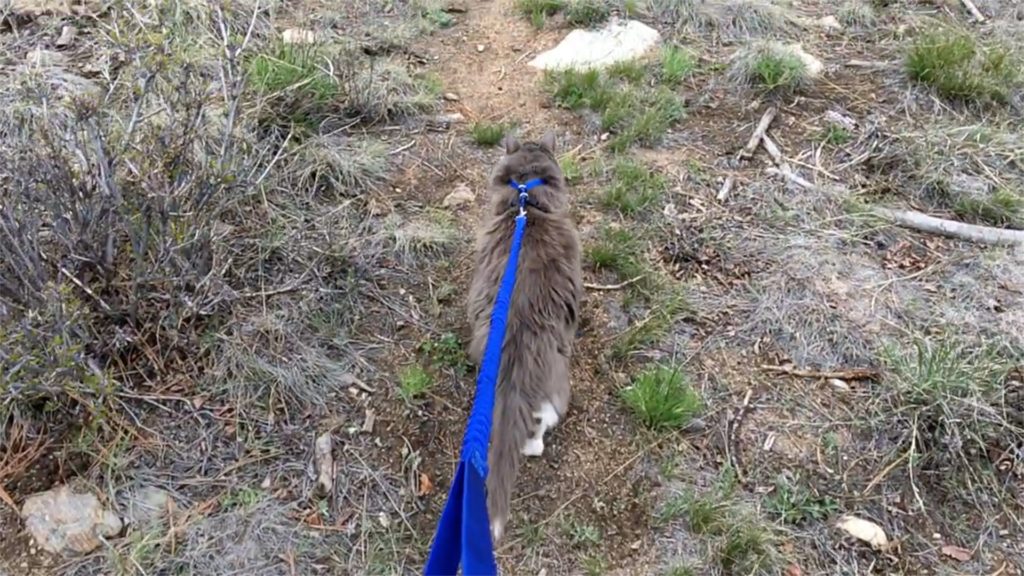
  • a leash – a leash about 4-6 feet long will work. I use an extendable leash with a bungee leash on the end in case my cat goes after a rabbit or mouse.
  • “treats for the trail”

cat with harness front view


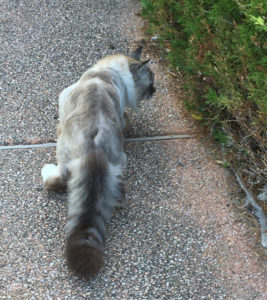
Cat from the bacj

Training for the Trail: The Harness


  • Let your cat smell the harness.
  • Slide the harness over his head. Click, treat and remove.
  • Work up to clipping the back.
  • Leave the harness on for increasingly longer times.
  • MAKE THIS FUN – MAKE SURE TO REWARD HIM.

Training for the Trail: Walking Indoors


  • Practice walks inside – using the leash
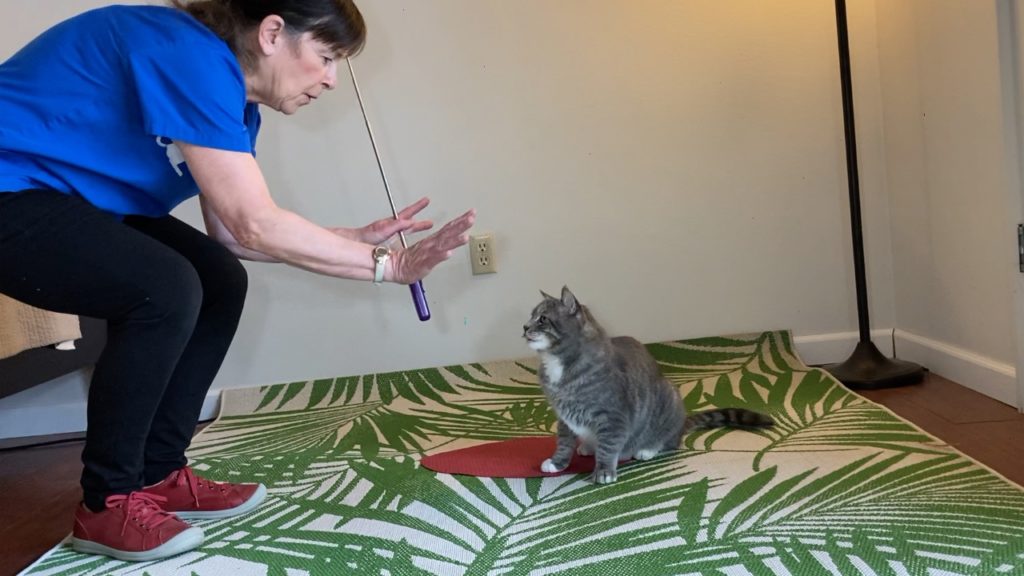
  • if your cat has been trained to a target, get him to walk along for short distances on the leash following the target
  • Alternatively, toss a treat in front of him to get him to move forward

Taking Your Cat for a Walk: Choose the Place


  • A back yard or enclosed area is an ideal place to start
  • Choose a QUIET time for his first walks

Taking your Cat for a Walk: Venturing further Afield


  • your cat is a small animal who is a predator but is also prey
  • you must provide a safe place for your cat if predators or unwanted people show up
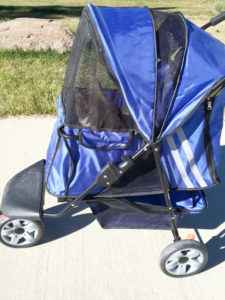
  • If you walk on sidewalks and paths, a pet stroller can be a wise investment
  • If you are more adventurous, a backpack can be a solution.
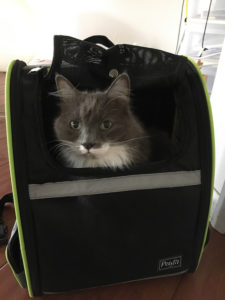
Cat in backpack


A Cat enjoys a walk in a stroller

Both backpack and stroller are best introduced to your cat with training. Your cat will soon figure out the stroller or pack means safety from dogs and sunshine.

Hazards of the “Trail”


Cat Fights


Strange cats: Feral cats are most likely not going to be around when you are out – they avoid humans and typically hunt during the evening and night time hours. Free-roaming pets or community cats present more problems. This is when you want to have your cat leashed.

Be attentive to your surroundings – your superior color vision can sometimes pick out strange cats before your cat is aware of them.  You may be able to put her in her stroller or pack  or take evasive action before there are any hostilities.

Monitor you cat’s body posture (tense, alert?) and vocalizations (low growl?) – these can indicate the presence of a strange cat.  Once your cat is aware of the stranger, AVOID picking him up.  Encourage the stranger to go away, while keeping a firm grip on the leash.

I have had a cat stalk us while I was walking Gus. I did encourage the strange cat to go away, verbally and with a well thrown pebble while keeping a firm grip on Gus’s leash.

Dogs


When I started walking cats around my townhome, I very quickly learned that many dogs are not well-trained – they escape their owners, leashes flying the breeze and make a beeline for your cat.

Offer the stroller or pack to your cat as a refuge.  Training your cat to sit when dogs approach can be helpful – if  your cat does not run, the dog usually will not chase them. 

Be calm and assertive to the approaching dog – firmly command them to “sit” or “down” or “stay” (common commands the dog may know).  Don’t turn your back on  on the dog; don’t stare directly at him.  Back away slowly. More tips..

Cars


Cars are terrifying – we need to get kitty into a safe place.

Train your cat to be picked up  so that you can hold her or put her in the stroller or pack. Cue is “up”, click  while lifting, and make sure to reward when you put her down.

Want to keep up with the world of cats? Subscribe to The Feline Purrspective!
Subscribe

Cats are considered mature at 7-10 years, senior at 11-14 years (human age 60-72 years) and Super Senior at 15+ years (human age 76+ years) (Your cat’s age in human years). Here are some tips for caring for your older cat.

Once past 2 years, cats age at a rate of 4 years per every human year. Regular veterinary visits are beneficial for your Mature, Senior and Super Senior cats. Good veterinary care can make your older cat’s senior years golden years.

Mature, Senior and Super Senior cats have the same needs as younger animals.


Caring for Your Older Cat: The “Senior” Cat Friendly Home


Safe Places


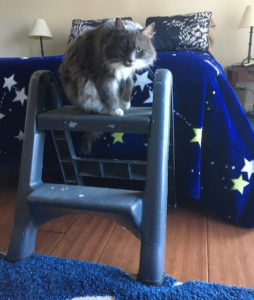
Steps to bed for older cat
A step ladder gives Athena easy access to the bed.


An older cat needs private and secure places to retreat to, to rest and take a break from household activity. Steps or ramps provide easy access to higher places. A heated bed with extra padding can be a real hit for an older cat stiff from arthritis.

Resources – Food, Water, Litter Boxes


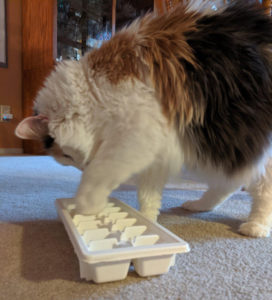
Ice cube tray as a food puzzle
This older cat is getting lunch from an ice cube tray.


Still a hunter at heart, your older cat is designed to eat small meals, frequently during the day.  Feeding stations throughout the house will encourage her to prowl and “hunt” her food, stimulating her physically and mentally.


Your old cat will most likely drink more than he did when he was young. Locate water sources throughout the house. If your cat seems stiff, try raising his food and water up so that he does not have to crouch down as much to eat and drink.

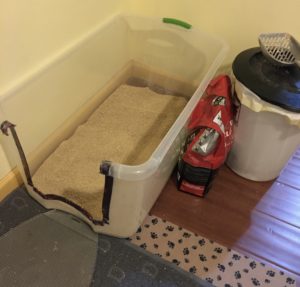
Litter Box from storage tote
A storage tote has been repurposed as a litter box. The front opening is low and was cut with heavy duty shears and a hacksaw. A trash can for scooping is nearby.

THE LITTER BOX

  • Large enough for your cat to turn around.
  • Entrance has a low sill for easy access.
  • On each floor of the house
  • In areas that are secluded and private
  • Finer textured litter may be more comfortable for older kitty paws.

Play is still important


Older cats can still can benefit from swatting at a wand toy or chasing treats. Daily play time close to early morning or early evening mimics the cat’s natural rhythms – prey is most active at these times.

Human Interaction


A familiar predictable routine reduces anxiety for all cats. Caring for your older cat should include grooming as well as play time. Grooming becomes more challenging for older cats as their flexibility decreases.

  • Make grooming sessions frequent and short.
  • Cats often groom after eating. This is a good time to gently comb or brush the older cat.
  • Regular nail trims are important for older kitties – the nails of older cats can sometimes grow into their paw pads, which is painful.
  • Older cats still need access to scratching areas – horizontal and angled scratchers may be easier for them to use

Your Cat’s Sense of Smell


Cats have a sense of smell that is 14x more sensitive than ours.

  • Diffusers containing facial pheromones placed near some of your older cat’s resting places will convey the messages of familiarity and safety
  • Scratching releases pheromones from glands in your cat’s paws that help mark his territory- have scratchers available to your older cat
  • Avoid using scented litters and strong smelling cleaners

Outdoor Access


A Cat enjoys a walk in a stroller

SAFE outdoor access is stimulating for older cats as well as young cats. Your cat may like some supervised outdoor time with you – the daily “walk” can provide quality time for both cat and owner.

IF you are lucky enough to live in a quiet neighborhood or have access to a quiet park, a cat stroller can get you and your old friend out. 

  • Get her used to the stroller first – offer some food in it, let her nap in it
  • Start with SHORT walks in QUIET places at QUIET times.
  • Increase the walking time IF she is enjoying it.

A Cat and his Territory

Cats are territorial. What does this mean for cat guardians?


An outdoor cat’s home range is the maximum area he roams and hunts in. Within the home range is a smaller area that the cat will actively defend – his territory. Inside this defended area is a smaller area called the “core territory”, where the cat can rest, has shelter, and feels safe from predators and other cats.

Free-roaming cats establish their territories around food supplies. They remain solitary hunters and don’t share prey with other cats.  Access to food, water and places to rest and shelter are some reasons why cats will fight with each other. Having a secure, established territory is essential to the free-roaming cat’s survival.

When cats move inside, their territories shrink and the house becomes the territory. Home ranges still apply for cats with outdoor access. Within the house, cats will choose their core territories – their safe places where they go to nap and feel secure. 

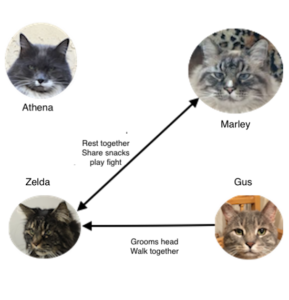
In my 4 cat household, Athena and Marley choose the master bedroom as their safe place, with comfortable resting places, water and access to a litter box; Gus’s safe place is the back office; Zelda floats between the office and the master bedroom.

What are the threats to the territory of the indoor cat?


  1. Outdoor cats: Neighborhood cats that come in the yard or come to the windows of the home may be seen as a threat by the indoor resident cat(s).  The threatened cat may strike out at humans or other pets nearby because he can’t get at the cat outside but is prepared to defend his territory.
  2. Other resident cats: Cats are territorial and remain territorial when they are kept indoors. There are often multiple social groups in a multi-cat home. Cats of one social group may guard resources such as litter boxes, food and water from cats of another group.
  3. People, other animals, inanimate objects:  Although territorial  behavior usually involves other cats, cats may see other species or things as threats to their resources and well-being, as threats to a secure territory. 

You will see your cat rubbing her face against walls and furniture. She is depositing pheromones from glands in her face to mark the area as safe. Cats also routinely mark areas by scratching, releasing another pheromone from glands in their paws, an olfactory signal to other cats that they passed by. This is normal behavior that the cat guardian needs to accommodate by providing scratching post and cleaning the “whisker walls” sparingly. Maintain the colony scent..

If your indoor cat perceives a threat, he may feel the need to mark the house with urine (sometimes feces) to establish the house as his territory. He also may respond to the “threat” with aggression.

It is up to the cat guardian to understand that cats are territorial and ideally modify the environment before marking or aggression starts.

What you can do:


Diagram social groups cats
There are 3 social groups in this 4 cat household.
  1. Outdoor animals: Restrict access to your yard if you can. “Critter spikes” can deter some cats and raccoons from scaling fences. A motion activated yard sprinkler can also be effective. You may wish to cover windows with static cling window film so that cats can’t see out.
  2. Multi-cat conflict: Identify the social groups in the household. Make sure resources are spread out and all the cats in the household have easy access to resources of their choice. Pay particular attention to the dynamics of feeding, using litter boxes, and resting. Make sure that all cats have an opportunity to exercise their hunting skills through play. Set up time-sharing for social groups if necessary.
  3. People, other animals, inanimate objects: Isolate your cat from the stressor or desensitize her if possible. For example, if she feels threatened by visitors, train her to go a safe place out of reach when visitors arrive.  Request that visitors refrain from interacting with your cat unless she chooses to interact. Make sure to reward her with something she likes in her safe place. She may elect to leave the room or observe from her safe place.
Daily Food Portion Cat
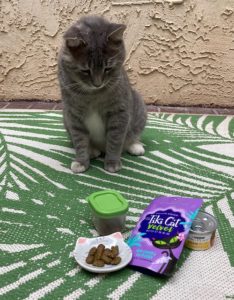
Gus looks at his daily food allotment. Treats count!

Cats are notorious for being picky about their food. Googling “finicky cat meme” brings up pages of cats turning down food after the owner has offered 3-4 different types. Morris the Cat was the focus of the 9Lives cat food advertising for years – he would only eat 9Lives. The pet food industry has capitalized on this image of a picky eater with many selections of food – textures, tastes, flavors.

Cats in the wild have far ranging tastes and will eat anything from bugs to bunny rabbits. So, what is this “finicky cat meme”?

In a previous post, we visited some facts about cats and how they are designed to eat – small stomachs digest mainly meat and cannot hold a lot at once. Hence the cat’s lifestyle – most of his waking hours are spent prowling and looking for prey.

You say, “OK, I get it – I need to feed 4+ meals a day and puzzle feeders can help.”

Is there more to the “finicky cat meme”? Look at the “Feline Facts” below.


Mom knows best…


Kittens learn food preferences from their mothers.

Cats have good taste…


Cats can “taste” amino acids and will head to food that will satisfy their needs (in general)

What does my cat taste?

Fresh is best…


Bitter receptors on your cat’s tongue and in her oral cavity alert her to the bitterness resulting from decaying meat. A solitary hunter cannot risk a bad meal – she will not be able to hunt if sick and will starve.

The Need to Feed…


Your cat requires protein every day.  Protein cannot be stored like fat, if your cat does not eat, his body will start to get protein from his muscles. Cats cannot fast more than 2-3 days.


The Pleasure of Dining Alone…


Although cats can live in groups, they are not social eaters and prefer to take their prey to a secluded place where they can eat in peace.

The Dining Experience…What’s on the Menu


How to feed the “finicky cat”…


  1. Offer a SELECTION of high protein foods – see what your feline gourmand prefers. (try 3 foods at a time -you can use one of those divided plates).
  2. CHOOSE FOODS WITH STRONG AROMA (e.g. fish), again playing on the cat’s well-developed sense of smell.
  3. OFFER WHAT YOUR CAT WILL EAT IN ONE SITTING. Once protein starts to deteriorate, the food may become bitter and she may not eat it.
  4. OFFER BOTH CANNED AND DRY FOODS – textures and size of food can be important; if your cat ate dry food as a kitten she may prefer dry food.
  5. Because taste receptors work best at 86 degrees F (30 degrees Celsius), refrigerator cold food may not be appealing. A little HEATING (careful with that microwave – a few seconds is often all you need) will release the aroma of the food and make it more appealing

The Dining Experience…Where to Feed Your Cat


Cats prefer to dine alone. Choose a place out of the way where your cat can view things while she eats – perhaps a corner near the kitchen. If you can, keep cats out of sight of each other when feeding.

The “Kitty Diner” – feeding and carrier training all at once!


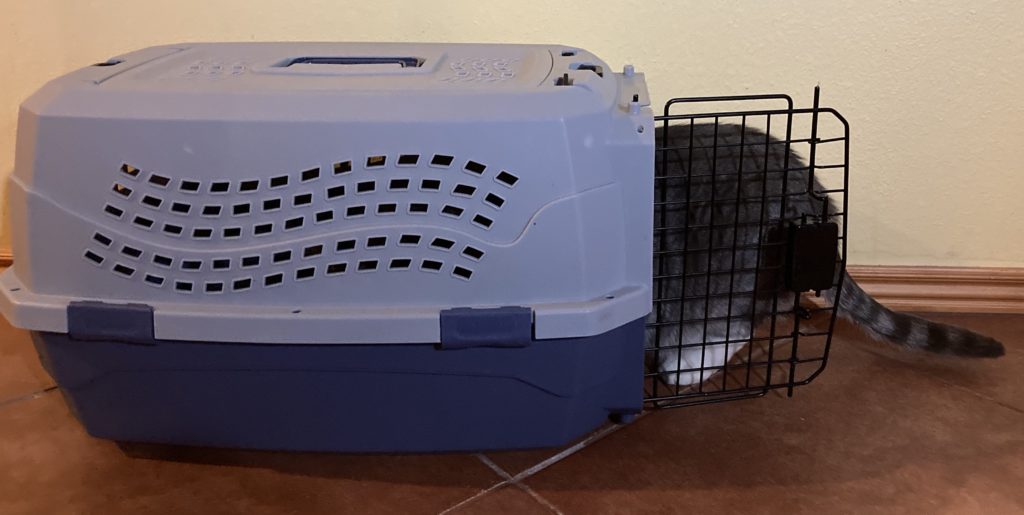
This is a solution I arrived at having 4 cats and a small townhouse. The cats eat their canned food meals in their carriers. Because they are in their boxes eating, they are out of sight of each other and I can feed them in a relatively small area. The bonus is that they have a better attitude toward their cat carriers when we need to travel.

Cat eating in carrier

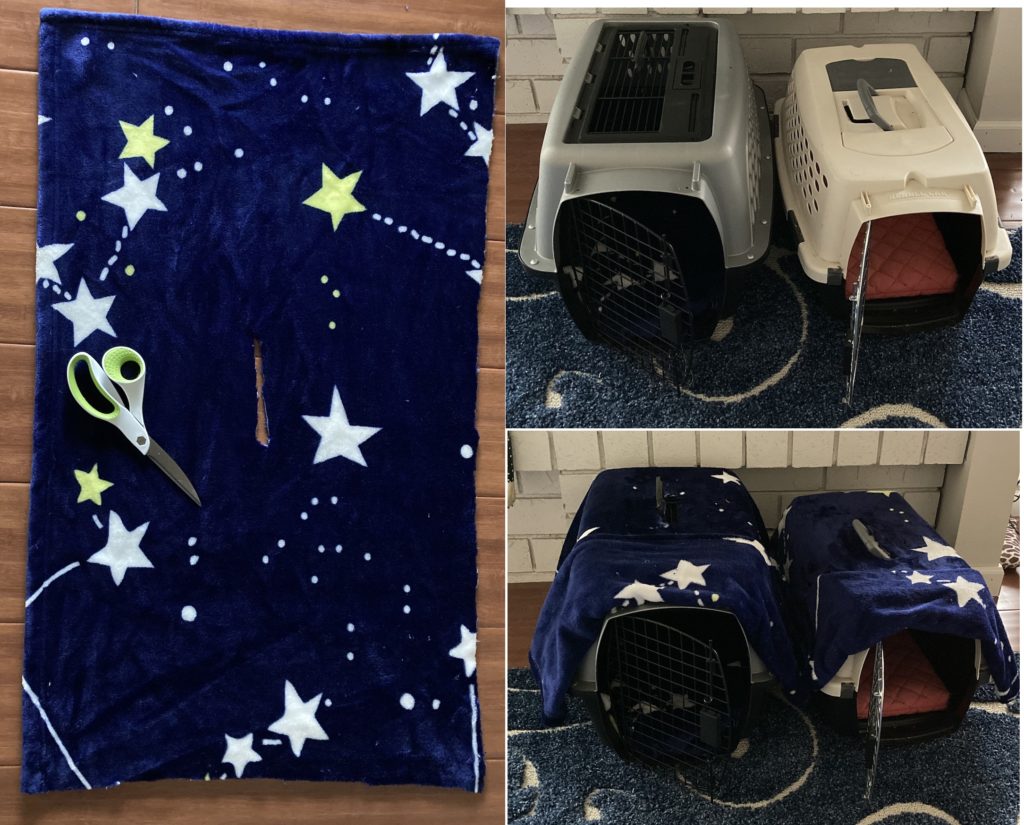
Unsightly carrier? Try a carrier cover. Pick something that coordinates with your decor. If you use fleece or felt, you don’t have to hem anything. You just cut a square and cut a slot for the handle, if you like. This also helps with vet visits since the cover makes the carrier dark like a wildcat’s den and your cat feels more secure.

Cat-Carrier-Cover

When to call in the veterinary team…
If your cat is losing weight
If you cat is vomiting frequently
If your cat has frequent diarrhea or you feel she may be constipated
If your cat has not eaten for 24-48 hours – So is she truly not eating? Is she producing poop?
If she is pooping, she is eating something – maybe not enough. Consult your vet if there is no poop in the litter box for several days

In my job as a veterinary technician, owners often tell me  “I can’t train my cat – food does not motivate my cat ”. ” My cat won’t eat his medication in a treat – he doesn’t like treats”.

Like people, cats are individuals – some are grazers and others will eat at any time. BUT… all domestic cats share common ancestry -Felis Libyca, the African Wildcat – and they have inherited a certain physiology.

The Behavior of Feeding


Cat on the Prowl
Marley looks for critters in the bushes


  • Cats have small stomachs and a short GI tract designed to digest meat.
  • They cannot wait until they get hungry to hunt – they will starve if they do.
  • Their lifestyle is one of being on the prowl most of their waking hours, looking for food
  • CATS ARE HARD-WIRED TO HUNT
  • “NEW PREY” IS A STRONG MOTIVATION

The free-roaming cat eats up to 8-10 meals daily.  The number of meals depends on the size of the meal – it will take a bit longer to digest a rabbit than a few bugs!

You say “Food does not motivate my cat”? What if we try to mimic the prowling feeding style of the wild cat?

Feeding 4+ Meals a Day


How much to feed?

Daily meals for a cat
A cat’s daily food ration – 2 meals of canned food with two puzzle feeder meals of dry food.


What your cat will eat in one sitting.

  • watch your cat – pick up and measure the food eaten when he leaves the bowl -OR-
  • offer a “2 mouse” meal of about 50 kcal

Feeding 4+ meals if you are not home during the day

  1. AM: meal feed: canned or dry food
  2. DAY: (2) food puzzles  with dry food
  3. PM meal feed: canned or dry food
  4. Snack at bedtime: Treats for training or play

How to Do It:

Use puzzle feeders/timed feeders

  • each puzzle has a “two mouse” meal
  • timed feeders with “two mouse” meals
  • some feeders can hold ice packs for canned food
  • “timed” puzzle feeders


Avoid leaving large amounts of food out.  While it is convenient just to top up the bowl, you don’t know how much your cat is eating.  Boredom can lead to self-soothing behaviors such as over-eating and over-grooming.

Food Security in Multi-Pet Households


My dog will eat the food puzzles

  • Food puzzles in boxes
  • Food puzzles in closets
  • Feed on counter or high places

My other cat will eat all the food 

  • Use a microchip feeder  Surefeeder
  • Feeding on different levels
  • Isolate cats when not at home
Move the puzzles and feeders around when you can. Once your cat is prowling to dine, he will be more interested in training treats and treats for medications.  Train and medicate BEFORE meals.  Find the treats he values or use his regular food as treats.

A timed puzzle feeder…

To train your cat to do a new skill, you will need to set aside a time and decide what you are training that day.  However, training should not always be something you do at a scheduled time with specific goals.

Training is a way of communicating with your cat, so training is a part of your  cat’s day.

My kitties wake up to a medication session. My oldest cat, Athena, is medicated twice daily. After having Zelda, the Maine Coon, dive in, snatch and swallow Athena’s medication, I decided to make training work for me.

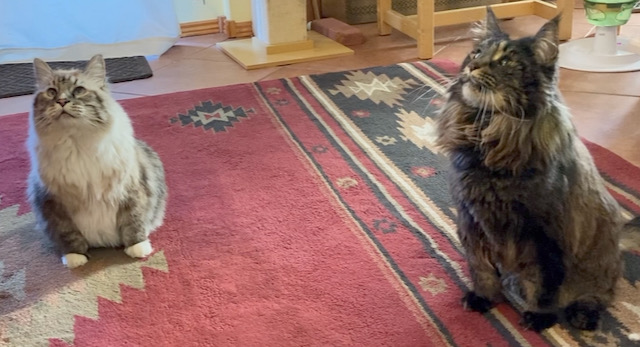
Two Cats sit and stay

Medication Etiquette

  • I prepare the medication (getting the treat box and wrapping the pill in a treat)
  • Marley, Gus, and Zelda COME and SIT on the floor by the dining table.
  • Athena is directed to the dining table.
  • Marley, Gus and Zelda are then asked to STAY.
  • Athena is given her tablet which she eats most of the time. If not, I give Marley, Gus and Zelda a REWARD and repeat the STAY command
  • I take an extra minute to pill Athena.
  • Marley, Gus and Zelda are REWARDED for the stay.
  • Athena is REWARDED for taking her pill.
  • I give all cats the ALL DONE signal.

The medication etiquette uses 4 skills the cats have learned.

  • COME when called
  • SIT
  • STAY
  • ALL DONE

It is a real time-saver when medication has to be given and I need to get to work.

Other times training is a part of your cat’s day…

Off the table!

You can ask your cat to move from place to place with your finger or a target stick. Let’s say that your cat jumps up on the table when you don’t want her to. You ask her to jump down; she does and gets rewarded with a treat.

Cat waits for food

Sit and wait for dinner!

You can ask your cat to SIT and STAY when you are fixing his food. You may need  a few treats to keep the STAY going until his dinner is ready.

Behavior when you don’t want it

Sometimes, you turn around in a minute or so, and your cat is back up on the table waiting to jump down and get a treat. When training, we repeat skills several times to see if kitty has gotten the idea.  So, it is not all that surprising when kitty repeats his skills when not asked, hoping to cash in on more treats.

It may be better to ask him to jump down, treat, then have him sit and stay for the count of 5. Then, give him a treat and the all done signal to let him know the session is finished.

The all-done signal is very important – it means that you will walk away and there are no more treats for the moment.

All Done
The “all done” signal marks the end of a training session.
Of course, you must have reasonable expectations. For example, if kitty really likes seafood, it may just be better for everyone if you ask him to go a room and close the door while you fix the fish or shrimp!