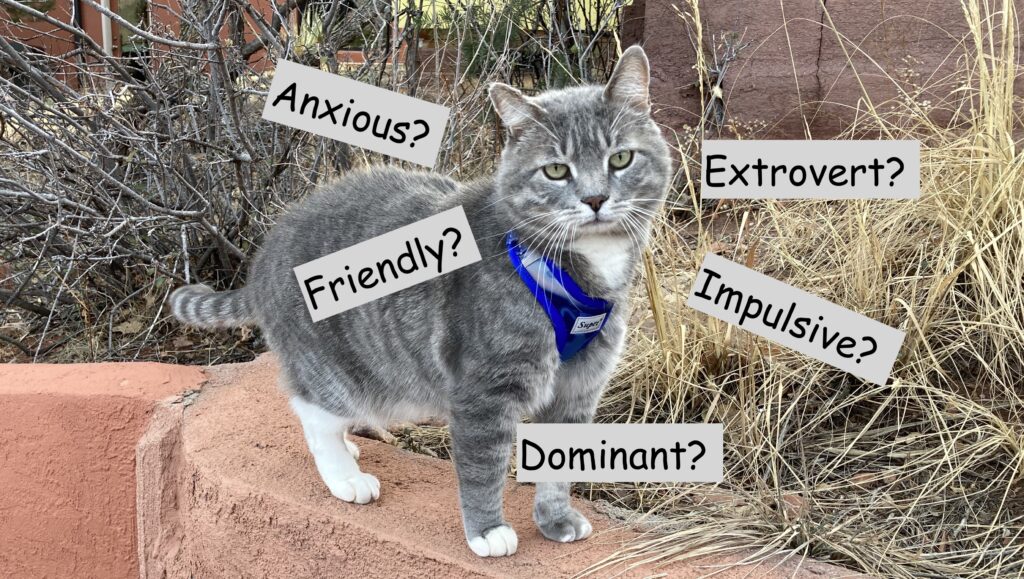
 Do cats have personalities? If you define personality as “the characteristic sets of behaviors, cognitions, and emotional patterns that are formed from biological and environmental factors, and which change over time” – yes, cats and other animals have personalities. How do describe your cat’s personality? How does personality affect how cats get along?
Studies (see Litchfield et al., cited below) of captive wild cats such as Scottish wild cats and cheetahs have suggested using personality assessments
- to house socially compatible animals together
- to tailor the environment to an individual animal’s needs – for example, provide more hiding places for a fearful cheetah
Can personality assessment improve the welfare of our domestic cats?
In 2017, Carla Litchfield and her research team published a study on personalities in pet cats. Litchfield’s team conducted a survey of 2,082 cats in New Zealand and Australia. The survey consisted of 52 personality items. Statistical analysis of the data found five reliable personality traits – “The Feline Five”: (citation below)
- Neuroticism
- Extraversion
- Dominance
- Impulsiveness
- Agreeableness
“The Feline Five” is similar to the Five Factor Method (FFM) used in human personality research. The FFM describes a person’s personality using five factors. An individual’s personality will have varying amounts of each factor. These five factors are: Extraversion, Agreeableness, Conscientiousness, Neuroticism, and Openness to Experience.
THE FELINE FIVE AND HOW CATS GET ALONG
Anxious or calm? (neuroticism)
Cats that score high on this factor are typically shy, fearful of people, insecure and anxious. On the other hand, calm cats don’t get as stressed when faced with changes in environment and exposure to other animals and people.
It is worth observing how the anxious cat gets along with other cats in the household. Timid, anxious cats can become the targets of more dominant cats who may stalk and chase them and prevent them from accessing resources such as food and litter boxes.
- Providing more resources and hiding areas will improve the welfare of anxious cats.
- It may be necessary to provide dedicated areas that only these cats can access.
The anxious cat will also benefit from consistent and regular interaction with humans following the CAT guidelines (See Touch not the cat: interacting with cats).
extroverted or introverted?
Extroverted cats are out-going and inclined to interact with people and other pets. They are sociable and curious. Introverted cats spend more time alone and are more quiet and reserved.
Extroverted cats can be energetic and prone to boredom. This can result in interact conflict – for example, a younger active cat may pick on a senior cat for entertainment. Extroverted cats can benefit from more play (hunting), foraging (food puzzles), and supervised outdoor access via leash walks or a catio.
dominant or Meek?
The dominant cat will stalk and chase other cats and sometimes humans. They displace other pets from favored positions and will steal their food. “Meek” cats are more tolerant of other cats and are willing to time-share places; they don’t exhibit the bullying behavior of a dominant cat.
Dominance behaviors are thought to occur more frequently in captive populations of cats. In the colonies of wild cats, the females raise the kittens co-operatively. There is competition between some male cats but there are also the “family toms”, unrelated male cats that affiliate themselves with the colony and have been known to protect and participate in rearing the kittens. [I. Rochlitz(ed.), The Welfare of Cats, 1-22 © 2007 Springer]
The popular “pack hierarchy” theory of wolves has been abandoned. Observation of non-captive populations of wolves show that they group together in family units, where the parents guide the activities of the group.
In the instance of a dominant cat “bullying” a more timid cat, the welfare of both the bully and the victim must be considered.
- Enrich the “bully” – give him or her more opportunities to play (hunt) and forage (food puzzles). If possible, offer supervised outdoor access via leash walks or a catio
- Provide the victim with ready access to resources and safe places. This may require separation when the two cats are not supervised.
impulsive or cautious?
Impulsive cats tend to be unpredictable and may react differently to the same thing at different times. Cautious cats are not so easily stimulated by their environment and keep to a smaller set of activities that they are comfortable with. Impulsive behavior is thought to be a response to environmental stress. [Litchfield et. al]
Agreeable or unfriendly?
Agreeable cats are well-adjusted cats that are friendly toward people and other pets. Low scores of agreeableness (irritable, aggressive toward people) may be due to poor socialization, frustration, pain or illness. [Litchfield et al.]
The agreeable cat is thought to be a source of enrichment for other cats in the household.
Personality and How Cats Get Along
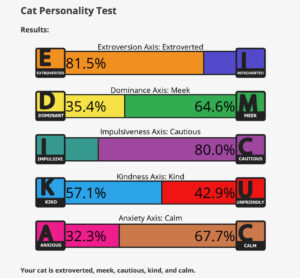
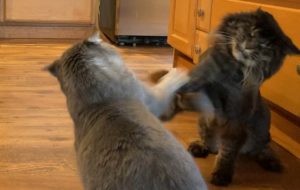
Recognizing different personalities in our cats can help us manage how cats get along in our multi-cat homes. Whereas two timid/shy cats may get along, two dominant cats can clash. A dominant cat and timid cat may suffer from a bully-victim relationship.
What are the personalities of your cats? Take the online test based on the “Feline Five” at https://www.idrlabs.com. (Search for “feline five”).
Citation: Litchfield CA, Quinton G, Tindle H, Chiera B, Kikillus KH, Roetman P (2017) The ‘Feline Five’: An exploration of personality in pet cats (Felis catus). PLoS ONE 12(8): e0183455. https://doi. org/10.1371/journal.pone.0183455


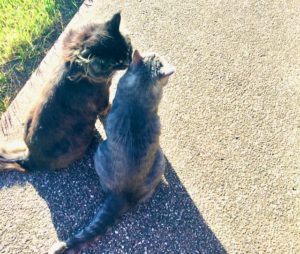
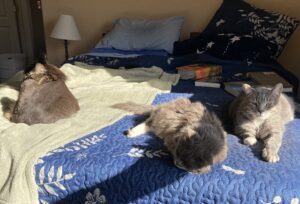 Cats don’t have to be “preferred associates” to choose a spot in the sun in the same room as a housemate cat. As long as there is plenty of space, peaceful coexistence should be possible.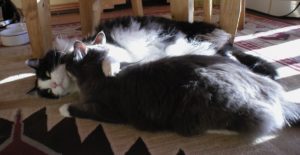
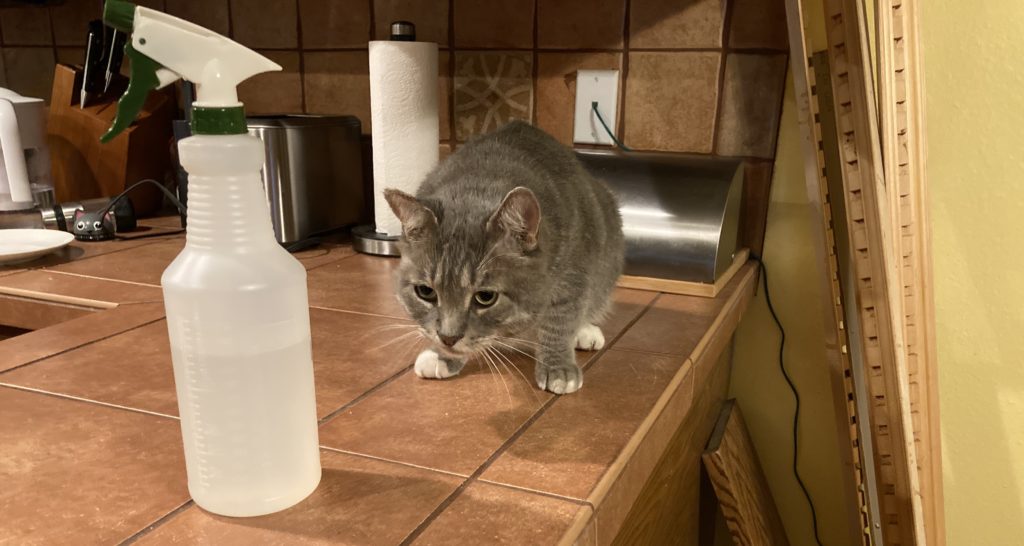 After adopting a feral cat 3 years ago, I am still struggling with cats on the counter. Gus spent most of his wild life dumpster diving, and hunting mice and bugs for food. He certainly would have availed himself of any food a good samaritan left out for the community cats. Understandably, the kitchen counter is a cornucopia of food as far as he is concerned.
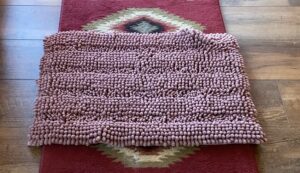 Choose a mat for your cat to sit on.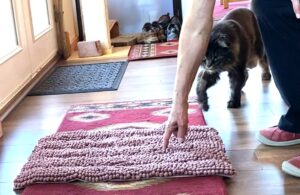
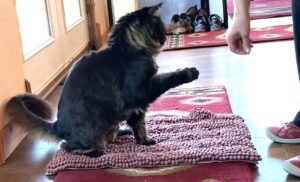
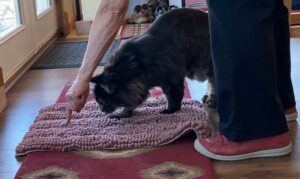
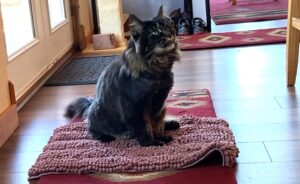 “Shape” the behavior by having her stay on the mat for increasingly longer periods of time.
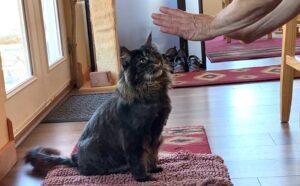 Establish a cue to let her know she can leave the mat.
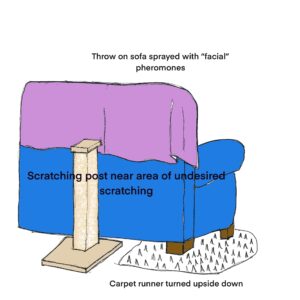 Use a synthetic pheromone spray such as “Feliway” Classic or Comfort Zone Calming. These are synthetic versions of the secretions cats deposit by rubbing their cheeks against things. To avoid staining your sofa, we can spray a throw or blanket that we drape over the sofa. Initially, you will need to spray this daily.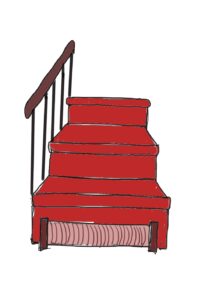

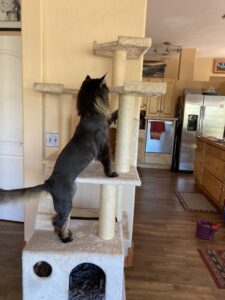 This tall cat tree is located in the interior of the house away from doors and windows. The younger cats (6 years), Zelda and Gus, use this tower to snooze on the upper levels or to get to the tops of the kitchen cabinets. Although it does meet the recommendations for the ideal scratcher, the cats don’t scratch on this tree all that much.
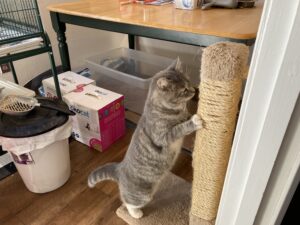
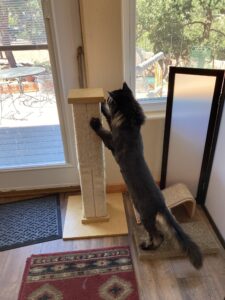 This very tall post (it is 41″) with sisal fabric is at the front door. It is popular with everyone, from the 17 lb Coon cat to the small senior at 8 lb. All four cats scratch before going out for a walk or when they sit to look out the window in the front door. The horizontal cardboard scratchers at the front door also see consistent use. The cats tend to use these with all 4 feet on the scratcher.
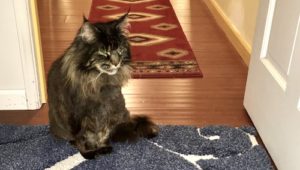
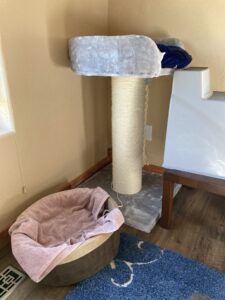 The sisal-covered base of this extra-large cat bed is tall enough for the large Maine Coon to scratch. This cat bed is located in the bedroom. It was purchased for the Maine Coon cat but has been taken over by 8 lb Athena, who sleeps in this bed or in her heated bed at the base of the scratcher. When she gets out of bed, she stretches and scratches on this scratcher. This is used infrequently by the other three cats.