Kittens at Kndergarten
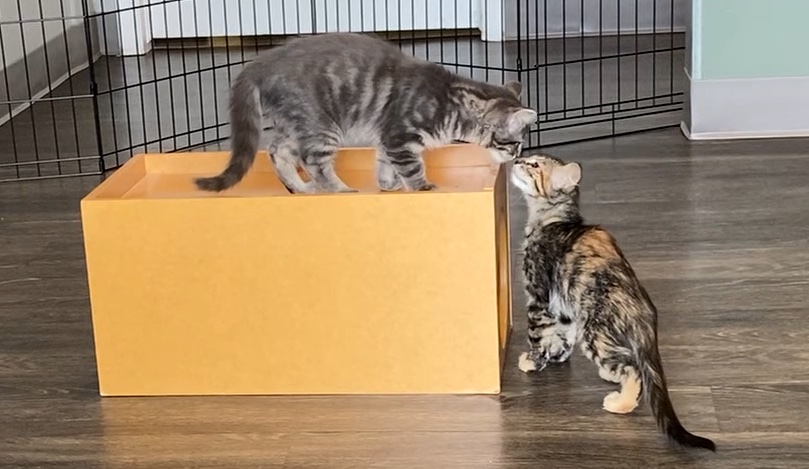
Kittens at “kitten kindergarten” session

What makes A good pet cat?


We will soon be entering “kitten season” in Colorado. Although cats indoors can breed at any time of the year, the wild cat population typically mates in January and February. The kittens will be born about 2 months later, during warmer temperatures when prey is more abundant.

Many of these wild kittens will end up at the shelter; some may be adoptable.

How do I know if a cat will be a good pet cat?


Nature and nurture are parts of the puzzle that determine how a cat will behave towards people.

Nature:

Nurture:

The science of epigenetics studies modifications to our DNA that don’t change the DNA sequence. The epigenome refers to chemical compounds that are attached to your DNA. Exposure to pollutants, what you eat and stress are some things that can result in certain compounds attaching to your DNA and turning particular genes on or off. These changes can remain as cells divide and may pass from generation to generation.

Nurture : The “Sensitive Period” in kittens


Kittens learn most efficiently when they are 2-7 weeks old.  This time is called  the “sensitive period”, when rapid growth of neural cells makes learning easier. The learning that happens during the “sensitive period” prepares a kitten for the social and physical environment she is born into. A cat who will be a good pet cat needs to be exposed to humans and where humans live during her “sensitive period”.

Human contact


Kittens who are handled kindly and gently by a variety of humans during the “sensitive period” quickly learn to accept people and enjoy being with them. The positively socialized kitten  generalizes what he learns about individual people to people in general.

Rough, insensitive handling during the “sensitive period” can make a kitten aggressive and fearful of people for life.

Exposure to Human households


Kittens exposed to the environment in human homes during the “sensitive period” adapt quickly to electronic devices and appliances, other animals, and living indoors. For example, they learn that the noise of the vacuum cleaner, although unpleasant, is not life threatening.

Diet


Kittens are more willing to try new foods at this time, although they follow their mother’s lead (if she is there) in choosing what to eat. Good nutrition helps a kitten’s brain and body develop – malnutrition early in life has been linked to epigenetic changes.


the end of the “sensitive period”


At 7 weeks, this “golden time” of learning closes – the fear reaction becomes established in the kitten. She will become more cautious and careful from now on. Caution and wariness are crucial to her development in the wild as a solitary hunter. She will continue to learn and develop socially but will not be as open to new experiences.

socialization after the “sensitive period”


By the time the sensitive period ends, kittens have been weaned and are eating solid food. In a wild cat colony, they will continue to play with other kittens and interact with adults. The kitten will learn how hard he can bite when playing- his litter mates will bite back! This is when he will learn the body language of adult cats, how to approach other cats, and improve his hunting skills by observing other cats.

thinking of adopting a kitten?


  • Think about adopting 2 – they can keep each other occupied and cats that grow up together often form strong bonds and a social group.
  • If possible, adopt kittens who are at least 12 weeks of age. These kittens will have spent some time with their mothers and litter mates, learning how hard they can bite when playing. They should also recognize some basic social signals given by adult cats (important if you are bringing them into a multi-cat home).
  • Above all – try to adopt kittens that were handled gently and kindly by people during their “sensitive period”. They are familiar with humans and enjoy being with them. Ask the adoption center about the kittens’ experiences when they were 2-7 weeks old!


If you opt to introduce kittens to older cats, SUPERVISE AT ALL TIMES. Make sure your older cats are vaccinated for upper respiratory diseases and feline leukemia (if they go outdoors). Gradual introduction is still recommended. A pair of kittens may still be your best bet in this situation and give you time to introduce all the cats at their own pace.


Want to keep up with the world of cats? Subscribe to The Feline Purrspective!
Subscribe

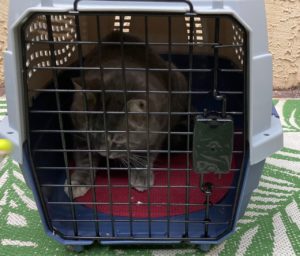
cat in carrier with removable topMany of us (cat owners) dread taking our cat to the vet. There is the ordeal of the carrier and car trip; once there, your cat seems miserable. However, regular veterinary care is the key to a happy and longer life for your cat. Can medication before your cat’s vet visit help?

Not every cat needs medication at the vet.  Some cats are fine just having some familiar things with them.  Familiarity can help reduce situational anxiety – the anxiety you experience when you are in a strange place. Things we can do to increase familiarity for your cat at the vet visit include:

  • Training her to be comfortable in her carrier
  • Choosing a carrier with a removable top to allow examination in her carrier
  • Getting her used to the car and taking her on some drives that don’t end up at the vet
  • Bringing your cat’s favorite treats
  • Spraying the carrier with pheromones (Feliway) before the visit

For some cats, this may not be enough. Your usually nice kitty becomes a raging demon or just freezes like a rock and doesn’t move – both reactions can be the result of anxiety and fear.

I recently took my youngest cat in a for a rabies vaccine and to have a tooth evaluated. Gus accepted handling and food but had a whopping heart rate of 230 beats per minute! He was anxious even though I was there with him.

We would like our cats to associate good things with going to the vet but they may not be feeling well when they are there or they anticipate getting poked with a needle for vaccinations or blood tests.  So, when the carrier comes out, your cat may associate it with negative emotions and understandably becomes anxious.

Anxiety actually has a function in our lives – worrying about something in the bushes pouncing on you probably saved a lot of cavemen and feral cats; anxiety can improve your physical and mental performance. But anxiety at the vet clinic does not benefit your cat and can actually make things worse. An unpleasant visit can become an unpleasant memory.

Medication before your cat’s vet visit


Have you ever had elevated blood pressure at a doctor visit?  Anxiety before medical appointments is common for people as well as cats.  Because cats don’t speak human language, we can’t reassure them and let them know exactly what is happening. It is worth considering medication before your cat’s vet visit to help reduce his anxiety.

Gabapentin and trazodone are two medications commonly used to reduce the stress of the vet visit.  These medications must be prescribed by your veterinarian.

Gabapentin


  • Developed as an anti-convulsant
  • Has anti-anxiety properties – reduces the release of excitatory neurotransmitters
  • Is a pain reliever

Gabapentin is commonly used in the veterinary practice to reduce anxiety in cats.  There have been a few studies evaluating fear and stress in cats having taken gabapentin – these studies found a reduced CSS (cat stress score) after administration of gabapentin.

The typical dose is 100 mg given 1.5 – 2 hours prior to the vet visit. Frequently, a dose is also given the night before. Doses can vary for individual cats – some cats may do well with a 50 mg dose while others may need 150 mg.

Gabapentin is available in capsules, liquid and small tablets.

  • Capsules: The capsule is opened and the powder is mixed in a small amount of tuna fish or canned cat food. Gabapentin is bitter and some cats may not eat it in food. The capsules may also be given using a pet piller or a squeeze up treat.
  • Liquid: The liquid may result in foaming at the mouth.
  • Tablets: Gabapentin can also be compounded into small, flavored tablets – these can be given in pill treats.

Your cat may be a little sleepy or wobbly after taking gabapentin. You may want to watch kitty near the stairs or jumping up on things!

Gabapentin is a pain reliever for cats – reducing pain may be one of the ways it helps reduce anxiety and fear


Trazodone


  • Antidepressant that is commonly prescribed for insomnia and depression in humans
  • One of its side effects is drowsiness

There have been a few studies looking at cats receiving trazodone. One study in particular found that the CSS (cat stress score) was the same in the treated group as the group receiving the placebo. So, trazodone appears to be more of a sedative (makes you sleepy) than an anti-anxiety drug.

Typical dose is 50 mg given by mouth 90 minutes before the stressful event.

  • Can result in lower blood pressure in cats
  • There is a risk of serotonin syndrome if used with other anti-depressant medication such as fluoxetine (Reconcile).
  • Available as a tablet or can be compounded into a liquid or capsule form.


There is increased interest in identifying medications to reduce stress and anxiety in cats at veterinary visits. We should expect to see more medications becoming available in the near future.

Medication before your cat’s vet visit can be part of a low-stress veterinary visit.  However, it will be most effective  when combined with training to reduce situational anxiety and low-stress handling techniques.

As for Gus, I will make sure to give him some gabapentin before vet visits.

Want to keep up with the world of cats? Subscribe to The Feline Purrpspective!


Subscribe


Invitation to play
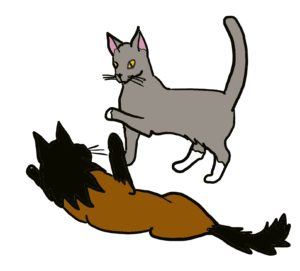
artwork by Phyllis Meyer

It’s fun to watch cats at play – pouncing on each other, wrestling and chasing after one another. But some of these behaviors are similar to fighting – how do you know when cats are playing or fighting?

A group of cat behavior researchers (Reference 1) posed this question recently. Previous research has focused on what the cat is playing with – an object, another cat? These researchers classify play according to the emotions and motivations of the cat.  They have coined the phrase “mutual social play” and have listed the behaviors that are characteristic of mutual social play between cats. This list will help us decide if our cats are playing or fighting.

“Play” has many different definitions. The Oxford English Dictionary defines “play” as “engag[ing] in activity for enjoyment and recreation rather than a serious or practical purpose”.

Cats at play – what are they playing with?


Object play


  • Chase a ball
  • Throw a catnip mouse into the air
  • Pounce and attack another cat’s tail – although the cat is playing with another cat, this play treats the other cat’s tail like an object.

Social Play


  • with other cats
  • with other animals (including humans)

Kittens practice hunting skills and improve their coordination through play.  Play helps adult cats explore their environment and engage in social relationships in a way that’s fun for them.

Let’s return to our original question – play between cats can look pretty rough. How do we tell whether cats are playing or fighting?

The body language of cat aggression


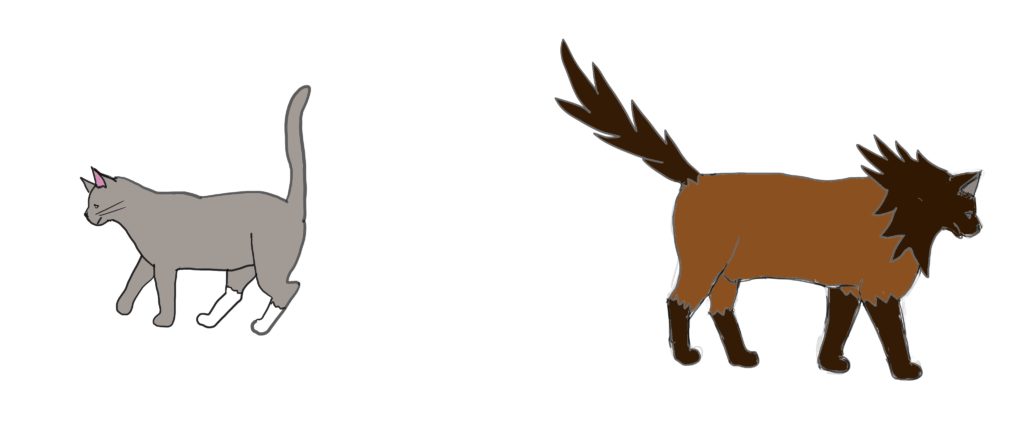
There is nothing as dramatic as a cat fight. Two cats face off, fur standing on end, yowling and spitting. Often, one cat may slowly move away, all the time presenting his side to the other cat (to look larger); his back may be arched. Depending on the motive for the standoff, the remaining cat may just stand his ground and allow the other to leave or he may pounce, and the two cats grapple each other, biting, clawing, kicking, and the “cat ball” rolls away until it stops and both cats take a breather.

Kittens practice these fighting postures when they play with littermates. You can see them arch their backs and sidestep. However, as kittens reach 12 weeks or so, the arch and sidestep (Reference 1) are seen less frequently. This is most likely because the kittens are starting to identify these postures as aggressive, as part of a cat fight.

Although kittens will continue play together, they start to become more interested in playing with objects around 10-14 weeks of age. They begin to focus more on capturing prey and getting food for themselves.

Cats at Play – Mutual Social Play


Adults cats also play, although play becomes less frequent as cats grow older.

The function of play is to build pro-social brains, social brains that know how to interact with others in positive ways,” said Jaak Panksepp, a noted neurobiologist.

Mutual social play

  • Is reciprocal, that is the participants want to play with each other
  • The participants enjoy the interaction
  • The participants exercise social skills that can be used in other social interactions

Cats at Play: the body language of mutual social play


In mutual social play, there should not be much vocalization such growling or hissing; claws are generally sheathed and biting is gentle, without intent to injure. There are lots of pauses.  Play starts with an invitation and ends by mutual consent.

Invitation to play


Two cats face each other – one may roll over on his back showing his belly. The other cat can be standing close over the first cat – the tail is often up. One cat may reach out and tap the other cat with his paw.

Play


Cats chasing each other

The invitation is often followed by a pounce and the two cats may engage in bouts of wrestling and chasing. The cats will switch roles. They may repeat the “invitation” to continue the play session.

end of play


Play is overPlay usually ends with one cat standing facing the other cat, who may be on his/her side, or there is a chase sequence that just dies off, with the cats walking away from each other.

When cats at play begin to fight:


What starts as mutual social play can sometimes turn into a cat fight.

What to watch for:


  • There is no reciprocity – cats are no longer taking turns pouncing and chasing
  • Increase in vocalization – hissing, growling
  • You start to see “distance increasing postures”:  standing sideways, arching back, fur on end


what to do: separate the cats


  • Distraction – If a bag of cat treats is at hand, shake it.  Try pulling a toy on a wand or shining a laser pointer on the floor between the two cats.
  • If hostilities are not too far advanced, try tossing treats in opposite directions
  • Use a towel or piece of cardboard to herd the cats away from each other
  • Give the cats a “cool-down” period in separate rooms

Above all, avoid handling the cats – cat bites and scratches can easily become infected and require medical attention.

Play can be part of the “social glue” that keeps a social group of cats together. Keep an eye on interactions between the cats in your home – particularly ones between cats of different social groups. Make sure to not to confuse fighting with mutual social play!

references

  1. Gajdoš Kmecová Noema, Pet’ková Barbara, Kottferová Jana, Skurková Lenka, Mills Daniel S.  “Are These Cats Playing? A Closer Look at Social Play in Cats and Proposal for a Psychobiological Approach and Standard Terminology”  Front. Vet. Sci., 23 July 2021. Sec. Animal Behavior and Welfare Volume 8 – 2021 | https://doi.org/10.3389/fvets.2021.712310

Want to keep up with the world of cats? Subscribe to The Feline Purrspective!

About a week ago, we had invited family members to the traditional Thanksgiving dinner. Appetizers had been set out to snack on prior to the main meal. There was a cheese and cracker plate, with an open box of crackers on it, where folks could serve themselves, taking a cracker and a slice of cheese.

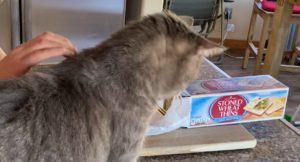
As we were eating dinner, I happened to look over to the counter with the cheese plate. Gus had gotten up on the counter, and was helping himself to a cracker. He very carefully selected a single cracker with his mouth without disturbing the other crackers, the plate or the box. He then carefully backed away to nibble on his prize.

What struck me was that he only took one cracker, he did not paw at the box or knock it on the floor. Had he been watching us? Can cats learn from us?

Trial and Error Learning


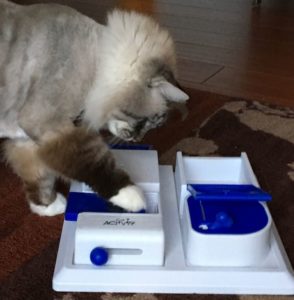
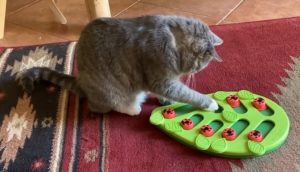
A cat presented with a treat ball containing treats for the first time will examine and smell the ball thoroughly, then perhaps nudge it with her nose while continuing to smell the ball. If some treats come out, the cat may then try nudging the ball again or try pawing at it. With each trial, the cat will refine her method of obtaining treats.

Social Learning – Can cats learn from us?


Cats can also learn by watching other cats do things – kittens watch their mother attentively as she manipulates prey and chooses things to eat. Their later success as hunters and the food preferences they develop reflects this instruction.

For the cat, other species are worth watching too – for example, humans, dogs and raccoons may give some invaluable lessons in manipulating doors to reach food or desirable places.

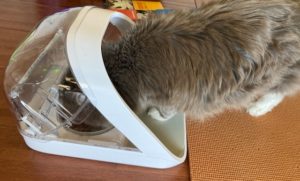
A cat will learn to use a microchip feeder or food puzzle faster if a patient owner sits by with treats and demonstrates the feeder or puzzle operation, speeding up the trial and error process.

“Do As I Do”


“Do As I Do” is a fairly new training method for dogs developed by Claudia Fugazza at Eötvös Loránd University in Budapest. In the “Do As I Do” method, an owner will demonstrate a behavior to her dog and then ask him to repeat it.

Can a cat “Do As I Do”?


In 2019, Dr. Fugazza decided to test this kind social learning in a cat. Her subject was an 11-year-old female cat, called Ebisu. Ebisu lived with her owner, Fumi Higaki, in Ichinomia, Japan. Fumi Higaki is a professional dog trainer, experienced in the “Do As I Do” method for training dogs.

Training Ebisu was a two-step process:

  1. First, Ebisu learned that the “Do It!” command meant that she should copy what her owner had done. The owner used three behaviors that Ebisu already knew to train the “Do It” command. For example, the owner would twirl around, then give Ebisu the “Do it!” command and also give Ebisu the verbal cure to twirl around.
  2. Next, the owner demonstrated three other behaviors that Ebisu was familiar with and gave her the “Do It!” command without the verbal cues. Once Ebisu successfully imitated her owner, she was ready to learn some new behaviors by copying her owner.

Ebisu successfully learned two new behaviors through imitating her owner:

  1. Sliding a lid on a container to open it – Ebisu succeeded on the first try!
  2. Placing her forearms on a book.

At this point, Ebisu was judged ready to be tested and two new behaviors were assessed in 18 test trials:

  1. Placing her paw on a box
  2. Rubbing her face on a box

During these trials, Ebisu mimicked her owner 80% of the time.  Fumi would put her hand on the box (or rub her face on the box).  She would then tell Ebisu to “Do It!”, and Ebisu would put her paw on the box (or rub her face on the box).

So what do we learn from this?

  • Cats are able to mimic the actions of a human.
  • They are able to adapt human actions to their own bodies – for example, the human touches a box with her hand and the cat touches the box with a front paw.

So, it is worthwhile for us to demonstrate the operation of food puzzles, automatic feeders, cat doors…to help our cats learn how to use these devices.  It should speed up the learning process!

Back to “cracker snatcher” Gus…can cats learn from us?


I really don’t know if Gus learned to pick out a single cracker by watching people but it’s fun to think that he did. And, not having opposable thumbs, he was not able to pick out the cracker with a paw but instead extracted it with his mouth, adapting the action so that he could perform it successfully!

Here is Gus with the box of crackers. Enjoy the video!

Want to keep up with the world of cats? Subscribe to The Feline Purrspective!

 

Subscribe

art by Cal Meyer

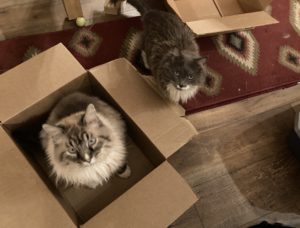
Cats and boxes are a purrfect combination.  An enclosed space like a box can be a safe place, help keep a cat warm and give him a vantage point to ambush “prey” (unfortunate insects, catnip mice…). Boxes are also popular with other animals – big cats are often given boxes for enrichment at zoos and refuges; dogs also like boxes to play in but some may tend to chew the box up!

Cats will also sit on just about anything, comfortable or not. Anyone who does craft projects well knows that once the fabric is out to be cut, a cat will be sitting on it soon enough. Years ago, cats sat on newspapers if you tried to spread the paper out on the table – nowadays, they park on computer keyboards. Some of this is attention-seeking behavior – Zelda only lets me type so long Sunday mornings before she gets up on my desk and threatens to contribute to the post if I don’t take her for her morning walk.

In 2009, the USPS came up with the Christmas slogan, “If it fits, it ships”.  A few years later, a variant of the slogan became an Internet cat meme: “It it fits, I sits”.  This gave rise to posts of cats in all sort of places, from egg cartons and shoeboxes, to bowls and sinks.

The Internet exploded again in 2017 as people used tape to outline squares on the floor for their cats to sit in. Cats were “trapped” in all manner of taped shapes, with cat experts offering explanations ranging from cats reacting to new smells (from the tape) to survival instinct, where the cats must investigate something new (the taped square) to determine if it poses danger to them.  Some felt that the taped square offered the cat a sense of security, much like a real box.

The phenomenon did not stop here – in 2020, during the COVID pandemic, a woman in the Philippines photographed stray cats practicing “social distancing” – the cats sat on circles painted on the ground 6 feet apart outside a food market.

cats and boxes: optical illusions


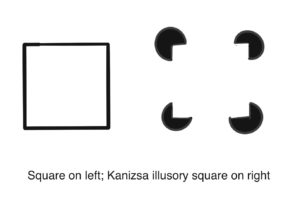
It is not surprising that cats in taped squares became the subject of a research study investigating cats’ responses to optical illusions. In a two month study in June-August of 2020, researchers at Hunter College enrolled over 500 cat owners to participate in a study to assess cats’ responses to a taped square, a Kanizsa square (which gives the illusion of a square), and a control figure.

Enrolled owners were sent booklets containing pairs of these shapes that they affixed to the floor.  The owners then took videos of their cats’ responses to the shape-pairs and submitted the videos to the research team.  They were to do this once daily for 6 days.

The results found that of the 30 cats that completed all six trials of the experiment, only nine of them “participated”, that is, sat in one of the shapes. These cats were just as likely to sit in the taped square as the Kanizsa square. Only once did one of the cats choose to sit in the control shape.

What does this tell us about cats? Are they susceptible to the optical illusion of a square? Do they recognize it as a square? I think more research will have to be done:

  • Only 9 out 30 cats actually sat in the shapes.
  • Cats are not as tall as we are and don’t see well close up. Can they see the squares from their vantage point?
  • I, for one, would like to know how many cats will voluntarily sit in a taped outline – I tried leaving a hula hoop out on the floor to see if any of my four cats would voluntarily sit in the circular outline. I did not have any takers!

This study is the first to use “citizen scientists” (the owners) to observe the cats in their home environments, thereby avoiding stress-induced behaviors that cats can exhibit in unfamiliar settings, such as a laboratory.

Back to cats and boxes…


Cats are practical. They prefer their owners to their owners’ T-shirts. I feel that they would prefer a physical box to a taped outline. A box is a great source of enrichment – it can be a bed, a den, it can be place to hide while ambushing a toy mouse going by. Shelter cats acclimate to their surroundings more quickly when provided a box to hide in.

Boxes that are too small to allow a cat to hide may make him feel good by putting physical pressure on his body, like when we wedge ourselves in the corner of the sofa watching a favorite TV program.  Pressure on soft tissue has been shown to promote relaxation and reduce anxiety in both humans and animals.

So, make sure your cat has a safe place – a place he can call his own, a place that is secure, secluded, a hiding place to retreat to, warm in the winter, cool in the summer. It can be a cardboard box in a closet or in a secluded corner!

Want to keep up with the world of cats?  Subscribe to The Feline Purrspective!
 

Subscribe

Identifying signs of cat dementia is not always straightforward. In the hubbub of daily life, behavior changes can be subtle and go unnoticed until they are more severe.

Changes in behavior can indicate if your cat’s mental state has changed. The acronym VISHDAAL summarizes the behavior changes we need to observe to care for our senior cats.

V = changes or increase in vocalization
I = changes in interaction with us and other pets
S = changes in sleep-wake cycle: restlessness, night time activity
H = housesoiling
D = disorientation and confusion
A = changes in activity
A = anxiety
L = learning and memory

Three cats – three outcomes


rupert, 18 year old neutered male siamese

Cat on sailboat


I had two senior Siamese cats when I had my first child.  A first-time mom, I was frazzled, dealing with the completely new experience of parenting and was not paying as much attention as I should have to my cats.

One day, an acquaintance asked why one of the cats, Rupert, was sitting on the kitchen counter, in a corner, facing the wall. I had been aware that he did that sometimes but when I paid closer attention, I found that he would eat in the morning, use his litter box and then spend the day on the counter, facing the wall. He would come down to eat, drink, and use the litter box but always returned to the counter.

Behavior Changes – signs of cat dementia?

  • I – Rupert was no longer interacting with us.
  • D – He seemed confused and “out of it” – sitting on the counter all day
  • A – His activity had changed – he did not move much from the counter

Diagnosis:

Rupert had lost quite a bit of weight, although he was eating well. My vet diagnosed him with hyperthyroidism, which was a new disease in cats at that time.

Outcome:

Use of radioactive iodine to treat the disease was pioneered about 10 years earlier but it was not commonplace. Surgery was an option but at 18 years of age, Rupert was not a good candidate for surgery and we elected euthanasia due to his declining Quality of Life.

The Takeway:

I suspect that Rupert had moderate to severe cat dementia. The symptoms were most likely apparent earlier and I just did not recognize them. Nowadays, drug therapy for hyperthyroidism is readily available – methimazole is an FDA approved treatment for hyperthyroid cats. Perhaps treatment of the hyperthyroidism would have reduced the symptoms of cat dementia enough for Rupert to have had some more time with us.

Athena, 16 year old spayed female


Athena had been slowing down over the past year, was not eating as well and was spending most of her time sleeping. We had provided her with steps to access window perches and our bed; we also provided her with a heated bed.

Behavior Changes – signs of cat dementia?

  • I – Although still willing to play, Athena was interacting less with us; she had previously been a “nosy, busybody” kind of cat.
  • A – Athena no longer went on her daily walk and was less active in general

Diagnosis:

Diagnostic blood work did not show any significant changes over the past year. Athena did not show other signs of cat dementia and would still learn new tricks when hungry for treats.

X-rays showed moderate to severe arthritis in one of her hips and knees. We decided to treat her arthritis pain with the drug gabapentin.

Outcome:

Treatment for her arthritis pain has been a game changer for her; her activity level has increased, her appetite has increased, and she is back to “being in your face” when she wants something.

The Takeaway:

Regular checkups and treatment of chronic conditions can make you and your cat happier! Some symptoms typical of dementia may be due to treatable, medical conditions.

Marley, 15 year old neutered male

cat with food puzzle
Marley works the Poker Box, a food puzzle.

Marley is a friendly, affectionate cat with good health overall. In the past several months, Marley showed some of the behavior changes that we need to monitor in senior cats.

Behavior Changes – signs of cat dementia?

  • I – Marley had become more clingy than usual and more interactive
  • D – He seemed confused when playing the nightly game of “treat toss” – he seemed to forget that he was chasing a treat!
  • A – He did not want to walk outside with us (which he has been doing for years).
  • A – He seemed anxious and a little fearful. His interactions with the other cats became timid.

Diagnosis

Marley’s senior exam and blood work did not reveal any abnormalities other than a slight decline in kidney function which could be expected at his age.

Marley appears to have some mild cat dementia. Since these changes were mild, we decided to try SAMe, a dietary supplement. SAMe has been shown to be effective at reducing symptoms of dementia in cats in the early stages of cat dementia.

Outcome

About 2 months have gone by with daily supplementation. Marley is taking his daily walk again and is not as clingy with his humans. He is no longer stand-offish with the other cats and is “catching” his treats again when we play the nightly treat toss.

A Final Word…


Cat dementia cannot be cured but it can be managed. With early diagnosis, appropriate environmental modifications, dietary supplements, therapeutic diets, and medication can help can reduce the symptoms of dementia and improve Quality of Life for both you and your cat.

Want to keep up with the world of cats? Subscribe to The Feline Purrspective!

Subscribe

Cat using food puzzle

At the veterinary clinic where I work, I often hear people say when I ask about their cat’s activity and play, “she sleeps most of the time and meows a lot at night. She doesn’t play – she’s an older cat”. How much of these behaviors is due to “normal” aging? How much is due to other medical conditions or a declining brain?

Cognitive Dysfunction Syndrome in cats or cat dementia refers to the decline in mental abilities associated with aging.

Cat dementia results from damage to the brain.  As your cat ages, the the numbers of molecules called  free radicals are no longer balanced out by the antioxidants in his body. These free radicals are reactive and cross the blood-brain barrier, damaging cells in the brain.

Changes in blood flow to the brain can also cause damage by starving the neurons of oxygen.  High blood pressure, heart disease, anemia – are all conditions that alter the flow of blood to the brain.

How can we tell if our cats are undergoing mental decline? Is there anything we can do about it?

VISHDAAL – behavior changes


Changes in behavior can indicate if your cat’s mental state has declined. The acronym VISHDAAL summarizes the behavior changes we need to monitor in our senior cats, from the most prevalent (vocalizing) to least frequent (changes in learning and memory).

V = vocalization
I = changes in interaction with us and other pets
S = changes in sleep-wake cycle
H = house soiling
D = disorientation
A = changes in activity
A = anxiety
L = learning and memory

How do we sort out behavior changes due to disease and those due to declining mental capacity?

Changes in behavior signal the onset of cognitive decline but they may also arise from other health issues:

  • Cats with untreated high blood pressure or hyperthyroidism may meow at night (vocalizing).
  • Cats with untreated hyperthyroidism may be restless and beg us for food (changes in interactions and sleep).
  • Kidney disease can be accompanied by increased thirst and urination which may result in house soiling (house soiling)
  • Cats with osteoarthritis may have difficulty accessing the litter box (house soiling).

behavior changes: disease vs Dementia


Regular veterinary exams and diagnostics can identify medical conditions such as high blood pressure, hyperthyroidism, and osteoarthritis.  If behavioral changes persist after treating these other medical conditions, your cat may have CDS or cat dementia. 

Cat dementia is a “diagnosis of exclusion” – it is the diagnosis that remains after all the other possible diagnoses have been eliminated. Cat dementia will usually have a slow onset and behavioral symptoms will gradually get worse.

Cognitive Dysfunction (CDS) cannot be cured but management can reduce the symptoms and improve the Quality of Life for both you and your cat.

managing cat dementia


  • environmental enrichment/modification
  • dietary supplements
  • therapeutic diets
  • medication

Environmental enrichment/modification


In the early stages of cat dementia, enrichment increases mental stimulation, leading to the growth and survival of neurons, preserving the thinking processes.  Enrichment should be tailored to the individual cat.  For example, some cats prefer high places; others are “ground dwellers”.  Arthritic cats will not have the range of motion of healthier cats but will still enjoy play that does not require lots of jumping.

Ways to enrich your cat’s environment:

  • play – interactive play and toys
  • scent enrichment – catnip, silvervine
  • food puzzles
  • motion – climbing (cat trees) and exploring (cardboard boxes)
  • supervised outdoor access

As CDS progresses…

Environmental changes become stressful and confusing. Cats with severe cat dementia need an environment that does not change much – daily routines and feeding schedules must be maintained. Litter boxes and feeding stations need to stay in the same place.

A cat with severe CDS may benefit from a “room of his own”, with easy access to his resources. Changes that need to be made must be done slowly. If you need to move a litter box or feeding station, do it gradually over a number of days so the cat can still find it.

Environmental modifications

Modifications to the environment of the cat with dementia should take into account the behavior that she is exhibiting.

  • Cats that constantly beg for food may benefit from a timed feeder at night or treat balls. 
  • Cats with house soiling tendencies may need more litter boxes and ones that are easily accessed, with a lower entry for example. 
  • Cats that become disoriented and confused may benefit from a night light and radio playing soft music.

Dietary Supplements


Dietary supplements in general seek to restore the balance between the activity of antioxidants in the body and the  production of free radicals.  Antioxidants give up electrons to the free radical, effectively “neutralizing” it so that it is no longer reactive. So, these supplements usually contain antioxidants.

SAMe: (S-adenosyl-methionine)  aids in the production of glutathione, an antioxidant. When elderly cats were supplemented with SAMe, there was improvement in cognitive tests. SAMe is best used pro-actively – it is most effective in cats in the early stages of cat dementia.

Proprietary supplements containing vitamins, resveratrol (antioxidant), and fish oils are on the market but there is no clinical data testing cats for these at this time.

other supplements


Melatonin: hormone in the body that is thought to promote sleep. It also has antioxidant properties. Melatonin declines with age.

Pheromones (Feliway), Zylkene, Anxitane (L-theanine) may help reduce anxiety in cats that are disoriented and may promote sleep.

Therapeutic diets


Therapeutic diets containing antioxidants and fish oils have been shown to help cat dementia. 

  • Feline Mature adult Hill’s Pet Nutrition
  • Purina Pro Plan Age 7+
  • Hills prescription diet j/d with fish oil for osteroarthritis

Diets that reduce anxiety may also help with cat dementia

  • RC Calm diets
  • Hill’s urinary support

Medications


Selegiline: licensed to treat dementia in dogs. Like the dietary suplements, it aims to reduce the production of free radicals.  Selegiline stimulates the production of enzymes that eliminate free radicals.

Anxiolytics: Prozac, gabapentin and clonazepam are used to treat dementia by reducing anxiety.

boxes as enrichment for cats
Boxes can be source of enrichment for senior cats.

If you feel there has been a significant change in your cat’s behaviors, keep a journal or log and make sure to mention it at her next senior exam. Start the conversation with your vet about cat dementia and how to manage it!

Want to keep up with the world of cats? Subscribe to The Feline Purrspective!
Subscribe


Cats greet other friendly cats by sniffing them first, before engaging in other social activities such as rubbing against each other or grooming each other’s heads. Scent is a way that members of a cat colony identify each other.

We are members of our cats’ social groups and they identify us by our  scent. They greet us by sniffing and rubbing against us. When leaving your cat at the vet or boarding facility, you may be asked to bring a blanket or t-shirt with your scent on it.  Does your scent comfort your cat when she is away from you?

Recently, researchers at Oregon State University tried to test whether such an object actually reduces a cat’s anxiety when her owner is gone. In this study, owners of 42 cats were asked to bring an unwashed object with their scent on it. Scent objects could include the owner’s shoe, sock, night shirt, or blanket.

The test started by evaluating the cat’s attachment to his/her owner – secure or insecure?
The owner would then leave: in some trials, the scent object was left behind; in others, the cat was alone.

The cat’s behavior was evaluated:

  • when he was with his owner
  • when he was alone with the scent object
  • when he was alone without the scent object
  • when his owner returned

Measuring attachment
Psychological attachment is measured using the Secure Base Test. The cat and owner are placed in a strange room for a few minutes; the owner then leaves for a few minutes and returns. The cat’s behavior is observed when the owner is present, when cat is alone, and when the owner returns.

Securely attached cats
willing to explore when Owner is present
continue to explore after Owner leaves
greets Owner on return but continues to explore and play

Insecurely attached cats
reluctant to explore even with Owner present
sit with Owner or hide in corner
do not explore when Owner leaves
may or may not solicit contact with Owner on return

Does your scent comfort your cat when you are not with her?


Researchers took videos of the sessions, recording how often cats vocalized, rubbed on their owners or the scent object, and how long they would stay close to the owner or scent object.

Researcher’s predictions


  • Cats would prefer their human caretaker over a scent stimulus alone.
  • Insecurely attached cats would interact with the scent object more than the securely attached cats.
  • Cats would be comforted by their owner’s scent.

what actually happened


  • Cats preferred their owners over the scent object – they vocalized less when owners were with them and rubbed on their owners
  • Insecure cats did spend more time close to the scent object than secure cats but only 4 of the 42 cats actually rubbed the object
  • The scent object did not seem to alleviate anxiety – cats vocalized just as much when alone with the scent object as they did when alone without the scent object.

Cats communicate in a large part by smell. They identify other cats and their owners by their scent and greet them by sniffing them and rubbing against them. To your cat, your t-shirt smells like you but does your scent comfort your cat the way your physical presence does? The answer is no according to this study.

Your t-shirt is not the same for your cat as a teddy bear that a young child clutches to face the world. The teddy bear is a “transitional object” that helps a human child become less dependent on his parents and learn to relate to other people.

Your cat is attached to you – not your t-shirt. It won’t hurt to leave the t-shirt at home when going to the vet or boarding facility.

Other Thoughts


 A cat’s territory where she feels safe is marked with her own scent. Providing your cat with a blanket from home with her scent might make her less anxious.

Want to keep up with the world of cats? Subscribe to The Feline Purrspective!


Subscribe

Moving can be hectic and stressful for both people and pets. When you move your cat, he is uprooted from his territory, a place where he feels safe and secure – where he can rest, has shelter, and is safe from predators. What do you need to consider when unloading the boxes and positioning the furniture?

Setting up a cat-friendly home can help reduce the stress of the move and help your cat quickly establish her new territory.

setting up a cat-friendly home


The American Association of Feline Practitioners (AAFP) list five things that make a healthy environment for a cat.

  1. Resources : food, water, litter box, shelter
  2. Safe access to resources
  3. Environment that respects the cat’s sense of smell: territory
  4. Human interaction: predictable
  5. Predatory behavior

Needs of Domestic cats

  1. If we organize these needs in a pyramid diagram, the lowest tier includes those needs essential to survival: food, water, and litter boxes.
  2. The next level ensures that these essential resources are available to each cat to use safely, without fear. We cat owners must provide multiple, separate feeding and watering stations and litter boxes.
  3. Another of the AAFP requirements is that the environment respects the cat’s sense of smell.  Such an environment is the cat’s territory. Cats will mark walls and furniture in the home with scents from glands in their faces and mark scratching posts with scents released when scratching. Your cat belongs to his territory.
  4. The final two tiers deal with how we interact with our cats and…
  5. Offering them an opportunity to exercise their hunting skills.

The first three tiers are ones that are physically affected by moving from one place to another.

  • Where do you locate litter boxes and feeding stations in your new home?
  • Where can you locate safe places for your cat to chill, nap and keep on an eye on the household?
  • How do you help your cat establish a territory and maintain the scent profile of the home?

I have recently moved from my townhome of 13 years into a 2 story, unattached house. Placing cat resources is a work still in progress – here is my “first cut”. Join me and take a look at the placement of my cats’ resources and the pros and cons of my choices. I hope you enjoy The Purrade of My Home!

Want to keep up with the world of cats? Subscribe to The Feline Purrspective!


Subscribe

a cat is examined in her carrier
A cat is examined in a familiar place – the bottom of her carrier.

The other day a client brought her cat in for an exam and vaccines. This cat had been previously seen at the clinic and had been aggressive toward the veterinary staff and the owner. She had been prescribed gabapentin to reduce anxiety when coming in for vet visits. Gabapentin is bitter, so some cats will not eat it in food and may need to be given the pill.

The owner was unable to get her cat to eat the powder in food and brought the cat in unmedicated. This cat was in a soft carrier and was striking with her front paws at the carrier sides when approached. When cats are in a negative emotional state as was this cat, the two ways available to the veterinary professional to try change the emotional state are food and play. This cat was having neither.

A dilemma – proceed with the visit?


the veterinary staff


If we move forward, glove up and use thick towels, we can immobilize the cat and perhaps administer vaccines. Being in the soft carrier, she would be difficult to get out, but we could give the vaccine through the mesh sides, although there would be the risk if she wiggled loose a vaccine intended to go under the skin could end up in the muscle.

the cat’s point of view


When presented with a threatening scenario, a cat has three options: 1) flight 2) fight 3) freeze (learned helplessness).
The cat in question was in a carrier in an exam room so flight was out of the question. She decided to fight, which she was ready to do,  striking at the carrier sides when the owner or veterinary staff approached.

Imagine being snugly enveloped by towels, you can’t see what’s going on nor can you move. Some cats will continue to thrash, kick, and bite; other cats will give up at some point. The exam may be very brief, perhaps just measuring the heart rate through the towel. Whether the cat continues to fight or gives up, the experience is negative. If the cat perceives that fighting is successful – after all, she goes home after the struggle –  she may fight even harder on the next visit. The cat will stick with a strategy she thinks works.

the stress of the vet visit


So many owners are stressed about how their cat is treated at the vet clinic, they try to avoid bringing the cat in until it is absolutely necessary. Sometimes, to the cat’s detriment, health conditions have worsened by the time the cat receives medical care.

owner’s stress


  • The cat hides under the bed when the carrier comes out.
  • The cat has to be “dragged” out from under the bed.
  • The cat does not want to go into the carrier.
  • The cat cries constantly on the way to the vet.
  • The owner anticipates that the cat will be difficult and sedation will increase the cost of the visit.

the cat’s stress


  • You are placed in a box that you associate with fear and anxiety.
  • Your box (with you in it!) is placed in a larger box that moves and smells funny.
  • You are frightened, may be nauseated, or may soil yourself.
  • The vet clinic smells of other frightened animals.
  • You are handled by strange humans.

Each time “heavy restraint” is used, a cat often becomes increasingly aggressive, until the exam and treatments have to be done under anesthesia.

Cat friendly handling – breaking the cycle


Cat friendly handling is geared toward following the CAT handling guidelines.

  • Give the cat as much choice and control as possible.
  • Pay attention  to the cat’s body language and tailor the handling to the individual cat.
  • Touch the cat where he prefers to be touched.
  • Positive Reinforement: Make unpleasant procedures (vaccines, sample collection) worthwhile to the cat, offering food or head rubs.

Low Stress vet visits require that the veterinary staff and cat owner work together as a team.  Cat friendly handling begins at home and continues when the cat and owner arrive at the vet clinic.

“A BETTER VET VISIT FOR YOUR CAT


  1. Train your cat to comfortable in her carrier. Consider a carrier with a removable lid so that she can at least be examined in the safety of her “home away from home”.
  2. Desensitize your cat to riding in the car – take a drive around the block where you don’t end up at the vet.
  3. If the veterinary team recommends an anti-anxiety “cocktail”, figure out how your cat will take it. Consider training your cat to accept medication.
  4. If your cat has a favorite treat or food that he likes, consider picking up his food the night before for a morning appointment or in the morning for an afternoon appointment. Bring the treats along and offer them to the staff to feed kitty during his exam or procedures.
  5. Choose a Cat Friendly Practice where the staff have had some training in cat friendly handling.

What happened with the cat we talked about earlier?


The owner felt that a cat-only practice made her cat more reactive. We elected not to proceed with the exam and suggested the owner find a clinic that was a better fit. We can only hope that the cycle of aggression will be broken.

Like taking a toddler to the doctor, the vet visit can be scary for your cat. Cat friendly handling can make the visit less stressful for both you and your cat!

Want to keep up with the world of cats? Subscribe to The Feline Purrspective!

Subscribe