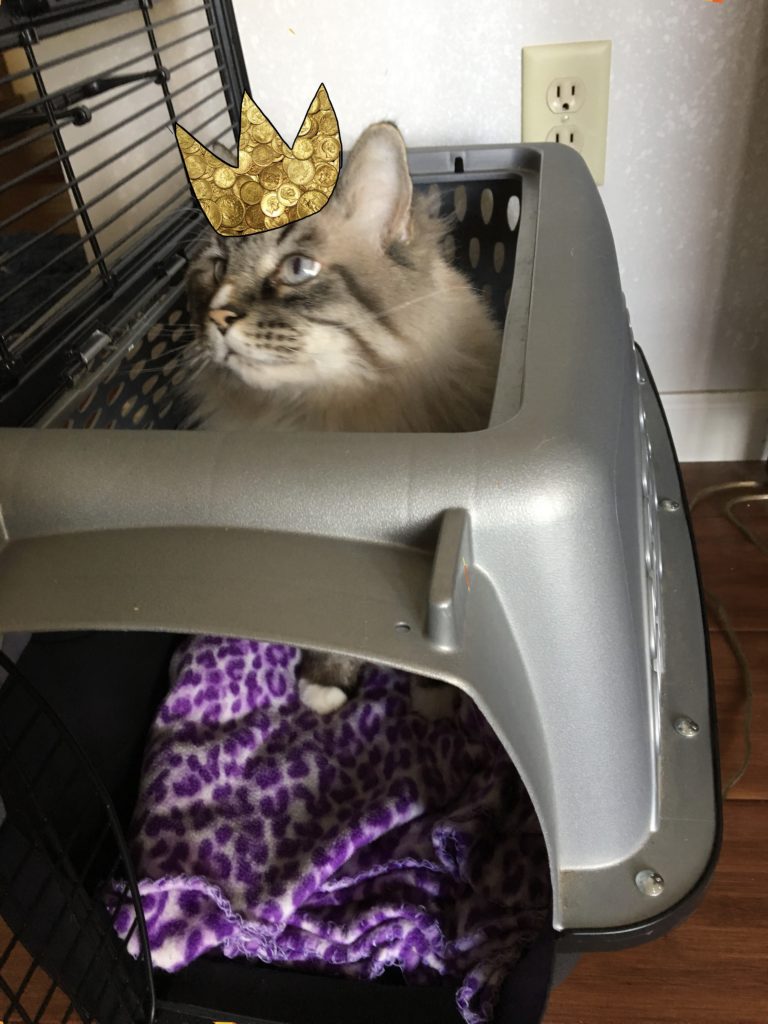
Cats are not only predators, they are also prey for larger carnivores like coyotes. A predator will target a weak or injured prey animal so it is important that prey animals hide their pain, so they don’t become some else’s snack. Cats are no exception and are masters at hiding pain. As a veterinary technician, I have found clients often do not give pain medication that we send home because “he didn’t seem painful”.
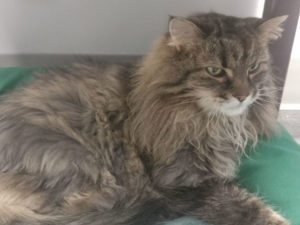
Painful cat?

how do I know if my cat is painful?


It is hard to assess pain in animals and young children.  They can’t tell you how it hurts. There has been interest in  developing methodology for computer assessment of pain in human children using facial expressions. Humans have expressive faces, with 42 facial muscles; there is a universal “pain face”, with lowered eyebrows, eyes squeezed together, nose wrinkled, raised upper lip and open mouth.

Like us, cats also have a “pain face” but it takes some practice to become attuned to it. The Feline Grimace Scale (FGS) was developed to give veterinary professionals an easy-to-use tool to assess whether a cat needs pain medication. With some practice and attention to your cat’s environment, you can tell if your cat is painful.

The FGS focuses on 5 facial features:

  1. position of the ears
  2. shape of the eyes
  3. shape of the muzzle
  4. attitude of the whiskers
  5. position of the head

Each feature is assigned a score of 0, 1 or 2.

“0” = no pain

“1” = moderate appearance of pain

“2” = obvious appearance of pain

The highest pain score with this system is 10; a score of 4/10 indicates the need for pain medication.

The Kitty Pain Face


scoring The Ears

  • Score = 0  Ears are up and facing forward
  • Score = 1   Ears are not facing forward and further apart; they are a little “flat” 
  • Score = 2   Ears are flattened and rotated out, like the wings of an airplane

scoring the eyes

  • Score =0     Eyes are open
  • Score = 1     Eyes partially closed
  • Score =2      Eyes are “squeezed shut”

scoring the muzzle

  • Score = 0    Muzzle is relaxed and round in shape
  • Score = 1     Muzzle is tense and starting to become flatter
  • Score = 2    Muzzle is tense and elliptical in shape

scoring the whiskers

  • score = 0   Whiskers are relaxed and curved downwards
  • Score = 1    Whiskers are beginning to straighten, as the muzzle becomes tense
  • Score = 3    Whiskers are straight or forward

scoring the head

  • Score = 0  The head is up and above the line of the shoulders
  • Score = 1  The head is in line with the shoulders
  • Score = 2   The is below the line of the shoulder

Using the FGS


The FGS was developed for veterinary staff to monitor hospitalized patients.  In the validation studies, cats were observed undisturbed for 30 seconds.  This could be a challenge in the home, where the cat is not in a kennel and can move around.

Pain causes anxiety and stress. The expressions making up the cat’s  “pain face” overlap with the body language of stress. How can you eliminate environmental stress when scoring your cat for pain?

getting a valid score for your cat


Don’t have 30 seconds?

If you’re having trouble watching your cat for 30 seconds, try scoring your cat, then score him again in 15-20 minutes and see if you get the same results as before.

Pain or environmental stress?

Reduce the effect of the environment on your cat. Don’t have someone hold him or rub his head. Try to observe him when there is not a lot of activity in the house – try guiding him to a quiet room and let him settle down before you try to score him.  Don’t interact with him – he may respond by hiding his pain.

If your cat is grooming, eating, or vocalizing, wait until she is finished before assessing her. If sleeping, wait until she is awake. 

practice telling if a cat is painful


Using the FGS can be challenging but it can help you decide sometimes if your cat needs veterinary treatment. Practice observing cats that are painful or not painful to give yourself a mental map of the cat’s face and demeanor.

  1. Go to  felinegrimacescale.com, and download the FGS manual.
  2. Using the FGS manual, practice your skills with the series of 11 cat photos on the website.
  3. Compare your results with those of the researchers.


Other indications that your cat is painful


  • she is hiding or you find her in a place she usually does not frequent
  • she is more subdued than usual
  • there is a decrease in appetite and activity

Want to keep up with the world of cats? Subscribe to The Feline Purrspective!
Subscribe

Cats plays with featther toy1
Zelda plays with a feather toy at the end of a wand.

Providing opportunities for predatory play is one of the components of a cat-friendly home. Like people, cats are individuals, with different tastes and experiences. This certainly is one reason for the large variety of cat toys at the pet store. But what if your cat does not want to play?

Some cats like to play more than others


A group of researchers observed the responses of 31 cats to toy balls, a fishing pole style toy with a soft bird shaped toy at the end, and recorded sounds of a chirping bird, a squeaking mouse, crumpled paper and a rustling plastic bag. Thirteen of these cats were indoor-outdoor cats; the remaining 18 were indoor-only cats.

What did they find out?

  • Indoor-only cats touched or played with balls sooner than indoor-outdoor cats.
  • Indoor-only cats started searching earlier for playback sounds (chirping, squeaking etc) than the indoor-outdoor cats.

Why do indoor-only cats like to play more than outdoor cats?


The two groups of cats had close relationships with their owners: the main difference was that one group had access to the outdoors.

The indoor-outdoor cats most likely had experience with actual prey animals. Live prey can “fight back” and cause injury to the hunter, so a slower, more cautious approach may be smarter.  The indoor-only cats don’t “know any better” and showed a more intense interest in and faster response to “simulated prey”, not having had any negative experience with hunting things.

Should I try to play with my indoor-outdoor cat?


Yes, play with your indoor-outdoor cat. Play is part of the regular, positive interactions we have with our cats. The need to hunt defines who your cat is – this is what he was born to do. Although he gets a lot of stimulation while outdoors, a short, regular play time helps reinforce the cat-owner bond.

It may be a bit more difficult to find that thing he’ll play with, compared to an enthusiastic indoor-only cat. 

Cat using food puzzle

My experience with “Gus, A former street cat”


  • Gus has always enjoyed “treat toss” ( I throw dental treats for the cats to chase and eat).
  • He is not interested in the feather and mice toys at the end of a wand.
  •  He occasionally plays with catnip toys and balls.
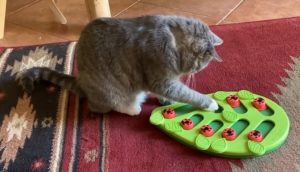
  • After two years, he has agreed to chase a pair of tied-together shoe laces down the hall and has his own preferred food puzzle.

My indoor-only cat just won’t play with anything


Cats are individuals and some cats like to play more than others. Yes, try to entice your cat to play. It can take longer to find out what some cats will play with. It may take a few tries before they become interested enough to chase that shoelace, mouse toy on a wand or the crumpled ball of paper you throw down the hallway.  If the cat walks away, then try again another day.

  • A play session around the same time everyday lets them know what is going to happen.
  • Be alert to possible frustration – your cat needs some reinforcement intermittently to keep her playing the game.
  • Use the laser pointer to point to a treat when ending the laser tag session.
  • Let her catch the toy on the wand and chew on it occasionally during a play session. 
  • End the play session with a game of “treat toss”.

Playing with more than one cat


Even if cats are not part of the same social group , they can still manage a joint play session. Cats are good at “time-sharing” – taking turns while another cat plays. Often they will have different preferences, so they will wait for “their toy”. Cats are often very willing to wait if there is a treat session at the end (after all, hunting requires patience!)

The importance of predatory play…


It is true that some cats like to play with toys or chase treats more than others.  But every cat has a hunting heritage and helping him use it strengthens the bond between you and your cat.

Tips for playing with cats


Play and Treat time is a meal

  • Cats do better physically and emotionally eating multiple small meals daily.
  • Restricting access to food (meal feeding) can make treat time a bit more special.
  • Include the treats in your cat’s daily calorie count.

Play and treat time – a positive, predictable interaction for your cat

  • Cats like to play with a variety of toys – have several boxes of toys that you rotate.
  • Marinate some of the toys in catnip or silvervine.
  • Play sessions do not need to be more than 5 minutes or so per cat.
  • Put all interactive toys away when playtime is over.

Want keep up with the world of cats? Subscribe to The Feline Purrspective.


Subscribe


cat with toy box

How do I know if my cat has a good quality of life? Take a minute and look at your cat’s life to see if the positive experiences outweigh the negative ones.

Quality of Life or QOL is just what it says – what is the quality of health, comfort and happiness experienced by an individual human or animal? Assessing QOL can help you decide which treatment to choose for a sick pet or help you improve your cat’s welfare.

QOL tends to come up when a pet is ill and euthanasia is being considered. Because of this association with end of life, evaluating quality of life is often neglected at other times in life. 

When my older cat was not doing well recently, I was thinking about her QOL.  It occurred to me that QOL is something that we should be aware of and assess regularly. It is a good idea to evaluate this when we feel our cat is healthy and happy so that we have a comparison for when he is sick, in pain, or feeling insecure or threatened.

If a cat has a good quality of life, he will have many positive experiences and have few negative experiences.

Let’s start with a cat’s basic needs…

  • Every cat needs a safe place – somewhere she can go, away from other pets and humans
  • He needs food, water and litter boxes that he can use without  being interfered with by other cats, dogs or humans
  • A stable environment allows a cat to feel confident and secure.  This environment is predictable, without too much physical change, and offers opportunities for positive experiences, say outdoor access to a backyard.
  • Interactions with humans and other pets should be pleasant and not frightening (so tell the kids not to run and shriek at the cat!)
  • Your cat is a born hunter so he needs to have opportunities for predatory activity – either through play or foraging toys.

How do i know if my cat has a good quality of life?


In addition to the basic needs, what about the needs of the individual cat? Pain, emotional state, presence of strange humans and other pets or environmental stress can impact quality of life. Let’s look at the Quality of Life of 16 year old Athena.

positive experiences


Cat with automatic toy

  1. Athena sleeps at the foot of the bed or under the covers when it is cold.
  2. She likes the treats she gets before and after having her twice daily thyroid medication.
  3. She likes to scratch on the scratching posts –  in the bedroom and by the door to the backyard.
  4. She will nap in her heated bed when it is cold or on the bed upstairs when it is warm.
  5. When the weather is nice, she will go out into the backyard.
  6. In the evenings, she enjoys a grooming session followed by some play with  a fishing pole toy or laser pointer.
  7. Her day finishes up with some dental treats.


Negative experiences


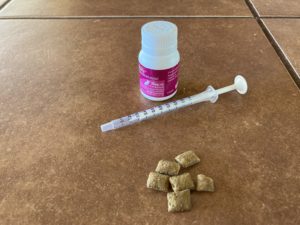
liquid medication for cat

  1. Athena gets another medication in the morning – a bitter liquid which she does not like.
  2. She does not like the other cats and prefers to avoid them
  3. She has arthritis and her joints hurt.
  4. Sometimes she is nauseated – she will approach her food, sniff it, but not eat.

Athena enjoys about 2 x as many positive experiences as negative experiences in her day. Although she suffers from arthritis pain and is not fond of other cats, she is still able to enjoy the positive things her environment offers her, such as going outdoors and engaging in predatory play. Overall, her QOL is good but here are some improvements.

  1. Giving food paste (for example, chicken baby food) before and after her bitter medication helps “get the bad taste out  of her mouth”. We end the medicating process on a positive note with her favorite dry treats.
  2. So that Athena can avoid the other cats, she eats from her own microchip-controlled feeder.  The other cats have learned that the feeder does not open for them.
  3. Athena receives an injection of joint protecting supplement to help alleviate her joint pain. She also has steps up to the bed and a heated bed to nap in.
  4. If she seems nauseated, she receives medication.

HOW DO I KNOW IF MY CAT HAS A GOOD QUALITY OF LIFE?


THE TAKEAWAY:


  • You want your cat’s life to have more positive experiences than negative experiences.
  • Make a list and see what the positive/negative balance is. Are there more positives than negatives? How can you improve things?
  • Compare and update lists before you take your cat in for his annual or bi-annual vet exam.
  • By being aware of your cat’s daily behaviors, you will be able to provide medical care and supportive care when needed, and preempt behavior issues.

Want to keep up with the world of cats? Click the button below and subscribe to The Feline Purrspective!
Subscribe

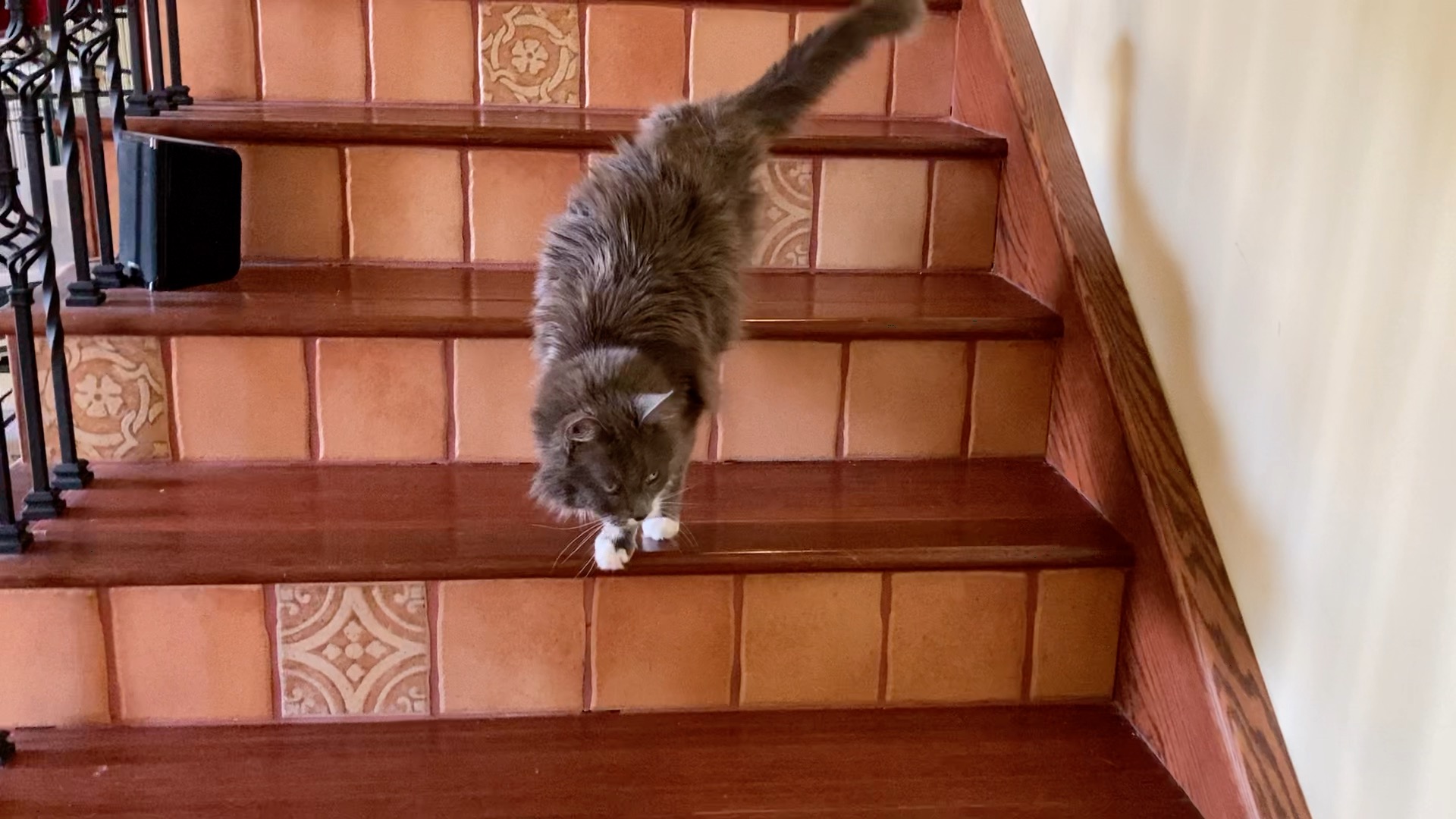
OLder cat coming dowm stairs

Arthritis refers to inflammation and stiffness in the joints. As humans and cats age, the protective cartilage that cushions the ends of the bones wears down. Osteoarthritis in humans most often affects our hands, knees, hips and spine; in cats, it is most prevalent in the hip, hock and elbow joint.

HOW DO I KNOW IF MY CAT HAS ARTHRITIS?


Your cat can’t tell you verbally that he is painful. You must watch his body language and behavior.Cat at top of stairs

BODY LANGUAGE:

  • Do you detect a limp or stiffness as he moves?
  • Is your cat more grumbly, maybe even aggressive when you groom or pet him?
  • Is she hunched-up instead of curled-up when sleeping?

BEHAVIOR:

  • Is she just not as active?
  • Does he still jump up on the bed, chairs, or counters?
  • Does he still use his scratching posts?
  • Does she still climb up the cat tower?
  • Does she still play with toys?

If your cat is still doing his regular cat things, we now need to consider HOW he is doing those things.

JUMPING UP AND DOWN

  • Does she still spring up on tables, counters, landing gracefully on all four feet? Or, does he pull himself up with his front claws to get on the bed?
  • Does she jump on a chair first and then go to the table instead making one jump from the floor?
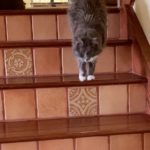
  • Does he go down in one jump or in stages?

UP AND DOWN STAIRS

  • Does he run smoothly up and down the stairs or does he go up and down the stairs a step at a time? Does he “bunny-hop” up with his back legs?
  • Does she stop for a break halfway?

PLAYING WITH TOYS

  • When he swats his catnip mouse about, is he still able to pass it smoothly from paw to paw or does he seem slow and stiff?
  • Can she still snatch the toy in mid-air?

OTHER THINGS TO WATCH FOR:

  • Is she not grooming as much as before? Are you noticing some mats forming in her coat?
  • Any litter box accidents?
  • Is his appetite still good?

If you answer “yes” to some of these questions, it is possible that your cat has arthritis and may be having some pain and stiffness in her joints.

Pain and discomfort that happens while you are doing something usually results in your avoiding that activity. Chronic pain can affect all the systems in the body, affecting appetite, sleep, and how well your bowels work. Treating your cat’s arthritis will improve his quality of life.

My cat has arthritis – WHAT CAN I DO ABOUT it?


A veterinary exam is needed to diagnose arthritis and to come up with a treatment plan.

Cats can be difficult to assess in the veterinary hospital. They are out of their environment at the hospital and are reluctant to play with toys or even just to move around. This is where, you, the cat guardian, can help your vet help your feline friend.

Smartphones nowadays can take high resolution video. We often have our phones with us, so take some video of your kitty going up the stairs, jumping up on the bed, or jumping down from her favorite spot. You can send the video to your vet to help with the diagnosis and treatment plan for your cat.

TIPS FOR TAKING VIDEOS

  • Take the video with your phone in the “landscape” orientation. If you video with the phone vertical, the video frame will have black borders on either side.
  • Have “LOTS” of light. The more light the better particularly in stairwells. Bring some of those floor lamps in there.
  • Most phone camera default to “autofocus”. You may need to FOCUS your phone. Tap on the screen where your “subject” (your cat ) is or will be – your camera will focus on that area; some exposure controls may also show up; adjust as needed.


MY CAT HAS ARTHRITIS – WHAT IS THE TREATMENT?


If your cat is diagnosed with arthritis, your vet can recommend a treatment plan. It may include:

Cat going down stairsIt is great that you are being proactive with your cat’s health! Arthritis is part of getting old but let’s try to make your cat’s senior years as “golden” as possible. You can find out more about your cat and arthritis at the Osteroarthritis Checklist for Cats.

Want to keep up with the world of cats? Click the button below and subscribe to The Feline Purrspective!
Subscribe

Cats plays with featther toy1

Keeping active physically has a lot of benefits for people. It helps your mind work better – you learn things more easily. Physical exercise helps increase your muscle mass and strength. It also tends to induce a positive mood or emotional state.

Exercising your cat can give your cat the same boost we get from physical activity. Unfortunately, just like us, it is easy for them to become couch potatoes.

My 16 year old, Athena, is the equivalent of an 80 year old person. She has developed osteoarthritis and chronic kidney disease. To help with the arthritis, I have provided her with steps to get places and litter boxes with lower entrances. This winter I bought her a heated bed which she really likes. I noticed, however, that she was spending an awful lot of time in this bed and not moving around as much.

Although heat increases blood flow and makes connective tissue temporarily more flexible, it also stimulates inflammation and swelling. So some heat is good for comfort but I wanted to reduce the inflammation associated with Athena’s arthritis and cheer her up a bit!

Exercising your Cat – A good Rx

  • Exercise reduces inflammation: Your body’s cells produce proteins called cytokines that regulate immunity and inflammation. Humans with arthritis who exercise produce more cytokines that reduce inflammation. Cells in cat’s bodies produce similar cytokines so exercise can also reduce inflammation in cats.
  • Exercise strengthens the muscles that surround joints making movement easier and less painful.
  • Exercise improves mood, memory, reduces anxiety and helps the GI tract to function better.

The TAKEAWAY: Daily play (exercise) is good for cats of all ages!

Here are some exercises to work into your cat’s daily play time.  Make sessions short and positive and work at your cat’s own pace.

Cat sitting up
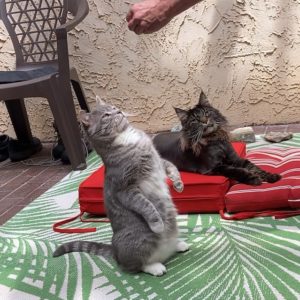
Gus sits up on his hind legs.

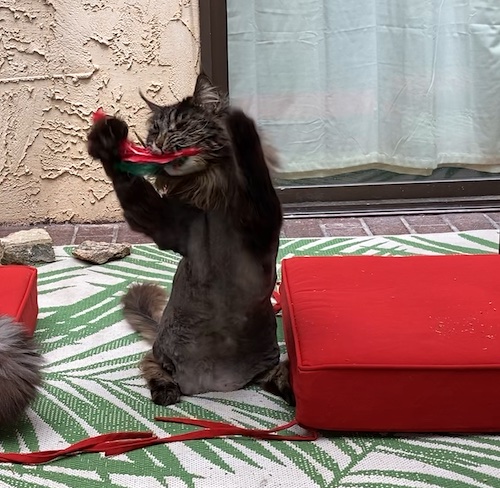
More Please!:  Holding a treat or toy above your cat’s head, encourage him to sit up with his front feet off the ground for a few seconds. This is good for kitty’s core muscles.

Catch the bird:  A feather toy on a wand can encourage your cat to “stand up”, engaging his core muscles.


Catnip/silvervine Roll: If your cat enjoys catnip or silver vine, by all means indulge her. The catnip response lasts less then 10 min and often involves rolling around, which is good for kitty’s core muscles.

Cat walking on cushions
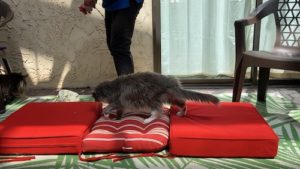
Athena has to shift her weight and balance to walk across the cushions.

Balancing: Have your cat walk over an uneven surface such as a bed or several pillows. She will need to shift her weight to keep her balance, exercising her legs, core, back muscles and more. She can follow a feather toy, target stick with food on the end or a trail of treats!

Strengthen back legs:  Following a string up the stairs or cat tree will put more weight on the rear legs. Alternate exercise: have kitty stand with his front legs up on some cushions or books so more of his weight is on his rear legs for a few seconds. Start low at first. Pet his head and reward him.

Strengthen front legs: Following a toy or string (slowly) down the stairs or cat tree will put more weight on your cat’s front legs.  Alternate exercise: you can use a soft towel or blanket around her lower belly to lift her hind legs, putting more weight on the front legs for a few seconds.  Start in a stationary position. Work up to going forward. Head rubs and treats will make this fun for your cat!

Cardio! Do a little play with the laser pointer, wand toys or shoelaces. Make sure to put these toys away when the play session is done.

Exercising your cat will help her to be happier and feel better. Less pain and better mood translates to better relationships for your cat with people and other pets! Remember, this does not have to take a lot of time: 10-15 minutes should do the trick!


Want to keep up with the world of cats? Click the button below and subscribe to The Feline Purrspective!
Subscribe!

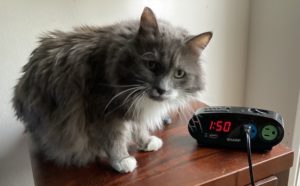
It’s 1:50 am – you know by the red numbers on your alarm clock. That darn cat meows at night and has woken you up once again.Cat and alarm clock

What is happening?
If this is a new pattern, it is time for a vet visit to make sure that there is not a medical cause underlying the nocturnal activity. High blood pressure and hyperthyroidism are two conditions that can contribute to meowing at night. Treating these conditions may solve the tendency toward night-time activity and meowing.

If your cat has had a physical exam recently and has no untreated health issues, there may different things underlying the “feline nocturnes”. In the wild, cats hunt at dusk, nighttime and dawn when their prey, small rodents, are foraging.

Our indoor cats usually adapt well to being active during daylight hours and snoozing at night.
If this is not the case, what can you do to reset your cat’s internal clock?

Perhaps your cat meows at night because he is bored and awake. He may be seeking your attention.

  • Make sure your cat is active during the day. Give him some play sessions during the day;  engage him in foraging behavior with food puzzles.
  • Establish a night time routine. Cats thrive on routine – it lets them know what is going to happen. Pets can be as good as a clock when reminding you for dinner. Let’s come up with a sequence of activities that signal that the household is slowing down and ready for sleep.

Bedtime Routines when your cat meows at night


Play/Treat time: My cats look forward to treats before bed every evening. After dinner and TV, the litter boxes are scooped and then – IT’S TIME.
All 4 cats proceed to the hallway where they take up their stations and wait to have treats tossed to them. After that, it is time to settle down and they each go to their sleeping place and tuck in.

Your cat might enjoy a play session before treats. This session does not have to be long – 10-15 minutes should do the trick. After that – IT’S TIME FOR BED!

Foraging toys: Try leaving some foraging toys (food puzzles) out and turn in. Again, this is a bedtime routine – you put the toys out and you turn in.

You can try closing the bedroom door. Of course, for many cats, if you close a door, this is the place they have to get into and will shake and rattle the door for access.

My Cat meows at night – Does he need a room of his own?


You have tried more play during the day and you are putting out food toys at night – still your cat meows at night.

This may be time for some “tough love” – after all, you need your sleep. If you have the space, give your cat a “bedroom” at night. This could be a spare bedroom or walk-in closet, someplace where you can close the door. Put all his resources (litter box, toys, water) in this room. Put a “calming” pheromone diffuser in this room.

When you are ready for bed…

  • Take kitty to his bedroom
  • Give him a snack.
  • Close the door – do not respond to crying at night once the cat is in the room.
  • He will be safe in there until you get him out in the morning.

While this may seem “cruel”, remember that cats are “socially flexible”. They are able to live socially with humans and other animals but do very well on their own. They don’t get “lonely” the same way we do.

to have a quiet night…


 Be sure to give your cat regular, daily playtime and activities. This may be a good time to review how you are feeding your cat – leaving out a food bowl filled all the time is like having a bowl of potato chips out all the time. Feeding can be self-soothing behavior for a bored cat.

3-4 smaller meals gives kitty something to look forward to – you can put one of these meals in his room for the night.

The Takeaway: if your cat meows at night, try giving him something to keep him busy – some extra play during the day and a bedtime routine just might silence the “kitty nocturnes”.

Want to keep up with the world of cats? Click the button below and subscribe to The Feline Purrspective.


Subscribe


Sometimes there is trouble when we house a group of cats together in our home. How do we reduce the number of inter-cat squabbles?

Cats are socially flexible

  • they do fine on their own
  • they can live with other cats IF there are enough resources.

This is the sticking point – cats are territorial. Territory is all about resources – food, water, litter boxes, resting places.  Cat fights are frequently about territory and resources!

Cats of the same social group can often (but not always!) use the same resources at the same time. If cats do not belong to the same group, then they will often time-share, taking turns to use that heated bed every cat likes.

But sometimes even cats that are “BFF”’s have a spat. One answer is to “space” them – make sure there are enough resources spread throughout the house or apartment.

Space Cats Vertically > more space for everyone > Less fighting>less stress


Many cats like to perch up high. They have a great vantage point and can see who’s coming. Your apartment or house may have a small footprint but have you thought about the unused “cat space” up toward the ceiling?

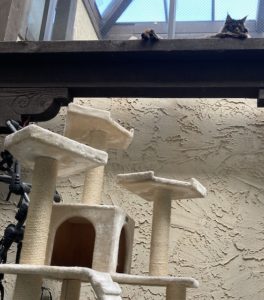
cat tree access to high beam
A tall cat tree gives this cat access to a high resting place.

Vertical places can be valued resting places or alternate feeding stations.


We’ve all seen the videos and posts of those amazing cat houses but your vertical cat world does not need to be so elaborate or require as much work. It can fit in seamlessly to your decor.

cat trees


Cat trees, true to their name, have  small footprints and utilize vertical space. Some  have “hide boxes” for an undisturbed nap. A cat tree also can give a cat access to a high place or offer an alternate path to another part of the home.  Placing a tall cat tree next to a stair case might allow a cat to climb up and through the railing,  avoiding another cat on the stairs.

book shelves


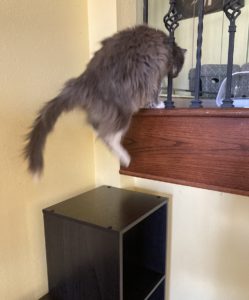
Whether actually used for books or storage, the tops of book shelves can be a cat highway. “Step” bookcases can provide tasteful storage for you but give your cats a ladder to a valued resting place – perhaps the top bunk of a bunkbed.

access to stair landing
A “step ” bookcase gives a cat a different route to access  a stairway landing.

the top shelves of closets


  • Often unused space – after all the shelves are hard to get to. 
  • Good place for a secluded nap.
  •  A step ladder may get kitty up there. Baskets that  hang on the underside of the steps can give you storage.
  • Stack storage bins in a step configuration so your cat can climb to that top shelf 
  • An inexpensive single pole cat tree may provide access.

“Thinking  vertically” allows you to provide your cats with additional resting places and feeding stations. There will be less conflict if each cat can find his own space.

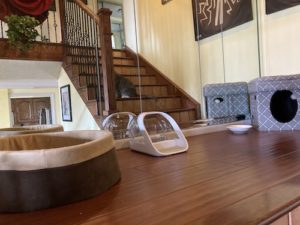
A stairway landing provides a feeding station, heated bed, and cat cube.

Release your inner cat and space cats vertically – spread out resting places and feeding stations!


Want to keep up with the world of cats?


Subscribe to The Feline Purrspective “

cat found in swamp

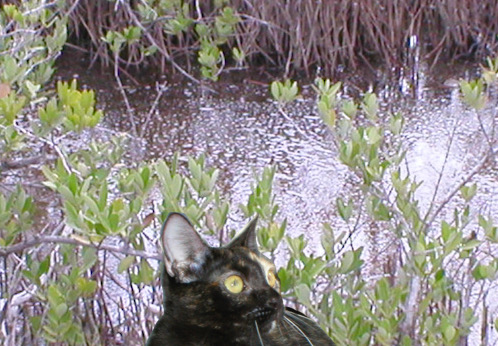
For a time, I lived in the Florida Keys, about 50 miles north of Key West. Half of the island where we lived was owned by the Nature Conservancy and was a natural habitat of mangrove swamps, alligators, snakes and raccoons. There were some feral cats in the Conservancy reserve.

One summer, there was a litter of 4-5 kittens that we saw playing with their mother near the side of the road. In a few weeks, these cats had disappeared with the exception of one little female kitten, who continued to return to the side of the road. We used a Havaheart trap to bring the small kitten home. It was October so we named the orange and black kitten Pumpkin.

Throughout her life, Pumpkin was prone to bouts of bloody urine and not using the litter box. Antibiotic treatment was palliative at best; x-rays and ultrasounds did not reveal any medical causes. She was affectionate but she did not like the other cats. She seemed happiest when my son took her with him when he moved.

Cats’ health and stress…


Veterinary medicine for cats has advanced in the past few decades. If Pumpkin were alive today, she might be diagnosed with FIC, or Feline Idiopathic Cystitis. Idiopathic means that although we recognize the condition we don’t know the cause of it; cystitis refers to inflammation of the bladder.

Cats that suffer from frequent FIC episodes handle stress differently than other cats – they do not release stress hormones such as cortisol in the same way “normal” cats do.

Cats prone to FIC


  • have lower levels of cortisol in their bloodstreams compared to “normal” cats.
  • have higher levels of the “fight-or-flight” hormones.

Like interstitial cystitis in humans, stress contributes to flare-ups of FIC, making a cat sick from stress.

 Cortisol is a potent anti-inflammatory hormone – the lack of cortisol can result in increased inflammation in the body, in this case, the bladder.

Ways to Reduce your cat’s stress at home…


Cat napping on dresser
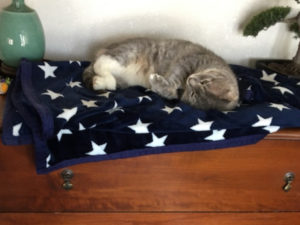
Gus takes a break on a blanket on a dresser.

Make sure each cat has a safe place – a place that is secure and secluded, a hiding place to retreat to.

Safe Place

Feeding stations for cats
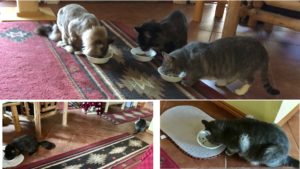
Gus is much more relaxed when eating away from the other cats.

Have several feeding stations, water stations, and litter boxes spread through out the house or apartment.

House map cat resources
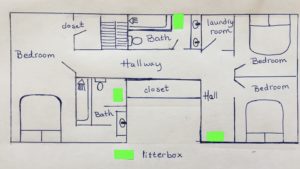
A simple sketch of your house can help with locating litter boxes.

Draw the paths a cat must take to get to her food, water and litter boxes in your house. Is there plenty of room for cats to pass other pets and humans?

cat with wand toy
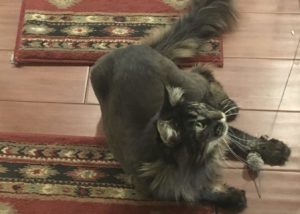
Zelda plays with a toy mouse on a wand toy.

Good kharma with humans.

  • Greet your cat before handling him or her.
  • Have a daily routine for grooming and play.

Positive cat-human interactions

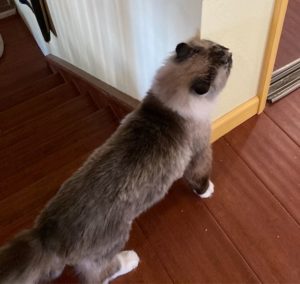
Marley marks the corner wall at the top of the stairs.

Cats communicate  by smell.

  • Use pheromone diffusers in the safe places.
  • Don’t use of strong smelling cleaners.
  • Scoop litter boxes daily.

The Colony Scent

Outside the home – what can make a cat sick from stress


Your cat may view neighborhood cats or other animals coming to the windows and into the yard as threats to his territory. Territorial threats can make your cat sick from stress. Consider…
  • A cat fence can keep other cats from entering the yard
  • Have scratching posts at doors and windows so that the resident cats can mark their territory.
  • A motion-activated sprinkler can help deter animals from coming into your yard.
There is no substitute for appropriate and timely medical care. However,  increased stress contributes to flare-ups of not only FIC,  but other conditions such as chronic diarrhea and overgrooming.

Pumpkin lived to be 17 years old. She was euthanized due to complications of chronic kidney disease. I wish I knew then what I know now – her life may have been less stressful and more comfortable.

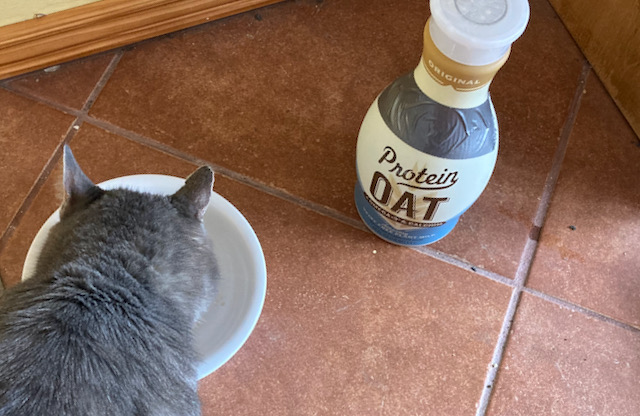
Cat with Oat Milk

I have been trying some plant-based milks. My most recent purchase was oat milk, fortified with other plant proteins, so that the protein content is similar to that of cow’s milk. While I was having cereal, I was mobbed by three of my cats who demanded a taste. All three liked the oat milk, and now recognize the jug, asking for more.

I am aware that oats can be in pet foods, so a taste of oat milk occasionally should not be a problem. Cats often like cow’s  milk but are lactose intolerant. Oat milk does not have lactose.

Was the plant milk appealing because of the added protein? This brand claimed to have the 9 essential amino acids that human adults need and as much protein as cow’s milk.

What amino acids do cats need? Could  plant based cat food be healthy with the right supplements?


Cats are what we call “obligate carnivores” -they evolved to eat meat, unlike dogs and humans who are omnivores (eat a combination of plant and animal foods).  Cats not only need protein from meat for repairing and building tissue and regulating their metabolism – they need protein to provide energy.

There are 20 amino acids that make up proteins. Human bodies  can make 11 of these 20 amino acids – the rest we have to get in food.

Amino acids that we must get from food are called essential amino acids.

Cats can synthesize 9 of the 20 amino acids. Their diet must provide the remaining 11: 9 essential amino acids that we humans require plus 2 additional ones: taurine, arginine.

What happens if a cat does not get Taurine and Arginine?


Not Enough Taurine…


  • blindness due to retinal degeneration
  • heart failure
  • reproductive issues
  • abnormalities in the central nervous system

Not enough Arginine…


  • high amounts of ammonia in the bloodstream
  • seizures and death
Cats need Taurine!
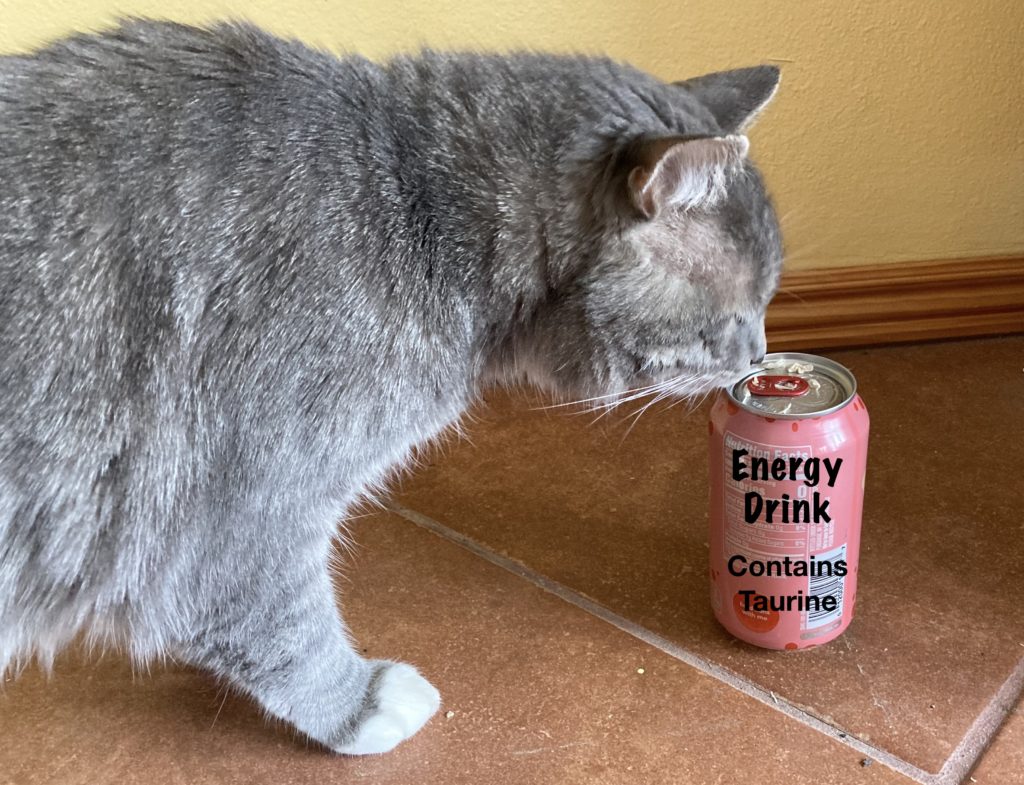
Taurine is a popular supplement in human energy drinks.

Sources of taurine and arginine in nature: animal tissues such as meat, fish and eggs!

What else do cats need to get in their food?  Niacin, vitamin A, and vitamin D – their bodies do not make these vitamins.

What if we supplement plant based cat food with taurine, arginine, vitamins…


Proteins can be found in plants as well as animal tissues (meat).  However, whereas animal tissues are “complete” and provide all the essential amino acids, plant sources are  not “complete”.  Taurine is not found in plants.

Now we arrive at the question of digestibility – sufficient amounts of the amino acids and vitamins must be digested from your cat’s food to be available to her body.

Plant based proteins are not as digestible as animal proteins. Plant protein has a different structure than animal protein and there are chemical compounds in plants that affect how well your cat’s digestive enzymes break down her food.

Recent research indicates that it is the “non-protein” part of whole grains that affects the digestibility of plant proteins. One finding in this 9 year study was that cats were able to digest appropriately processed plant proteins such as corn gluten as well as they digest chicken and fish proteins.

The Future of Cat Food


There is an ethical and economical drive to reduce the carbon footprint of companion animals and one way is to reduce their consumption of meats sourced from livestock bred for this purpose. Increasing the amount of plant protein in commercial cat food is the subject of current research.

There are some plant based cat foods already on the market.  However, I was not able to find ones that advertised having done AAFCO feeding trials. There are concerns about nutritional adequacy with these foods.  Personally, I am not ready to risk my “fur babies” on these foods yet.

I feel we will see more plant-based foods for our cats in the future. In the meantime, make sure your cat’s food has taurine, arginine, niacin, Vitamin A and Vitamin D in addition to plenty of “complete” protein.

Make sure to feed your cat a diet formulated for cats.  Dog food typically does not contain the taurine, arginine, niacin, and vitamin A required by cats.

Your cat’s carrier should be his castle. His carrier should be a place of safety and comfort, a little piece of home away from home. Cats are territorial and are attached to their territory.  When your cat travels, the stroller, backpack or carrier is part of his territory – it has his scent and is a “safe place” for him.

You may need different carriers depending on what you are doing.  Strollers and backpacks are more suited to walking or hiking with your cat. A kennel-style cat carrier is better for extended car travel and veterinary visits.

Cat in hard kennek
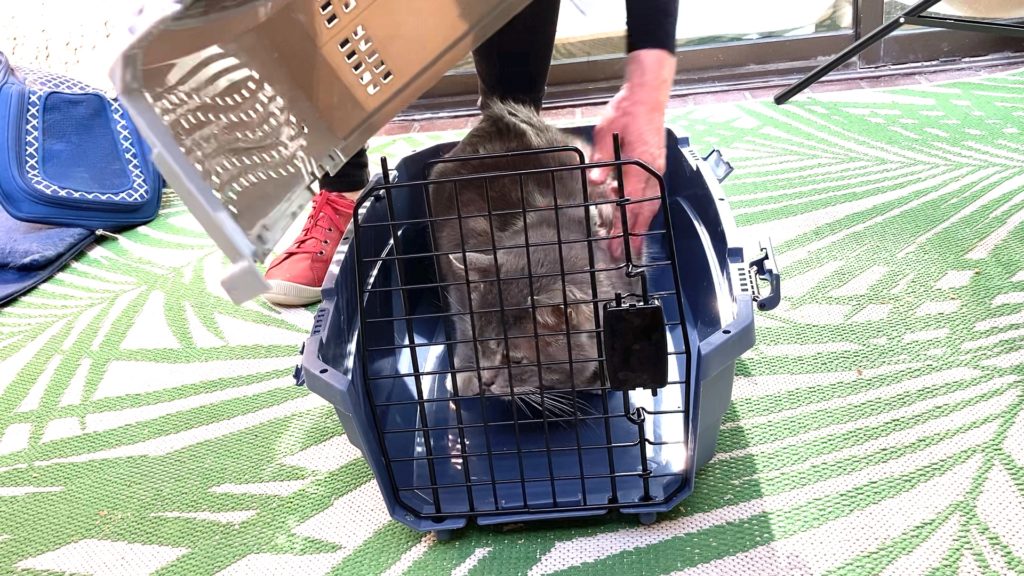
The top comes off this hard kennel, making it easy to load Gus in the carrier.

There are many kennel-style cat carriers that you can buy. Here are some tips when choosing a cat carrier that you plan to use for extended car travel or vet visits.

  • the carrier should be large enough for your cat to stand up and turn around.
  • it should have a rigid frame so that it does not collapse on your cat.
  • it should be easy to take apart or have more than one opening where you can easily remove your cat from the carrier
  • easy to clean
  • make your cat feel safe and secure – like a wildcat’s den

Tips for Choosing a Cat Carrier for Car Travel and Vet Visits…


Hard, plastic carriers


  • come in lots of sizes.
  • many have detachable tops which makes getting your cat in and out easy
  • they are easy to clean
  • can be covered with a blanket or towel to make your cat feel secure

Flexible, fabric carriers


  • attractive and are not as bulky as the hard plastic ones
  • some of these carriers tend to collapse in on your cat and are not as comfortable for him to stay in for longer periods of time
  • more difficult to clean than the hard, plastic kennels

Even if the carrier is rigid and has a top panel that zips open or unlatches, it can be difficult to put the cat in when he doesn’t volunteer to go in on his own. It can be hard to fit your cat and your hands through the top panels. Some fabric carriers have a zippered front and side mesh panels, making loading and unloading a bit easier.

Choosing a cat carrier that comes apart into two sections – a top and a bottom – can be really handy. If you need to get the cat out of the carrier, you can remove the top half and gently pick him up out of the bottom. You can put him back in the carrier in the same way. Your veterinarian can examine your cat in the bottom half of the carrier, where he feels safe. The bottom half can double as a basket to sleep in.

Fom the feline purrspective… being dragged bodily out of a place you are sheltering in is confusing and frightening. Be aware that a cat may feel threatened if you have to drag him out and may strike or even bite.

Choosing a Cat Carrier…Make your Cat’s Carrier His Castle


THERE’S NO PLACE LIKE HOME


Leave the carrier out at home and let your cat nap and play in it. Place it in a “neutral” area – away from food and litter boxes.


PURRSONALIZE THE CARRIER


Place a towel or blanket that has your cat’s smell in the carrier. Put some of his favorite toys and treats in the carrier.


FUN AND GAMES


You can also play games with your cat in and around the carrier. If your cat is fond of “treat toss” (tossing treats that kitty “hunts” down), make sure some treats go into the carrier during the game.


TAKE KITTY FOR CAR RIDES THAT DON’T END UP AT THE VET.


Start with short rides, maybe just around the block. Work up to longer rides to pleasant places – if you have a cat stroller you could work up to going for walks in the park. Remember, always move at your cat’s pace – if he is hunched and hiding, slow down and shorten the length of the ride until kitty is comfortable. Ask your vet about treating carsickness if your cat is prone to it.


CLEAN AS A WHISTLE


Clean your cat’s carrier regularly. When you are finished, spray the carrier and the bedding inside with Feliway, a synthetic feline pheromone that tells your cat that this a safe place. Make sure to give enough time for the alcohol in the spray to dissipate before using the carrier – 20 minutes should do the trick!

A Cat in his carrier
Marley is “king of his castle”!

Car travel – where to put your cat’s carrier in the car

The Center for Pet Safety recommends placing your cat’s carrier behind the front passenger seat or driver seat.
Crash tests have shown that the seatbelt used to secure a carrier can actually crush it in an accident.
Unless the manufacturer can show you that the carrier survives a crash test buckled up, don’t use the seat belts with your cat’s carrier.